

Growing spinach in Argentina
Spinach production evidence in Argentina comes from distinct systems: the Rosario horticultural belt supplies fresh and industrial markets, Córdoba has a recent producer-linked field trial, and northern Patagonia has protected-crop guidance. Their dates and methods are local examples, not a national calendar.
Scope: Commercial leaf spinach in Argentina, with Rosario processing trials and other regional systems identified separately. Seed production is not treated as leaf production. Updated 2026-10-07.
At a glance
- Main documented production area
- Rosario horticultural belt; spinach serves fresh and industrial markets1,3
- Rosario processing-trial layout
- 17.5 cm seed rows and 2.2 million seeds/ha in the reported trials3
- Córdoba fresh/industrial trial
- Elli F1; 23 March 2024 sowing and a reported 45-day crop cycle4
- Protected Patagonia reference
- INTA Alto Valle manual covers spinach under protected horticulture5
- Market data context
- Buenos Aires wholesale arrivals averaged 6,276.7 tonnes/year in the source period; this is not national production2
Planting and harvest calendar for Argentina
Use the source-backed production windows to coordinate establishment, crop care and harvest. Production districts and cultivars can have different cycles; the historical climate adds context for the field plan.
Planting: Rosario processing-trial sowing dates3
Three industrial-destination trials were sown in May: 12 May 2015, 2 May 2016 and 5 May 2017. These are trial records for the Rosario belt, not a current national planting recommendation or a planting-feasibility classification.
Harvest: Rosario processing-trial harvest dates3
The same trials were harvested on 3 August 2015, 2 June 2016 and 12 July 2017. Different years produced different harvest dates; use crop maturity and buyer specifications, not the month band alone.
Historical monthly climate
Reference period: 1996-01-01 to 2025-12-31. ERA5-Land monthly mean soil temperature at 0–7 cm, air temperature and frost days at the regional reference point (-34, -62). Select a month to inspect its historical conditions.
Month tiles show mean topsoil temperature.
May historical conditions
- Mean topsoil temperature
- 14.8°C
- Mean air temperature
- 14.3°C
- Mean frost days per month
- 0.1 days
These are monthly means at one reference location. They describe seasonal field conditions, not crop maturity, actual seed-zone conditions, frost forecasts or a planting recommendation. Harvest bands follow the crop-specific production sources above.
Climate source: Open-Meteo Historical Weather APIChoose the fresh or processing market first
- 1
Fresh market
Plan for leaf appearance, tenderness, bunching or baby-leaf packout and rapid delivery.
- 2
Processing
Agree on machine-harvest traits, leaf quality, cleanliness, volume and delivery timing with the processor.
- 3
Confirm the sales route
The Rosario belt uses wholesale and direct channels; processing crops depend on a defined buyer.
- 4
Keep seed production separate
A Santa Cruz seed-filling trial is not a leaf-spinach planting calendar.
- Use belt-wide market evidence at the right scale
- The 2021 Rosario horticultural census covered 205 producers and 2,929 horticultural hectares across four departments. Spinach is among the leading crops by area, but the cited wholesale and irrigation percentages describe the belt’s crop mix rather than spinach alone.1
- Wholesale arrivals are not total national production
- Mercado Central de Buenos Aires reports an average 6,276.7 tonnes of spinach arrivals per year and an 11.5% decline from 2020 to 2024. This is supply entering that market, not a national production or consumption total.2
Match planting to the local production system
- Do not blend regional dates into a national window
- The Rosario May sowings and June–August harvests belong to three processing trials. Córdoba’s 23 March 2024 sowing was a separate producer-linked trial; the Patagonia Norte manual addresses protected production. None alone supports an Argentina-wide planting calendar.3,4,5
- Use the protected-crop manual within its scope
- INTA Alto Valle describes protected spinach production in northern Patagonia, including low-temperature growth and bolting risk under long days combined with warmer conditions. These observations apply to that protected system; confirm structure, cultivar and local advice before applying them elsewhere.5
- The calendar records trial history, not monthly feasibility
- The climate panel below shows historical conditions at a regional reference point. It does not classify a month as suitable for sowing because the sources do not establish an Argentina-wide temperature threshold and field window for commercial leaf spinach.3,4,5
Use trial layouts as trial references
- 1
Confirm end use
The cited field work evaluated cultivars for industrial supply.
- 2
Read the stand specification
The trials used 17.5 cm seed rows and 2.2 million seeds/ha.
- 3
Check machinery and bed geometry
Adapt the local layout to the seeder, irrigation system and harvest equipment.
- 4
Agree processor tolerances
The study emphasizes usable leaf, machine cutting height and low foreign material.
- Do not publish the trial seeding rate as a universal prescription
- The Rosario processing study reports 17.5 cm rows and 2.2 million seeds/ha in its own commercial-field trials. Seed lot, equipment, cultivar, target product and buyer specifications all affect a farm’s stand plan.3
- Fresh and processing cultivars solve different problems
- The industrial trial compares named entries on several traits and does not identify one cultivar as best for every field. For fresh use, align leaf type and packout; for processing, confirm leaf-to-petiole ratio, color, machine harvest and cleanliness with the buyer.3,4
Protect leaf quality from field to buyer
- 1
Set harvest maturity by destination
Fresh, baby-leaf and processing products have different harvest targets.
- 2
Keep soil out of product
Processing and fresh buyers require clean leaves and limited foreign material.
- 3
Protect perishability
The Patagonia manual notes rapid water loss and short market life in its protected system.
- 4
Review each crop record
Compare the field’s actual date, cultivar and yield with the cited local example.
- Use the Córdoba trial duration as a single-field observation
- The producer-linked 2024 Córdoba trial reports a 45-day cycle for Elli F1, sown on 23 March. It is not a maturity promise for other cultivars, dates or production zones.4
- Seed production is a different crop objective
- The Santa Cruz experiment evaluated seed filling after staggered sowing dates and concluded that September–October performed better in that experiment. Those dates refer to seed production, not harvesting spinach leaves.6
Frequently asked questions
- Where is spinach grown commercially in Argentina?
- The Rosario horticultural belt is a documented fresh and industrial production area. Other sources describe a Córdoba field trial and protected spinach in northern Patagonia; these are separate regional systems.
- When is spinach planted in Argentina?
- Three Rosario industrial trials were sown in May from 2015 to 2017, while a Córdoba trial was sown in March 2024. These records do not establish one current national window.
- What spacing was used in Rosario processing trials?
- The reported field trials used 17.5 cm seed rows and 2.2 million seeds/ha. Treat these as study settings, not a universal planting prescription.
- How long does spinach take to grow in Argentina?
- One producer-linked Córdoba trial reported a 45-day crop cycle for Elli F1 in 2024. Different varieties, destinations and environments can change the cycle.
- Are Argentina spinach seed dates the same as leaf harvest dates?
- No. A Santa Cruz experiment studied spinach grown for seed; its September–October results do not describe a commercial leaf-spinach calendar.
Regional spinach guides
Local dates, soil-temperature history and sources for specific regions:
Sources and image credits
- 1. UNR Agrarias — Rosario horticultural belt census summary — 2021 census summary. Belt-wide producers, horticultural area, crop mix, irrigation and marketing context; not all percentages are spinach-specific.
- 2. Mercado Central de Buenos Aires — Invierno de espinaca — 24 June 2026. Spinach arrivals to that wholesale market and supply origins; not national production.
- 3. UNR Agromensajes — Rosario industrial spinach cultivar trials — 2017 article; field seasons 2015–2017. Three local industrial-destination field trials, sowing and harvest dates, row layout and cultivar comparisons.
- 4. INTA / CONICET / Córdoba producer — spinach fertilizer trial — 2024. One Córdoba producer-linked trial of Elli F1; date and crop-duration observations are not regional recommendations.
- 5. INTA EEA Alto Valle — protected vegetable production in northern Patagonia — INTA manual. Protected-horticulture spinach production for northern Patagonia, including crop response, irrigation, harvest and handling.
- 6. Horticultura Argentina — Santa Cruz spinach seed-production experiment — 2012. Small seed-production phenology experiment; not leaf-harvest advice.
- 7. Spinach photograph — Sayeed Chowdhury — Pexels license. Spinach leaves in cultivation. Photo: Sayeed Chowdhury via Pexels; resized. Crop reference, not a Texas or Argentine field.
- 8. Spinach photograph license — Pexels license. Reuse terms for the credited photograph; resizing is noted in its caption.
Image credits
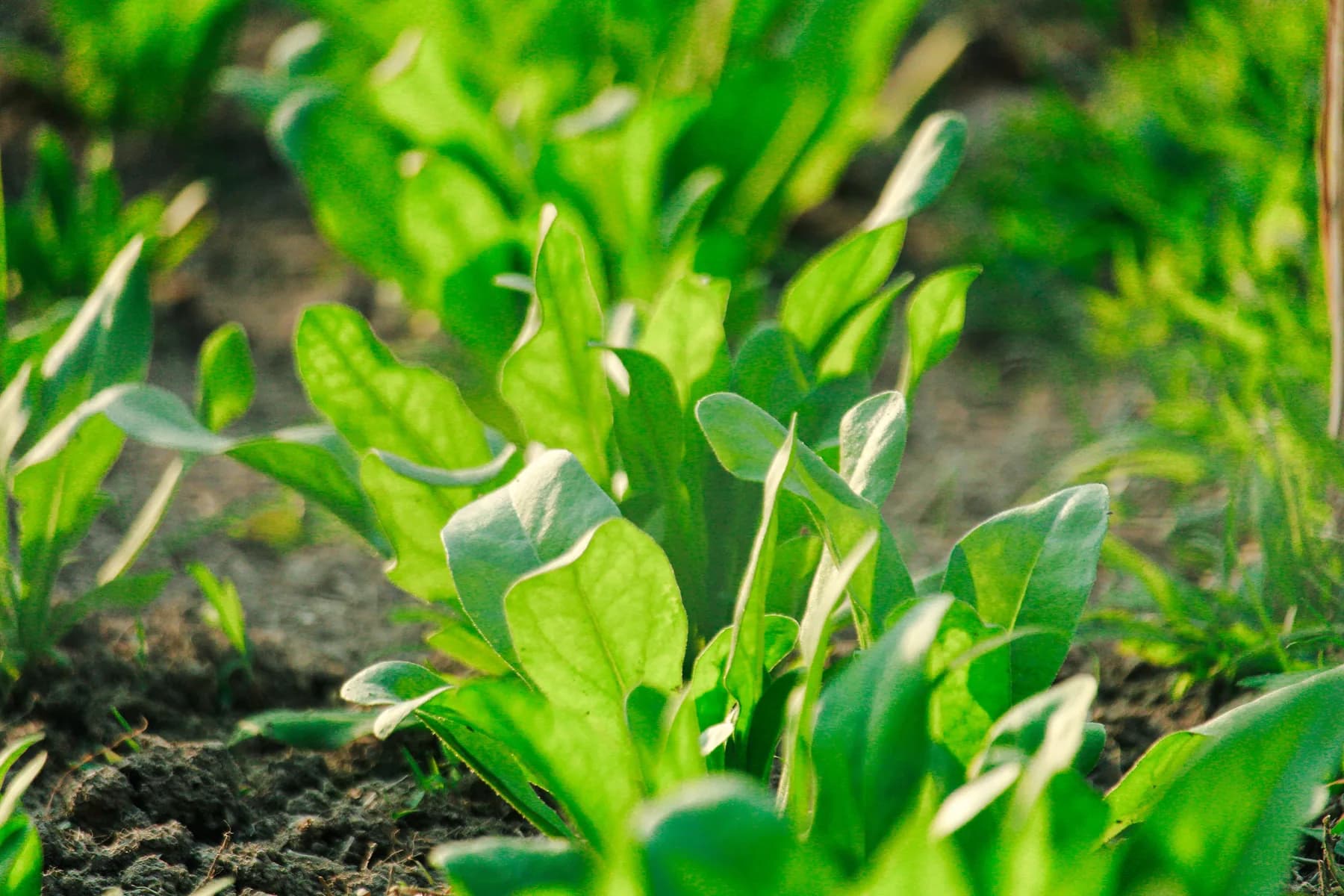
- Spinach leaves in cultivation. Photo: Sayeed Chowdhury via Pexels; resized. Crop reference, not a Texas or Argentine field.
Figures are published averages or study assumptions for the places named, not guarantees for your field. Check current local recommendations and product labels before acting.