

Growing raspberries in Germany
Germany’s 2025 raspberry statistics show more area and harvest under high accessible protective covers than open field. Lower Saxony and NRW trials show how rain caps, tunnels, cultivar type and long-cane systems change harvest timing and output; trial results are not interchangeable with soil-grown field spacing.
Scope: Commercial open-field and protected raspberry production in Germany, using 2025 federal statistics and named state trials. Trial results are tied to cultivar, container, substrate, structure and season. Updated 2026-10-07.
At a glance
Perennial growth and climate in Germany
A perennial planting remains in the field for multiple years. Establishment is a long-term investment; flowering, fruit development, harvest and plant care recur as the planting matures. Follow the named cultivar and production system.
Establishment: Protected-trial establishment examples5,6
NRW long-cane trials were installed on 27 March 2024 and 28 April 2025; a separate autumn-raspberry pot trial was planted on 6 April 2023. These are trial dates for specific protected systems, not a general German establishment window.
Management: Protect developing fruit from weather4,7,8
State extension reports describe rain covers and tunnels as tools to reduce rain, hail, sunburn and weather variability. Structure type and ventilation create different crop conditions; monitor heat and humidity within each system.
Harvest: Combined commercial harvest envelope3,6,8
Lower Saxony describes newer systems supplying May–September; NRW reports autumn raspberries continuing into October. This broad envelope combines different cultivars and systems; a particular unprotected cultivar will have a narrower season.
Historical monthly climate
Reference period: 1996-01-01 to 2025-12-31. ERA5-Land monthly mean soil temperature at 0–7 cm, air temperature and frost days at the regional reference point (51, 10). Select a month to inspect its historical conditions.
Month tiles show mean air temperature.
March historical conditions
- Mean topsoil temperature
- 3.6°C
- Mean air temperature
- 3.9°C
- Mean frost days per month
- 15.6 days
Use this monthly history to assess winter exposure, seasonal heat and water planning. It does not calculate cultivar chill hours, flowering dates, frost damage during bloom or fruit maturity. Topsoil at 0–7 cm describes shallow soil context, not the full root zone. Harvest periods follow the production evidence above.
Climate source: Open-Meteo Historical Weather APIChoose between open field and protected production
- Open field1,431.8 tonnes
- High accessible covers4,752.6 tonnesIncludes greenhouses and similar walk-in structures; excludes low tunnels and temporary rain covers.
- Statistics show the scale of protected production
- Destatis records 359.38 ha and 1,431.8 t of open-field raspberries in 2025, compared with 454.64 ha and 4,752.6 t under high accessible protective covers. The categories do not include every low tunnel or temporary rain roof, and the comparison is not a controlled yield trial.1,2
- A Lower Saxony example illustrates the system difference
- The state chamber reports 2025 yields of 3.7 t/ha open field and about 13.7 t/ha under film tunnels/greenhouses. These are regional results from different production systems and farms, not a guaranteed treatment effect or expected yield for a new operation.3
Match protection and cultivar to the buyer
- 1
Choose cover type
Rain caps, tunnels and closed greenhouses create different costs and crop microclimates.
- 2
Set the market period
Long-cane and autumn-fruiting systems extend or shift harvest in specific trials.
- 3
Check heat and rain exposure
Extension guidance cites fruit-development heat stress and cover-related quality protection.
- 4
Confirm labor and cold chain
Fresh fruit needs careful handling, rapid cooling and a buyer-ready schedule.
- Use the temperature figure as a fruit-development reference
- NRW extension describes raspberry fruit development around 18–25°C and warns that warmer conditions can stress plants and reduce yield. This is a practical extension range, not a whole-season cultivar suitability threshold or a planting heatmap.4
Keep trial plant density tied to its system
- 1
Long-cane Vajolet
7-L pots on coco substrate with drip; compared 4.7, 5 and 6 canes per linear metre.
- 2
Autumn-fruiting cultivars
Malling Bella and Nobility in a rain-cap/open-tunnel container system.
- 3
Use the system-specific result
LWK recommended 6 Vajolet canes/m agronomically in the tested setup.
- 4
Recalculate for the farm
Soil-grown plants, cultivar, cover and machinery can require another layout.
- Six canes per metre is specific to the Vajolet trial
- The NRW trial compared 4.7, 5 and 6 long canes per linear metre in 7-L coco pots with drip irrigation under a tunnel and then a rain cap. LWK recommended six canes/m on agronomic output, while noting wider spacing might still be more economical. It is not a field row-spacing recommendation.5
- Keep the autumn trial separate
- The autumn-raspberry trial used Malling Bella and Nobility in a protected container setup. Its plant and pot counts describe that specific system, not a general soil-grown German stand density.6
Irrigate and feed protected substrate from measurements
- 1
Establish roots without excess water
The protected-berry bulletin cautions against keeping new plants too wet in the first weeks.
- 2
Measure water and drainage
Use the system’s current water analysis, substrate response and crop development.
- 3
Check the fertigation recipe
Older NRW EC values are system-specific and need current verification.
- 4
Keep advice current
Do not reuse obsolete pesticide or product directions from old bulletins.
- Do not transfer substrate EC to soil-grown fields
- The 2021 NRW bulletin gives electrical-conductivity values for protected berry substrate systems. Those older numbers are not a field-soil nutrient recommendation; confirm the current recipe, substrate and irrigation-water analysis with local advisers.9
Harvest ripe fruit gently and cool it quickly
- 1
Set cultivar-specific harvest timing
Summer and autumn types have different cycles; protection can extend the season.
- 2
Pick at target maturity
Raspberries do not continue to ripen after harvest.
- 3
Handle gently and keep shaded
Fruit loses quality quickly and is easily damaged.
- 4
Move through the cold chain
Arrange rapid buyer-specific cooling and delivery; no universal storage temperature is claimed here.
- Use the harvest envelope as a combined system range
- May–September supply is described for newer Lower Saxony systems; NRW autumn-fruiting examples can continue into October. The combined window reflects cultivar and structure choices rather than one farm’s guaranteed season.3,6,8
- Confirm cooling and sales before the season
- BLE notes that berries do not ripen after harvest and lose quality quickly. Agree harvest maturity, pack, cooling, delivery and rejection standards with the buyer; the reviewed national storage page does not set a raspberry-specific temperature protocol.10
Frequently asked questions
- Are raspberries grown more under cover or in open fields in Germany?
- Destatis 2025 records 454.64 ha and 4,752.6 t under high accessible covers, versus 359.38 ha and 1,431.8 t open field. The covered category excludes low tunnels and temporary rain covers.
- When are raspberries established in Germany?
- The cited NRW protected trials planted long canes in late March or late April and autumn types in early April. These are examples for specific container systems, not a general German field calendar.
- What harvest season can German raspberry farms target?
- The combined evidence shows May–September from newer Lower Saxony systems and some NRW autumn-fruiting crops through October. Individual cultivar and system windows are narrower.
- How many raspberry canes should be planted per metre?
- NRW recommended six canes per metre for the Vajolet long-cane trial in 7-L pots and coco substrate. That finding does not set density for soil-grown crops or other cultivars.
- What temperature suits German raspberry fruit?
- NRW extension gives around 18–25°C as a fruit-development reference and warns of heat stress above that context. It is not a full-season climate threshold or planting recommendation.
Regional raspberries guides
Local dates, soil-temperature history and sources for specific regions:
Sources and image credits
- 1. Destatis — GENESIS table 41232-0002, German shrub-berry production by system — 2025 data. National raspberry area and harvest in open field and high accessible covers.
- 2. Destatis — 2025 shrub-berry harvest and production-system definitions — February 2026. Definition of the high accessible protective-cover category.
- 3. Landwirtschaftskammer Niedersachsen — raspberry production and 2025 state statistics — 6 July 2026. Open-field and protected production area, harvest, yields and season context in Lower Saxony.
- 4. Landwirtschaftskammer Nordrhein-Westfalen — regional fruit harvest and raspberry growing conditions — 18 June 2025. NRW production context, fruit-development temperatures and weather protection.
- 5. Landwirtschaftskammer NRW — Vajolet long-cane density trial poster — 2024–2025. Cultivar- and container-specific cane density comparison under tunnel/rain-cap production.
- 6. Landwirtschaftskammer NRW — autumn raspberry trial poster — 2023–2025. Malling Bella and Nobility in a protected container system and pruning comparisons.
- 7. Landwirtschaftskammer NRW — Auweiler trial tour, June 2024 — 2024. Vajolet long-cane trial establishment and June harvest observation.
- 8. Landwirtschaftskammer NRW — Auweiler trial tour, August 2026 — 2026. Protected autumn-fruiting raspberry season observations into October.
- 9. Landwirtschaftskammer NRW — protected berry culture bulletin — 9 March 2021. Older protected-substrate water and fertigation context; outdated pesticide advice is not reused.
- 10. Bundesanstalt für Landwirtschaft und Ernährung — fruit and vegetable storage overview — Updated 9 March 2026. General berry perishability and postharvest quality; no raspberry-specific storage temperature.
- 11. Raspberry photograph — Lizzy Shaanan Pikiwiki Israel — CC BY 2.5. Raspberry picking at Moshav Avnei Eitan, August 2024. Photo: Lizzy Shaanan Pikiwiki Israel, CC BY 2.5; resized. Harvest reference, not a Chinese or German farm; cultivar is unverified.
- 12. Raspberry photograph license — CC BY 2.5. Reuse terms for the credited photograph; resizing is noted in its caption.
Image credits
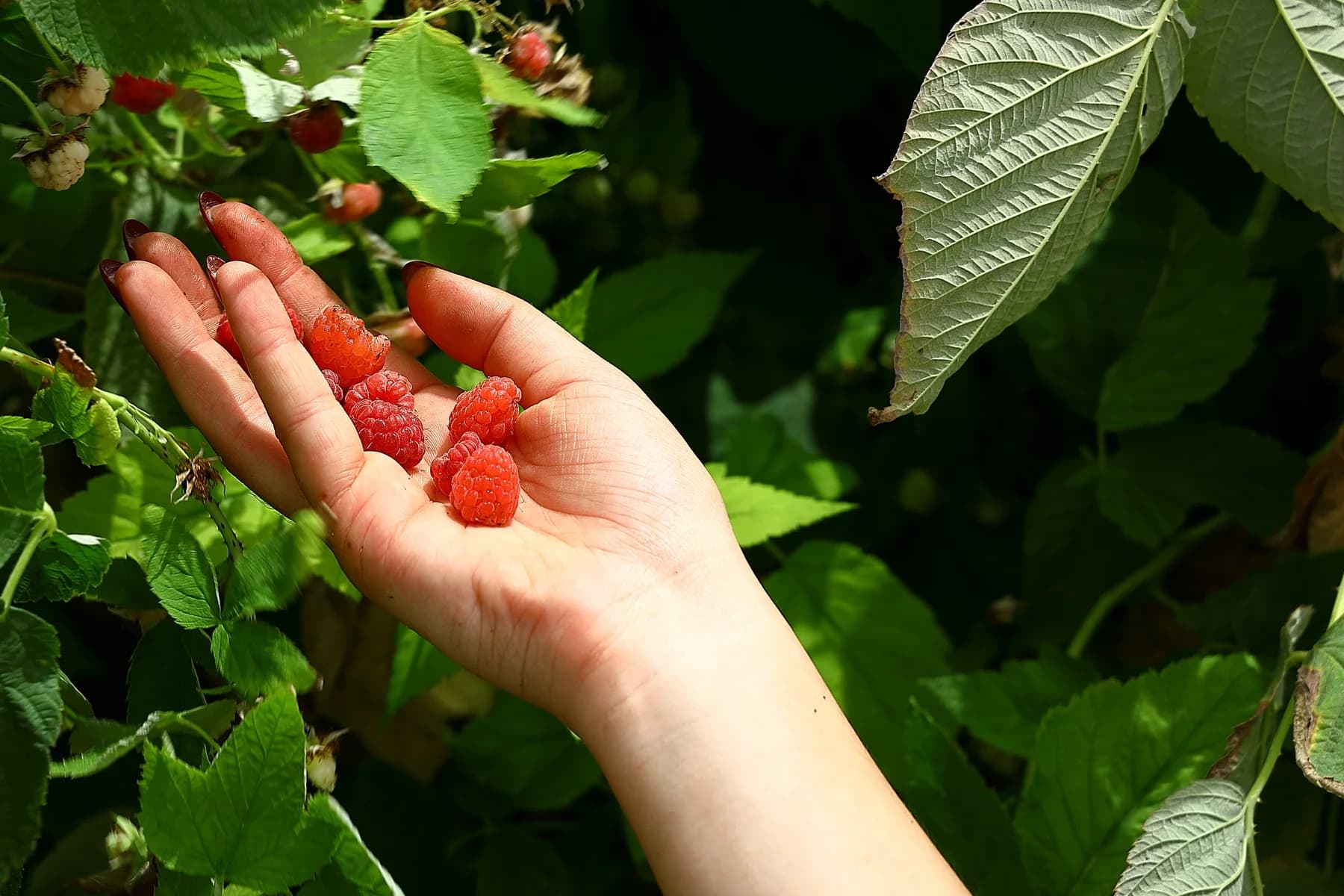
- Raspberry picking at Moshav Avnei Eitan, August 2024. Photo: Lizzy Shaanan Pikiwiki Israel, CC BY 2.5; resized. Harvest reference, not a Chinese or German farm; cultivar is unverified.
Figures are published averages or study assumptions for the places named, not guarantees for your field. Check current local recommendations and product labels before acting.