

Growing raspberries in China
Choose a raspberry production system before planning the field in Northeast China. Heilongjiang’s open-field model and Shangzhi specifications provide regional examples. Summer-fruiting, autumn-fruiting and greenhouse crops require different pruning, management and harvest schedules. Match the cultivar and system to your site and buyer.
Scope: Commercial raspberry production in Heilongjiang and the Shangzhi area. Extension figures are regional model references, not national standards; greenhouse examples are described separately from open-field practice. Updated 2026-10-07.
At a glance
- Main documented area
- Heilongjiang cold-region berry districts, including Shangzhi and Linkou6
- Summer-fruiting row reference
- 2.0–2.5 m rows; 0.6–0.7 m between planting stations; two plants per hole1
- Autumn-fruiting row reference
- 1.5–2.0 m rows; 0.6–0.7 m between planting stations; two plants per hole1
- Shangzhi site-screen reference
- Well-drained sandy loam or loam; GI specification pH 6.2–6.8 and organic matter at least 3.2%2
- Annual harvest reference
- Summer types: July–August; autumn types: September in the reported Heilongjiang season4
Perennial growth and climate in China
A perennial planting remains in the field for multiple years. Establishment is a long-term investment; flowering, fruit development, harvest and plant care recur as the planting matures. Follow the named cultivar and production system.
Establishment: Dormant root-sucker establishment1
The 2025 Heilongjiang model gives mid-April to early May for spring establishment and early-to-mid October for autumn planting of dormant root-sucker plants. These are regional transplanting dates, not seed-sowing months or a China-wide schedule. Tissue-culture plants with intact root balls follow a different instruction.
Management: Irrigate at active growth stages1
The Heilongjiang model calls for soil-moisture-based irrigation before budbreak, before bloom, during rapid shoot growth and fruit enlargement, plus a winterizing irrigation before canes are buried. Do not copy the stage list as a fixed volume or calendar schedule.
Harvest: Heilongjiang fruiting seasons4,5,8
The provincial report places summer-fruiting harvest in July–August and autumn-fruiting harvest in September. Cultivar, site and season change timing; a local greenhouse case reporting October–June fruit is a distinct protected example, not an open-field norm.
Historical monthly climate
Reference period: 1996-01-01 to 2025-12-31. ERA5-Land monthly mean soil temperature at 0–7 cm, air temperature and frost days at the regional reference point (34, 113). Select a month to inspect its historical conditions.
Month tiles show mean air temperature.
April historical conditions
- Mean topsoil temperature
- 16.9°C
- Mean air temperature
- 16.6°C
- Mean frost days per month
- 0.1 days
Use this monthly history to assess winter exposure, seasonal heat and water planning. It does not calculate cultivar chill hours, flowering dates, frost damage during bloom or fruit maturity. Topsoil at 0–7 cm describes shallow soil context, not the full root zone. Harvest periods follow the production evidence above.
Climate source: Open-Meteo Historical Weather APIChoose a well-drained site and a local cane type
- 1
Identify fruiting type
Summer- and autumn-fruiting canes use different row spacing and trellis arrangements.
- 2
Check drainage
A local production survey reports losses after planting in a low, waterlogged site.
- 3
Test the soil
The Shangzhi GI profile is a local reference, not a national soil threshold.
- 4
Plan winter management
Use the regional model and local cultivar experience for cane protection.
- Keep the cultivar evidence local
- The 2025 Heilongjiang model lists summer types 菲尔杜德, 托拉米 and 波尼, and autumn types 波尔卡, 秋萍, 哈瑞太兹 and 秋福. It identifies 哈瑞太兹 for central and southern Heilongjiang. Preserve the local cultivar names and confirm plant identity and availability with a regional supplier.1
- Do not apply the Shangzhi profile across China
- The Shangzhi Red Raspberry specification describes well-drained sandy loam or loam, pH 6.2–6.8 and soil organic matter of at least 3.2%. Treat these as product-area specifications, not nationwide limits. The 2026 provincial survey also reports losses from a low-lying waterlogged block.2,5
- Use the verified 2025 model for field practice
- A 2026 Heilongjiang spring-production webpage contains a raspberry subsection whose soil, spacing, pruning and fertilizer text repeats blackcurrant guidance. Those figures are excluded here; the technical references on this page come from the separate 2025 raspberry model.1,7
Lay out the cane stand for its fruiting type
Between rows: 2.0–2.5 m between rows · Within the row: 0.6–0.7 m between stations
The Heilongjiang model places two plants at each station and uses a single-arm trellis. Schematic, not to scale; allow access for winter cane handling and farm equipment.
Between rows: 1.5–2.0 m between rows · Within the row: 0.6–0.7 m between stations
The model places two plants at each station and uses a T-trellis. Adapt the field plan to cultivar, equipment, winter protection and market.
- Keep two distinct trellis systems
- The Heilongjiang model pairs summer-fruiting raspberries with a single-arm trellis and autumn-fruiting raspberries with a T-trellis. It describes a 2.5 m post height and system-specific support-wire levels; construct and anchor the trellis to the site and local snow/wind loads.1
- Treat the Shangzhi density ceiling as a local standard
- The Shangzhi GI specification sets a maximum of 10,000 plants/ha. It is a product-area requirement, not a universal optimum or a target density for every cultivar and machinery system.2
Manage fertility and water from field evidence
- 1
Test soil before preparing the block
Use the Shangzhi soil profile only as a local comparison.
- 2
Base fertility on soil condition
The provincial model gives different organic amendment ranges for fertile and poorer soil.
- 3
Check root-zone moisture
Irrigate around budbreak, bloom, shoot growth and fruit enlargement as needed.
- 4
Prepare for winter
Follow the model’s regional cane-protection and winter-water steps where applicable.
- Do not turn model input rates into a national prescription
- The 2025 model lists decomposed manure or biofertilizer amounts by its soil-fertility categories and a phosphate-potassium compound rate per mu. Soil test results, nutrient analysis, local regulation and cultivar must guide the farm plan; the published model values are regional references.1
- Use moisture triggers rather than a fixed irrigation volume
- The model names several sensitive growth stages but does not provide a universal water volume for every soil and system. Monitor root-zone moisture and rainfall, particularly during rapid fruit enlargement and before winter cane protection.1
Harvest by cane type and protect fruit quality
- 1
Set the outlet before picking
Fresh sales and freezing have different labor, cooling and lot requirements.
- 2
Follow the fruiting type
Summer- and autumn-fruiting cultivars reach harvest in different seasonal windows.
- 3
Arrange cooling or processing
The local industry reports cold-storage capacity lagging recent expansion.
- 4
Track each field separately
Record cultivar, harvest date, marketable packout, labor and losses.
- Use reported prices and yields only as dated cases
- A 2025 expert survey described one local operation, harvest labor and processor price, and one local yield result. Those snapshots are not a provincewide average, a current price forecast or a profitability estimate.3
- Cold chain and labor affect the production plan
- Heilongjiang’s 2026 survey reports predominantly manual raspberry harvesting and cold-storage capacity lagging sector expansion. Fresh production needs a workable rapid-handling route; freezing is a documented local outlet, not a guarantee of buyer access.3,5,8
Frequently asked questions
- Where are raspberries grown commercially in China?
- The strongest current technical evidence reviewed is for Heilongjiang, including Shangzhi and Linkou cold-region districts. Protected systems also exist locally, but the evidence does not establish one national production package.
- When are raspberry plants established in Heilongjiang?
- The 2025 provincial model gives mid-April to early May and early-to-mid October for dormant root-sucker plants. These are regional transplanting windows, not seed-sowing dates.
- How far apart are raspberry rows in Heilongjiang?
- The model gives 2.0–2.5 m for summer-fruiting types and 1.5–2.0 m for autumn-fruiting types, with 0.6–0.7 m between stations and two plants per hole.
- When are raspberries harvested in Heilongjiang?
- The cited provincial report places summer-fruiting harvest in July–August and autumn-fruiting harvest in September. Local greenhouse off-season reports describe a distinct protected system.
- Can I use one raspberry fertilizer rate throughout China?
- No. The cited soil and fertilizer values are from a Heilongjiang model and a Shangzhi product-area specification. Test the farm soil and follow current regional recommendations.
Regional raspberries guides
Local dates, soil-temperature history and sources for specific regions:
Sources and image credits
- 1. Heilongjiang Department of Agriculture and Rural Affairs — 2025 crop production technical models — 12 February 2025. Open-field standardized raspberry production model for Heilongjiang.
- 2. China National Intellectual Property Administration — Shangzhi Red Raspberry GI protection requirements — 2025. Product-area cultivars, soil, plant-density ceiling and production specifications; not a national raspberry manual.
- 3. Heilongjiang Department of Agriculture and Rural Affairs — cold-region berry production survey — 11 August 2025. Local crop, cultivar, yield, processing, cost and processor-price case; not a provincial average or price forecast.
- 4. Heilongjiang Department of Agriculture and Rural Affairs — berry industry report — 25 December 2025. Reports local summer- and autumn-fruiting harvest seasons.
- 5. Heilongjiang Department of Agriculture and Rural Affairs — raspberry production survey — 19 August 2026. Protected systems, waterlogging loss, cold-storage constraints and mechanization needs.
- 6. Heilongjiang Department of Agriculture and Rural Affairs — 2026 economic-crop development plan — 2026. Province-level cold-region berry production priorities and focus areas.
- 7. Heilongjiang Department of Agriculture and Rural Affairs — 2026 spring berry guidance — 2026. Its raspberry subsection repeats blackcurrant text; included to document why those unsupported figures were excluded.
- 8. Tongbei commercial raspberry greenhouse case — 2025. One local greenhouse and open-field operation; example only, not a national production calendar.
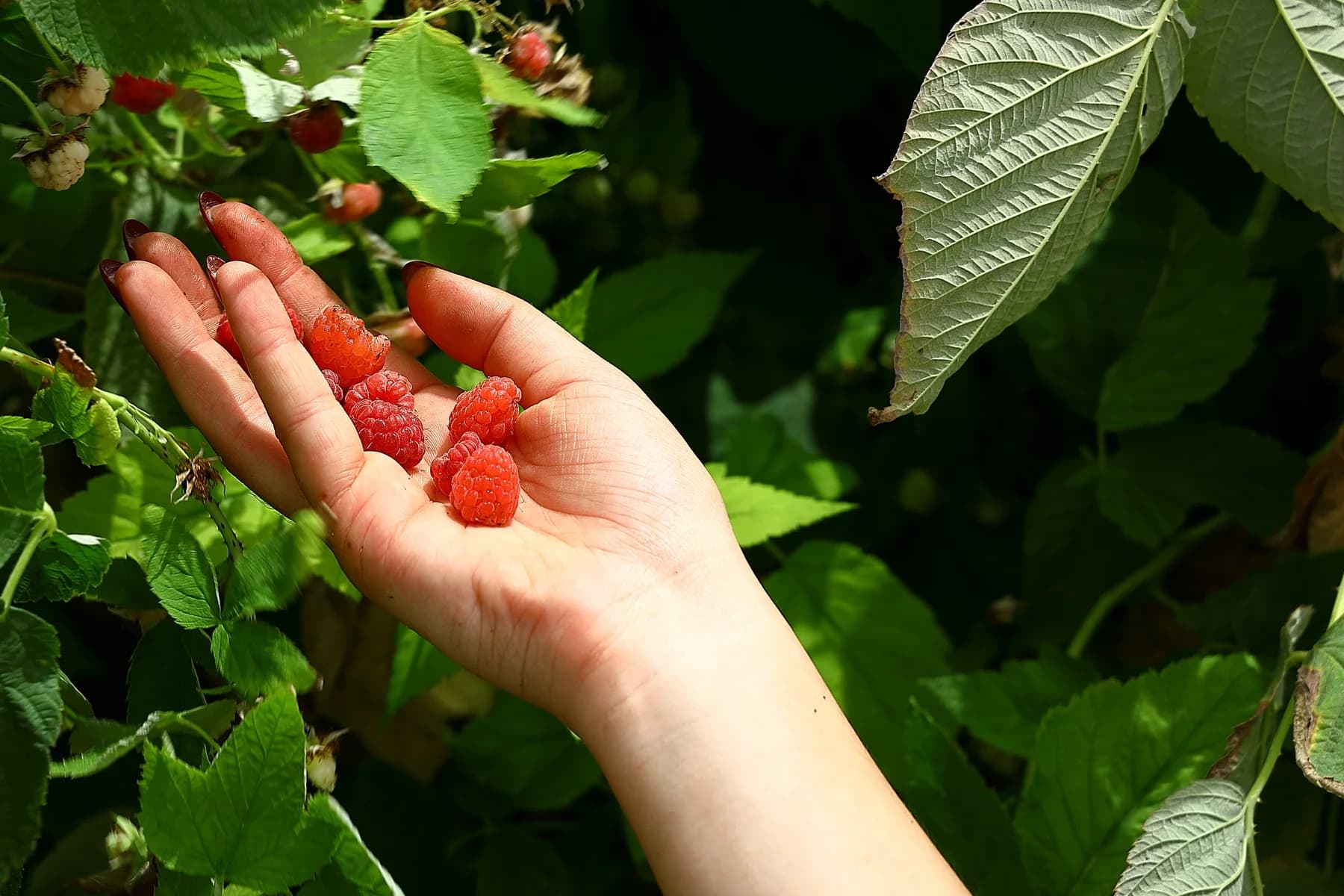
- 9. Raspberry photograph — Lizzy Shaanan Pikiwiki Israel — CC BY 2.5. Raspberry picking at Moshav Avnei Eitan, August 2024. Photo: Lizzy Shaanan Pikiwiki Israel, CC BY 2.5; resized. Harvest reference, not a Chinese or German farm; cultivar is unverified.
- 10. Raspberry photograph license — CC BY 2.5. Reuse terms for the credited photograph; resizing is noted in its caption.
Image credits
- Raspberry picking at Moshav Avnei Eitan, August 2024. Photo: Lizzy Shaanan Pikiwiki Israel, CC BY 2.5; resized. Harvest reference, not a Chinese or German farm; cultivar is unverified.
Figures are published averages or study assumptions for the places named, not guarantees for your field. Check current local recommendations and product labels before acting.