

Passion fruit farming in Texas: species and feasibility
Before investing in tropical passion fruit in Texas, confirm the species, cultivar, winter protection and buyer. Commercial passion fruit is Passiflora edulis. Native maypop (Passiflora incarnata) is a different crop, so its local survival does not establish whether your tropical fruit vines will produce a saleable harvest. Start with a monitored trial before expanding.
Scope: Site and trial planning for perennial tropical passion fruit (Passiflora edulis) in Texas, including species identity, winter survival, harvest quality and market checks. Updated 2026-10-07.
At a glance
- Taxonomy evidence
- Texas sources distinguish native maypop from tropical yellow passion fruit3
Perennial growth and climate in Texas
A perennial planting remains in the field for multiple years. Establishment is a long-term investment; flowering, fruit development, harvest and plant care recur as the planting matures. Follow the named cultivar and production system.
Establish a long-lived planting1,2,3
Choose establishment timing with a local adviser using your cultivar, planting material and field conditions in Texas. A single month cannot cover every site and production system. The historical climate display describes one regional reference point.
Historical monthly climate
Reference period: 1996-01-01 to 2025-12-31. ERA5-Land monthly mean soil temperature at 0–7 cm, air temperature and frost days at the regional reference point (31.5, -99). Select a month to inspect its historical conditions.
Month tiles show mean air temperature.
January historical conditions
- Mean topsoil temperature
- 10.1°C
- Mean air temperature
- 10.1°C
- Mean frost days per month
- 6.9 days
Use this monthly history to assess winter exposure, seasonal heat and water planning. It does not calculate cultivar chill hours, flowering dates, frost damage during bloom or fruit maturity. Topsoil at 0–7 cm describes shallow soil context, not the full root zone. The monthly history does not establish a local flowering, maturity or harvest period.
Climate source: Open-Meteo Historical Weather APIConfirm the species before ordering vines
- 1
Confirm species
Write P. edulis or P. incarnata, not just passionflower.
- 2
Check fruit use
Identify tropical fruit versus native maypop.
- 3
Verify planting material
Record cultivar and source.
- 4
Match research to the same crop
Do not transfer native plant ecology to commercial P. edulis.
- Maypop is not tropical passion fruit
- Texas Parks and Wildlife describes native Passiflora incarnata. A 1998 Texas Agricultural Extension Service note distinguished that native species from tropical yellow passion fruit, P. edulis f. flavicarpa. Maypop hardiness and growth details must not be transferred to commercial P. edulis.1,2,3
Test the production system before expanding
- 1
Choose a documented cultivar
Verify tropical species and plant source.
- 2
Test a defined production system
Compare field and protected conditions only with a trial plan.
- 3
Record winter injury
Measure survival, regrowth and time to fruiting.
- 4
Track harvest and market
Measure packout, maturity, yield and buyer response.
- Measure farm performance before expanding
- The reviewed sources do not establish Texas P. edulis establishment, trellis design, winter survival, irrigation, fertility, fruit set, harvest maturity, yield or buyers. Use a monitored local field or protected-crop trial to assess these requirements before investing.1,2,3
Plan establishment around your site and cultivar
- 1
Measure winter lows
Check the site, not a statewide average.
- 2
Assess frost duration
Record frequency and protection options.
- 3
Check heat and water
Evaluate summer stress and irrigation supply.
- 4
Confirm disease and pollination needs
Seek species-specific extension or trial data.
- Climate averages do not prove a planting window
- Passion fruit is a perennial vine and the crop-specific Texas temperature, frost and establishment thresholds were not verified here. A month-by-month screen would suggest precision the sources do not support; evaluate the intended county and production system directly.1,2,3
Confirm the species and local crop performance
- 1
Resolve intended species
Confirm whether the intended crop is P. edulis or native maypop.
- 2
Find a local production record
Require field-level evidence and growing conditions.
- 3
Secure buyer interest
Verify fruit grade, volume and route to market.
- 4
Scale only after repeat trials
Use several seasons of survival and yield data.
- Separate maypop from tropical passion fruit
- Texas native-plant references identify maypop, not a validated commercial tropical P. edulis system. For edible passion-fruit production, request species-confirmed local trial or grower data on survival, fruiting, harvest quality and buyer demand before committing acreage.1,2,3
Frequently asked questions
- Is passion fruit grown commercially in Texas?
- The reviewed sources do not establish a Texas commercial system for tropical Passiflora edulis. They mainly describe native maypop, a different species.
- Is Texas maypop the same as passion fruit?
- No. Maypop is Passiflora incarnata. Tropical passion fruit is P. edulis; do not transfer its production requirements.
- Can I use Texas maypop spacing for passion fruit?
- No commercial P. edulis spacing recommendation was found for Texas. Maypop references are not a tropical passion-fruit orchard protocol.
- When should passion fruit be planted in Texas?
- No Texas-specific commercial P. edulis establishment month was verified. A local trial must assess cultivar, winter risk, water and production system.
Regional passion fruit guides
Local dates, soil-temperature history and sources for specific regions:
Sources and image credits
- 1. Texas Parks and Wildlife Department — South Texas wildscape plant list — Native-plant reference. Texas maypop (Passiflora incarnata) identity; not commercial tropical passion-fruit advice.
- 2. Texas Parks and Wildlife Department — Bayou planting guide — Native-plant reference. Regional maypop context only.
- 3. Texas Agricultural Extension Service — Passion fruit species distinction — 1998. Distinguishes native P. incarnata from tropical P. edulis; dated and not used for current farm practices.
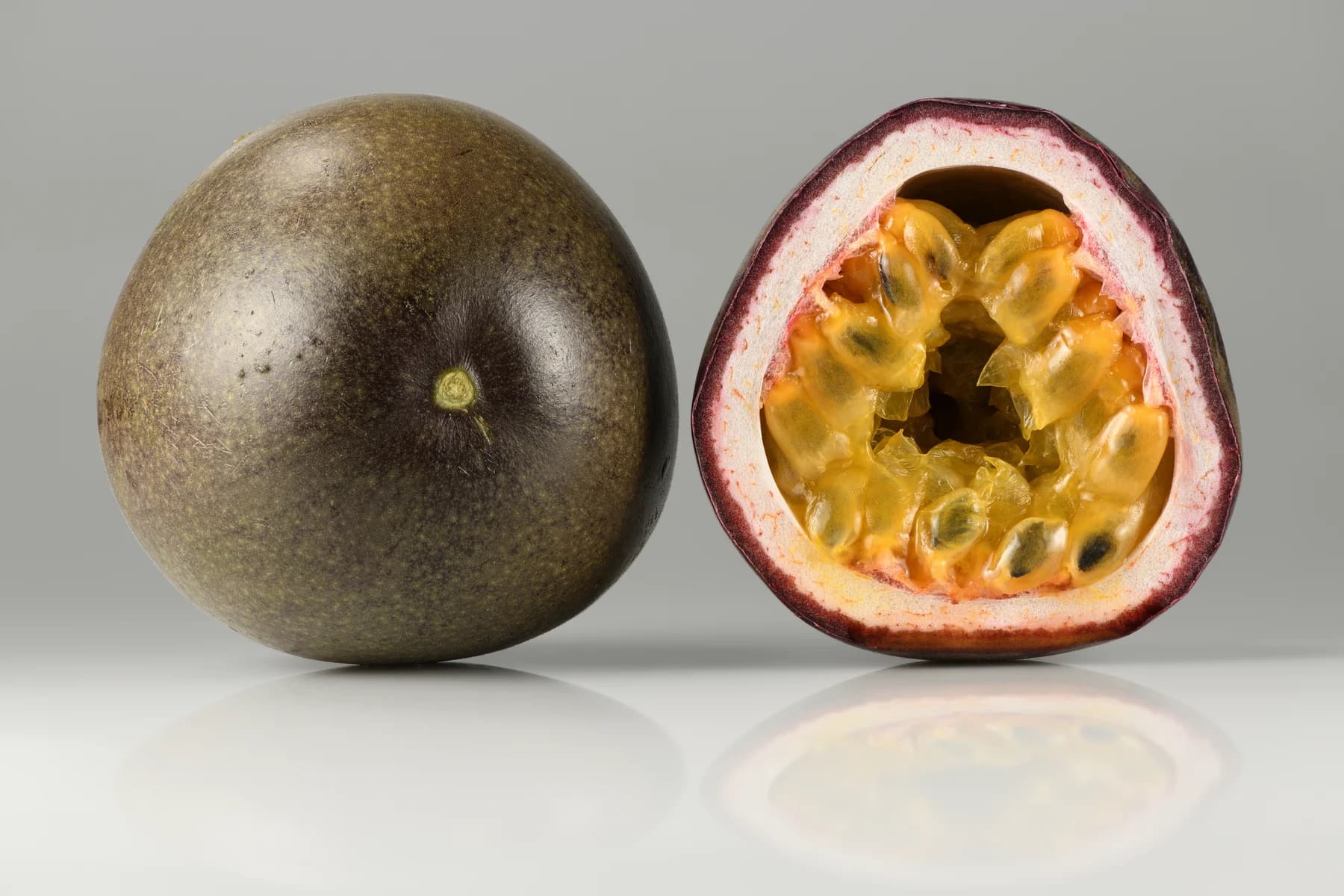
- 4. Passion fruits — whole and halved — Ivar Leidus — January 28, 2022; CC BY-SA 4.0. Focus-stacked Colombia-grown purple Passiflora edulis product photograph. Does not show native maypop, an Indian cultivar trial or Texas production. Resized under the original license.
- 5. Fruit photograph license — CC BY-SA 4.0 — Creative Commons Attribution-ShareAlike 4.0. The resized fruit photograph retains its original share-alike license.
Image credits
- Purple passion fruit (Passiflora edulis), grown in Colombia. Photo: Ivar Leidus, CC BY-SA 4.0; resized.
Figures are published averages or study assumptions for the places named, not guarantees for your field. Check current local recommendations and product labels before acting.