

Growing passion fruit in India
The clearest Indian commercial evidence is for passion fruit in the Northeast, particularly purple Passiflora edulis in Mizoram. A 2025 field study reports a 3 × 3 m trial layout and crop-regulation results from a farmer-field experiment in Mualkawi, Mizoram; these are local experimental findings, not an all-India calendar or routine input prescription.
Scope: Purple passion fruit (Passiflora edulis) in northeastern India, with the 2021–23 Mizoram trial clearly identified. Yellow forms and giant granadilla are separate crop forms. Updated 2026-10-07.
At a glance
Perennial growth and climate in India
A perennial planting remains in the field for multiple years. Establishment is a long-term investment; flowering, fruit development, harvest and plant care recur as the planting matures. Follow the named cultivar and production system.
Establish a long-lived planting1,2,3
Choose establishment timing with a local adviser using your cultivar, planting material and field conditions in India. A single month cannot cover every site and production system. The historical climate display describes one regional reference point.
Historical monthly climate
Reference period: 1996-01-01 to 2025-12-31. ERA5-Land monthly mean soil temperature at 0–7 cm, air temperature and frost days at the regional reference point (22, 79). Select a month to inspect its historical conditions.
Month tiles show mean air temperature.
January historical conditions
- Mean topsoil temperature
- 19.8°C
- Mean air temperature
- 18.5°C
- Mean frost days per month
- 0.0 days
Use this monthly history to assess winter exposure, seasonal heat and water planning. It does not calculate cultivar chill hours, flowering dates, frost damage during bloom or fruit maturity. Topsoil at 0–7 cm describes shallow soil context, not the full root zone. The monthly history does not establish a local flowering, maturity or harvest period.
Climate source: Open-Meteo Historical Weather APISelect species and fruit type for the local market
- 1
Identify the species and form
Separate purple and yellow P. edulis from P. quadrangularis.
- 2
Match elevation and climate
Use local trial evidence rather than a national average.
- 3
Confirm the buyer
Specify fruit type, quality and delivery volume.
- 4
Source healthy plants
Verify cultivar identity and propagation source.
- Do not combine the different Passiflora systems
- ICAR distinguishes purple P. edulis at higher elevations, yellow/golden forms at lower tropical elevations and giant granadilla (P. quadrangularis) grown as a vegetable. Confirm the intended fruit, elevation band, cultivar and buyer before choosing planting material.1,2
Use the Mizoram layout as a trial reference
- 1
Assess slope and drainage
Record field conditions before laying out a perennial block.
- 2
Prepare a durable trellis
Design support around local wind and access.
- 3
Mark trial spacing
The cited farmer-field experiment used 3 × 3 m spacing.
- 4
Keep plants traceable
Track accession, planting date, survival and canopy growth.
- The 3 × 3 m layout is a local trial reference
- The 2025 ICAR field paper used 3 × 3 m spacing on clay-loam soil around pH 5.67 in a farmer field at Mualkawi, Mizoram. This is a documented trial layout, not a national standard; adapt only after checking cultivar, trellis, machinery, slope and local extension guidance.1
Treat crop regulation and fertilizer figures as experimental
- 1
Read the treatment design
Separate control, thinning and growth-regulator treatments.
- 2
Check product registration
Use only current local authorizations and labels.
- 3
Compare across seasons
A two-season trial is not a universal commercial guarantee.
- 4
Record farm response
Test crop load, yield, fruit quality and labor locally.
- Do not convert trial treatments into routine advice
- The 2025 study tested manual thinning with growth regulators and reported its highest yield for one treatment. It also states experimental per-vine nutrient quantities. These findings are cultivar-, site- and trial-specific; check current Indian registration, labels and local recommendations before considering any regulator or rate.1,3
Build the local crop calendar from field data
- 1
Log flowering and set
Record dates by site, elevation and cultivar.
- 2
Track fruit maturity
Use buyer quality and ripeness criteria.
- 3
Record harvest volumes
Separate marketable fruit and culls.
- 4
Update the next cycle
Use measured farm records instead of a national date band.
- Do not transfer a general May–September harvest band
- A broad TNAU compendium mentions a May–September harvest, but its regional and cultivar basis is unclear for Northeast commercial production. The Mizoram study supports fruit production, not one Northeast-wide harvest schedule or planting-feasibility heatmap.1,2,3
Frequently asked questions
- Where is passion fruit grown in India?
- The strongest regional evidence reviewed is from Northeast India, including a 2021–23 purple passion-fruit trial in Mizoram.
- What spacing was used in the Mizoram trial?
- The 2025 ICAR field paper reports 3 × 3 m spacing in the Mualkawi farmer-field experiment. It is a trial layout, not a nationwide recommendation.
- When is passion fruit planted in Northeast India?
- The reviewed sources do not establish one regionwide planting month. Cultivar, elevation, field conditions and local extension should guide establishment.
- Can the Mizoram growth-regulator treatment be used routinely?
- No. It is a local experiment, and any plant-growth regulator needs current Indian registration and label verification before use.
Regional passion fruit guides
Local dates, soil-temperature history and sources for specific regions:
Sources and image credits
- 1. ICAR Indian Journal of Agricultural Sciences — Purple passion fruit crop-regulation trial in Mizoram — 2025; field seasons 2021–22 and 2022–23. Purple passion-fruit farmer-field trial at Mualkawi, Mizoram; spacing, soil conditions, crop regulation and experimental yield.
- 2. ICAR Indian Horticulture — Cultivated Passiflora species in Northeast India — Regional overview. Species and elevation distinction for Northeast passion-fruit forms.
- 3. Tamil Nadu Agricultural University — Horticulture compendium — General, older compendium. Background cultivation notes; its harvest band is not treated as a Northeast calendar.
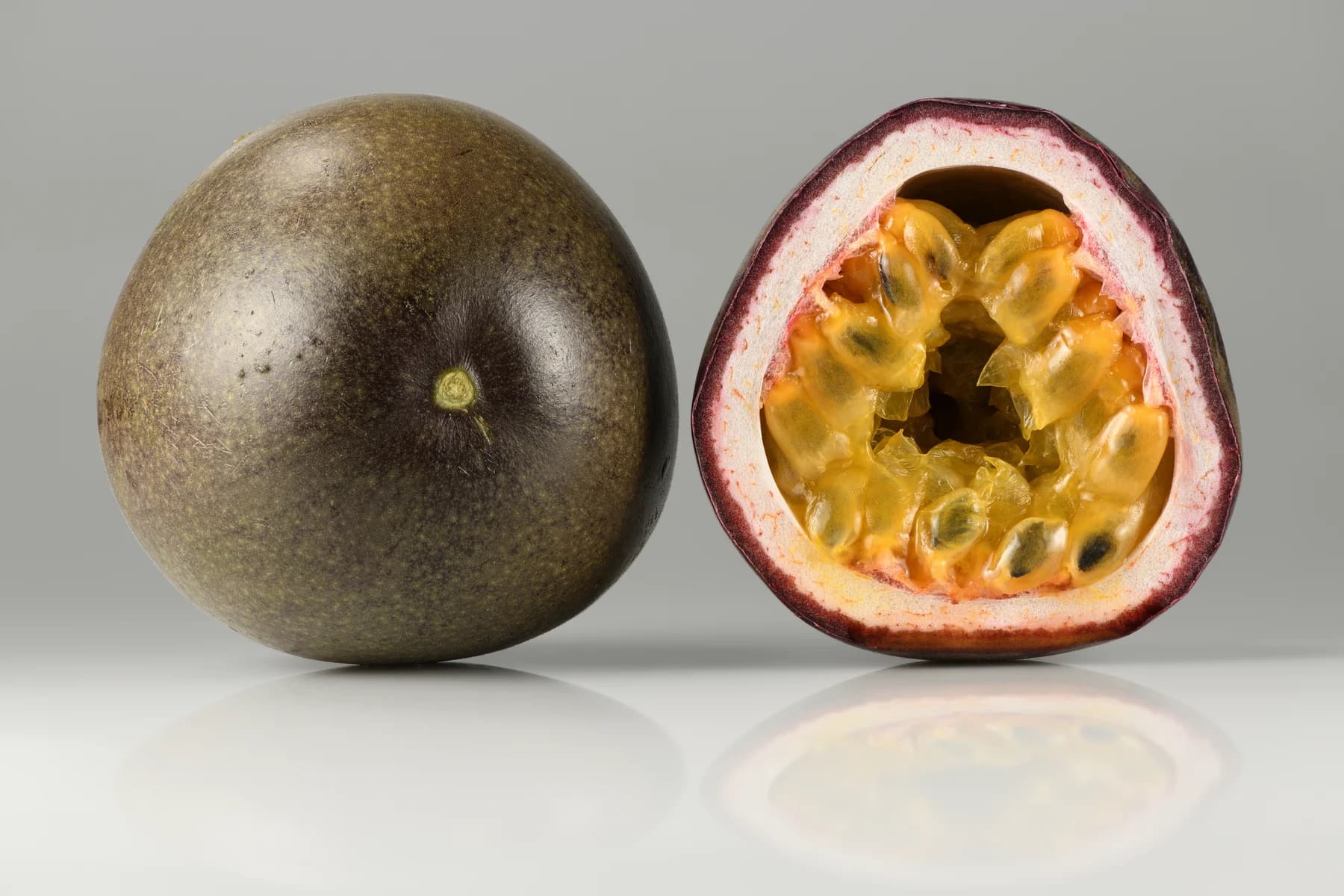
- 4. Passion fruits — whole and halved — Ivar Leidus — January 28, 2022; CC BY-SA 4.0. Focus-stacked Colombia-grown purple Passiflora edulis product photograph. Does not show native maypop, an Indian cultivar trial or Texas production. Resized under the original license.
- 5. Fruit photograph license — CC BY-SA 4.0 — Creative Commons Attribution-ShareAlike 4.0. The resized fruit photograph retains its original share-alike license.
Image credits
- Purple passion fruit (Passiflora edulis), grown in Colombia. Photo: Ivar Leidus, CC BY-SA 4.0; resized.
Figures are published averages or study assumptions for the places named, not guarantees for your field. Check current local recommendations and product labels before acting.