

Growing mangoes in Italy
The strongest Italian mango-production evidence reviewed is specific to Sicily, where official integrated-production rules and university field studies describe coastal orchards and trials. They do not establish one commercial protocol for all of Italy; this guide keeps the location and limits explicit.
Scope: Commercial and experimental mango production documented in Sicily. Cultivar trials, crop rules and phenology are Sicilian evidence and should not be generalized to every Italian region. Updated 2026-10-07.
At a glance
- Preferred soil profile in Sicily rules
- Deep (about 90–100 cm), fertile, well-drained loam to sandy loam1
- Orchard layout reference
- 4–5 m between rows and 5–6 m between trees1
- Irrigation protocol range
- 4,000–5,000 m³/ha per season depending on orchard age, under local rules1
- Trial harvest development
- Open-air fruit reached final size about 90–110 days after full bloom in one Sicilian study3
Perennial growth and climate in Italy
A perennial planting remains in the field for multiple years. Establishment is a long-term investment; flowering, fruit development, harvest and plant care recur as the planting matures. Follow the named cultivar and production system.
Establish a long-lived planting1
The Sicilian rules describe nursery-tree establishment and site requirements but do not support a single month window for every orchard. Choose a sunny, sheltered coastal site without frost or waterlogging, then schedule establishment with local extension advice, soil work, tree availability and irrigation readiness.
Management: Pruning before spring growth resumes1
The Sicily 2026 integrated-production rules recommend pruning every one to two years in early spring before vegetative restart. They caution against autumn or winter pruning because it can increase cold exposure.
Harvest: Observed Sicilian harvest period1,7
Sicilian regional and trial sources describe harvest commonly from August into November, with timing varying by cultivar and year. The regional production rules also describe a broader early-summer-to-late-autumn span; use fruit maturity, not the month alone.
Historical monthly climate
Reference period: 1996-01-01 to 2025-12-31. ERA5-Land monthly mean soil temperature at 0–7 cm, air temperature and frost days at the regional reference point (42.8, 12.8). Select a month to inspect its historical conditions.
Month tiles show mean air temperature.
August historical conditions
- Mean topsoil temperature
- 24.8°C
- Mean air temperature
- 24.1°C
- Mean frost days per month
- 0.0 days
Use this monthly history to assess winter exposure, seasonal heat and water planning. It does not calculate cultivar chill hours, flowering dates, frost damage during bloom or fruit maturity. Topsoil at 0–7 cm describes shallow soil context, not the full root zone. Harvest periods follow the production evidence above.
Climate source: Open-Meteo Historical Weather APIRestrict the plan to suitable Sicilian coastal sites
- 1
Prioritize frost-free coastal exposure
Use sunny sites sheltered from wind and cold air.
- 2
Inspect soil depth and drainage
Confirm deep, fertile soil without waterlogging or excessive salinity.
- 3
Assess spring cold risk
Protect young trees where local winter or spring cold remains a concern.
- 4
Match the cultivar and market
Use local trial evidence and confirm maturity and postharvest route.
- Use Sicily’s production rules within Sicily
- The 2026 regional rules favor sunny, sheltered coastal sites with medium-to-high temperatures and no frost or waterlogging. They warn about poor drainage, salinity, excessive active lime, late spring frost and strong winds. These criteria are not an Italian national suitability guarantee.1
- Treat acreage statistics carefully
- CREA describes tropical fruit as a small, pioneering sector and gives a combined estimate across several crops and regions. It does not provide a mango-specific national area or production figure, so that combined total should not be attributed to mango.5
Use trial cultivars as evidence, not a ranking
| Cultivar | How to interpret the evidence |
|---|---|
| Glenn, Osteen, Maya, Nam Dok Mai, Irwin | Included in a ten-cultivar trial at Caronia, Messina |
| Calypso, Valencia Pride, Keitt, Kent, Tommy Atkins | Also included in the same trial; results are site and study specific |
Sources2
- Do not assume equal performance
- The University of Palermo trial assessed ten cultivars at one farm in Caronia. The report supports discussing the tested material and coastal microclimate, not claiming every cultivar is equally recommended or validated across Italy.2
- Protect young trees from cold exposure
- The Sicily trial authors identify winter cold as a limitation and describe windbreaks and individual protection for young trees. Evaluate the actual exposure and age of each block.2
Lay out the orchard and manage water by measurement
Between rows: 4–5 m between rows · Within the row: 5–6 m between trees
The rules describe a vase training form. Final spacing should reflect soil fertility, rootstock, cultivar, machinery, light and airflow.
- Use soil and leaf analyses for nutrition
- Sicily’s rules prefer fertigation and condition nutrient amounts on soil analysis, yield and plant status. Do not turn the protocol tables into a universal Italian fertilizer rate.1
- Use low-volume irrigation
- The rules favor micro-sprinkler or subsurface systems, with timing and volume based on weather and root-zone moisture. Their seasonal 4,000–5,000 m³/ha range varies with orchard age; they prohibit flood irrigation within the protocol.1
Pick to fruit maturity and protect quality
- 1
Check cultivar and bloom date
Track full bloom to estimate the local fruit-development stage.
- 2
Inspect maturity indicators
Use peel color, size, firmness, aroma, detachment and sugar level.
- 3
Harvest at early-to-mid maturity
Follow the regional rules and the destination market specification.
- 4
Move fruit promptly
Protect fruit and coordinate packing, storage and sale.
- Do not use a fixed national calendar
- One Sicilian study observed open-air fruit reaching final dimensions about 90–110 days after full flowering. The number is cultivar- and system-specific; a separate greenhouse study reported a longer period.3
Frequently asked questions
- Where is commercial mango production documented in Italy?
- The strongest evidence reviewed is for selected Sicilian coastal sites and trials. It does not establish a commercial protocol for all Italian regions.
- What spacing is used for mango orchards in Sicily?
- Sicily’s 2026 integrated-production rules give 4–5 m between rows and 5–6 m between trees, with final spacing adapted to site, cultivar and equipment.
- When are mangoes harvested in Sicily?
- Regional and trial sources commonly describe August–November, varying by cultivar and year. Pick to measured maturity rather than relying on a fixed month.
- Can Sicily’s guide be used for mangoes elsewhere in Italy?
- Not as a proven package. The cited rules and field studies are specific to Sicily, particularly selected coastal microclimates.
- How much irrigation do mango orchards need in Sicily?
- The regional rules list 4,000–5,000 m³/ha per season depending on orchard age, but water timing and volume must follow soil moisture, weather and the local protocol.
Regional mangoes guides
Local dates, soil-temperature history and sources for specific regions:
Sources and image credits
- 1. Sicily Rural Development — Integrated Production Rules 2026, mango chapter — 2026. Sicily-specific site selection, orchard layout, pruning, irrigation, nutrition and harvest rules.
- 2. University of Palermo — Sicilian mango cultivar and fruit-quality study — Accessed 7 October 2026. Ten cultivars studied at a Caronia, Messina farm; local trial evidence and winter-cold limitations.
- 3. University of Palermo — open-air and greenhouse mango fruit-growth study — Accessed 7 October 2026. Cultivar- and system-specific time from full flowering to final fruit dimensions.
- 4. Sicily Rural Development Programme — INNO.M.A.M. project — 2025 project publication. Experimental orchards, weather-station phenology, irrigation, harvest-maturity and postharvest protocol work.
- 5. CREA — Italian Agriculture Yearbook 2023 — 2023. Combined tropical-fruit context; does not disaggregate Italian mango acreage.
- 6. Sicilian regional agriculture — local mango production and markets — Accessed 7 October 2026. Sicily-specific harvest-season and short-chain market context.
- 7. Mango photograph — safaritravelplus — CC0 1.0. Mango on a tree in Nairobi, Kenya. Photo: safaritravelplus, CC0 1.0; resized. Crop reference, not a Brazilian or Italian orchard.
- 8. Mango photograph license — CC0 1.0. Reuse terms for the credited photograph; resizing is noted in its caption.
Image credits
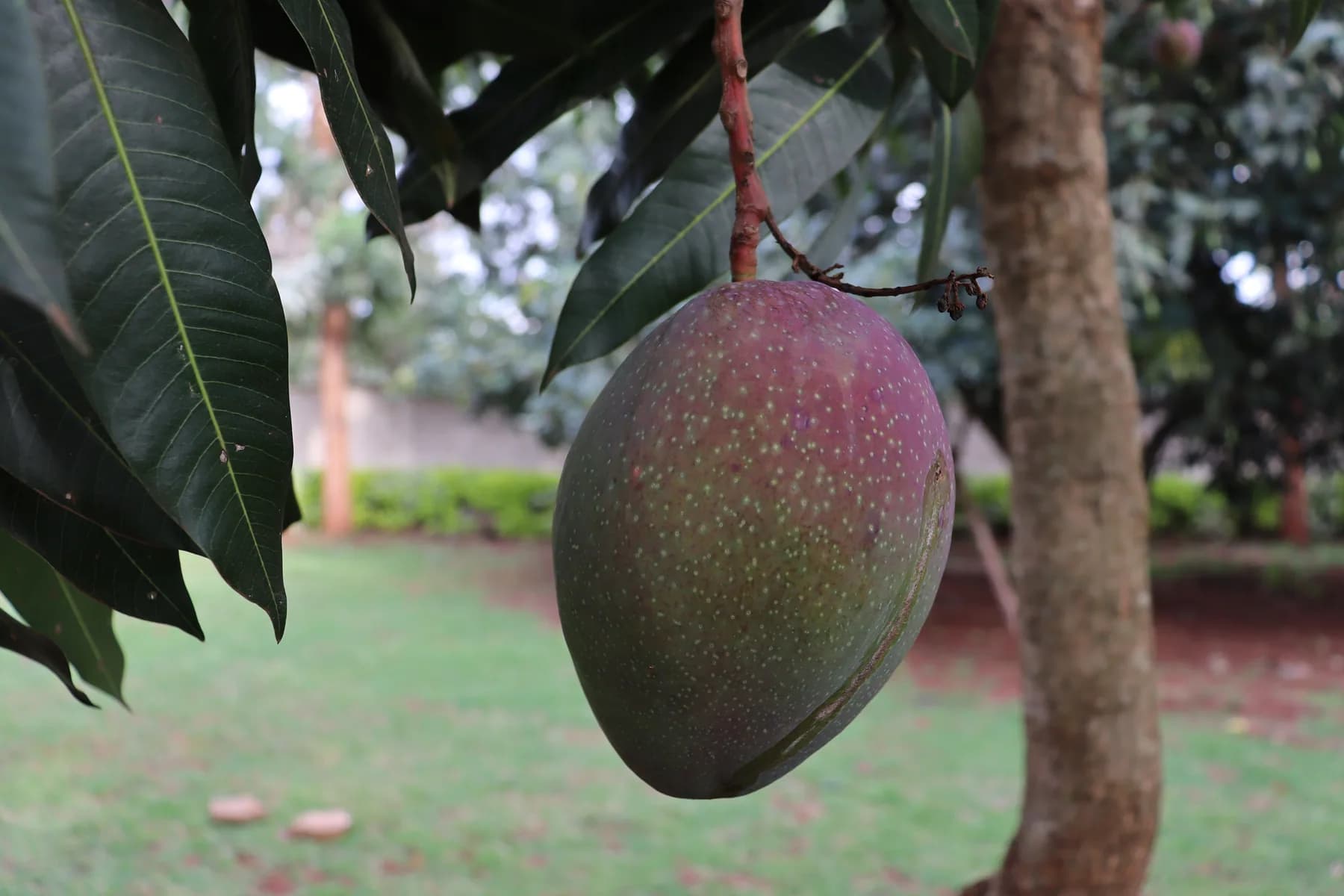
- Mango on a tree in Nairobi, Kenya. Photo: safaritravelplus, CC0 1.0; resized. Crop reference, not a Brazilian or Italian orchard.
Figures are published averages or study assumptions for the places named, not guarantees for your field. Check current local recommendations and product labels before acting.