

Growing mangoes in Brazil
Brazilian mango production is concentrated in the Northeast and Southeast, but rain-fed orchards and irrigated semi-arid systems follow different field decisions. Embrapa’s national figures and production guidance support this overview; use local irrigation, cultivar, rainfall and buyer information before fixing an orchard plan.
Scope: Commercial mango orchards in Brazil. National figures and calendar examples are labeled by production system; they are not a city-specific establishment prescription. Updated 2026-10-07.
At a glance
- Brazil production, 2023
- About 1.76 million tonnes on 80,700 ha1
- Production concentration
- Northeast: about 77%; Southeast: about 22% of output1
- General temperature reference
- Embrapa cites 24–30°C as preferred; above 38°C can limit production3
- Spacing range
- 5–8 m between rows and 1–5 m between trees; density and management vary5
- Irrigated versus rain-fed harvest
- Potential year-round supply under irrigation; broad rain-fed context November–March4
Perennial growth and climate in Brazil
A perennial planting remains in the field for multiple years. Establishment is a long-term investment; flowering, fruit development, harvest and plant care recur as the planting matures. Follow the named cultivar and production system.
Establish a long-lived planting4
Embrapa’s broad summary says rain-fed orchards are planted during the rainy period, while irrigated orchards can be established throughout the year. These are system-level notes, not a month-by-month recommendation for every Brazilian state; verify field access, rainfall, water supply, nursery stock and local advice.
Management: Flowering and dry-period management8
Commercial flowering responds to cool and dry conditions in tropical/subtropical production. Irrigated semi-arid systems may manage flowering to schedule supply, but the induction process is a specialized production practice, not a guaranteed year-round yield method.
Harvest: Broad rain-fed harvest context4,8
Embrapa’s national summary gives November–March as a broad rain-fed harvest period and says irrigated production may be harvested year-round. The natural Southern Hemisphere season is not a fixed schedule for a named farm or cultivar.
Historical monthly climate
Reference period: 1996-01-01 to 2025-12-31. ERA5-Land monthly mean soil temperature at 0–7 cm, air temperature and frost days at the regional reference point (-15, -50). Select a month to inspect its historical conditions.
Month tiles show mean air temperature.
November historical conditions
- Mean topsoil temperature
- 26.8°C
- Mean air temperature
- 25.6°C
- Mean frost days per month
- 0.0 days
Use this monthly history to assess winter exposure, seasonal heat and water planning. It does not calculate cultivar chill hours, flowering dates, frost damage during bloom or fruit maturity. Topsoil at 0–7 cm describes shallow soil context, not the full root zone. Harvest periods follow the production evidence above.
Climate source: Open-Meteo Historical Weather APIChoose the production system and target market
- Northeast77–100 % of output
- Southeast22–100 % of output
- Do not treat Brazil as one orchard climate
- Embrapa reports about 1.76 million tonnes from 80,700 ha in 2023, with approximately 77% of output in the Northeast and 22% in the Southeast. The semi-arid irrigated export system and rain-fed orchards have different water and flowering decisions.1,2
- Select cultivars for the outlet
- Embrapa lists Tommy Atkins, Palmer, Kent, Keitt, Haden, Rosa and Espada among Brazilian-market cultivars. Tommy Atkins, Palmer, Kent and Keitt are important export cultivars; choice depends on target market, maturity, quality and regularity.6
Screen the site, soil and water supply
- 1
Check seasonal temperature
Use Embrapa’s broad crop references as context, then assess the local field climate.
- 2
Confirm drainage and soil depth
Favor deep, well-drained, non-saline soils.
- 3
Secure irrigation where needed
Assess water availability, quality, delivery and environmental constraints.
- 4
Plan access and harvest
Lay out roads and headlands for crop care, fruit handling and transport.
- Use temperature values as context
- Embrapa gives 24–30°C as a preferred temperature range and says temperatures over 38°C can limit production. These general crop values are not monthly feasibility cutoffs or a yield forecast for a particular orchard.3
Set spacing to cultivar and equipment
Between rows: 5–8 m between rows · Within the row: 1–5 m between trees
The source reports a wide range of densities, about 250–1,500 trees/ha. Higher-density systems require more intensive pruning, irrigation, nutrition and crop protection; this range is not a universal layout.
- Map machinery before ordering trees
- Choose spacing around cultivar vigor, mature canopy, light, equipment movement and access for crop protection and harvest. Match the final row plan to the local system and labor capacity.5
- Use localized irrigation and diagnosis
- Embrapa describes drip and micro-sprinkler options and says the system should fit soil, orchard, water supply, economics and environmental conditions. Soil and leaf analysis should guide nutrient planning; fruit set and fruit growth are sensitive to water deficit.7
Harvest to maturity and destination market
- 1
Assess maturity before picking
Consider fruit age, size, appearance, firmness, climate and destination.
- 2
Handle gently and keep fruit shaded
Use clean containers and protect harvested fruit from heat and impact.
- 3
Match postharvest to the market
Export routes can require specific treatments, storage and quarantine compliance.
- 4
Track pests and rots
Fruit flies, anthracnose and postharvest rots can affect quality and market access.
- Separate calendar context by system
- Embrapa’s national summary describes year-round harvest under irrigation and November–March for rain-fed production. These broad references do not replace block maturity checks or cultivar scheduling.4
Frequently asked questions
- Where is most mango grown in Brazil?
- Embrapa’s 2023 figures place about 77% of output in the Northeast and 22% in the Southeast. These regions include different irrigated and rain-fed systems.
- Can mango orchards be planted year-round in Brazil?
- Embrapa’s broad summary says irrigated orchards can be planted throughout the year, while rain-fed planting is tied to the rainy period. Check local field access and water conditions.
- What spacing is used for mango trees in Brazil?
- Embrapa describes 5–8 m between rows and 1–5 m between trees, with about 250–1,500 trees/ha across systems. Select density to fit cultivar, equipment and management capacity.
- When are Brazilian mangoes harvested?
- The broad rain-fed summary gives November–March, while irrigated systems may supply fruit year-round. Use cultivar and fruit maturity to schedule a specific block.
- Which mango varieties are grown in Brazil?
- Embrapa lists Tommy Atkins, Palmer, Kent, Keitt, Haden, Rosa and Espada among cultivars encountered in Brazilian markets. Match choice to product destination and local advice.
Regional mangoes guides
Local dates, soil-temperature history and sources for specific regions:
Sources and image credits
- 1. Embrapa Ater+ Digital — Mango crop overview — Accessed 7 October 2026. 2023 national production area/output and main production regions.
- 2. Embrapa — Mango climate and soil — Accessed 7 October 2026. Temperature, dry-period, soil, water and site considerations.
- 3. Embrapa — Mango temperature guidance — Accessed 7 October 2026. General temperature references; not monthly site-specific thresholds.
- 4. Embrapa — Mango summary production and calendar data — Accessed 7 October 2026. Broad irrigated and rain-fed planting and harvest distinctions.
- 5. Embrapa — Mango orchard spacing — Accessed 7 October 2026. Spacing and density range with management tradeoffs.
- 6. Embrapa — Mango cultivars and nursery stock — Accessed 7 October 2026. Brazilian market cultivars and planting-material considerations.
- 7. Embrapa — Mango irrigation and nutrition — Accessed 7 October 2026. Irrigation methods, crop-stage water sensitivity and soil/leaf-based nutrition.
- 8. Embrapa — Mango flowering and production — Accessed 7 October 2026. Flowering response, managed production and Southern Hemisphere season context.
- 9. Embrapa — Mango harvest and postharvest — Accessed 7 October 2026. Maturity checks and harvest handling.
- 10. Embrapa — Mango postharvest — Accessed 7 October 2026. Postharvest treatment and quality.
- 11. Embrapa — Fruit-fly management and quarantine context — Accessed 7 October 2026. Economically important fruit flies and market access considerations.
- 12. Mango photograph — safaritravelplus — CC0 1.0. Mango on a tree in Nairobi, Kenya. Photo: safaritravelplus, CC0 1.0; resized. Crop reference, not a Brazilian or Italian orchard.
- 13. Mango photograph license — CC0 1.0. Reuse terms for the credited photograph; resizing is noted in its caption.
Image credits
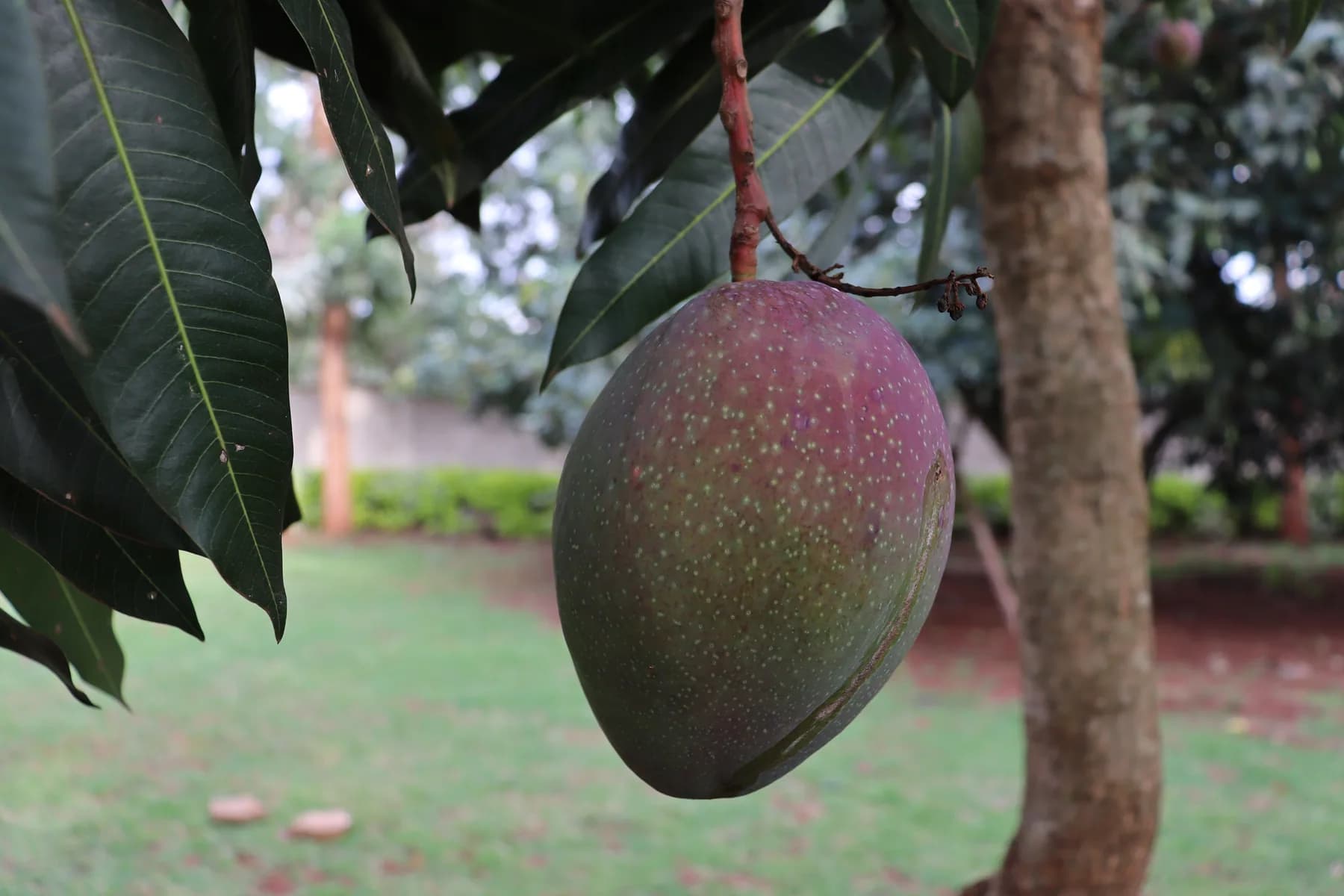
- Mango on a tree in Nairobi, Kenya. Photo: safaritravelplus, CC0 1.0; resized. Crop reference, not a Brazilian or Italian orchard.
Figures are published averages or study assumptions for the places named, not guarantees for your field. Check current local recommendations and product labels before acting.