

Commercial field guide · Ireland
Growing carrots in Ireland
Carrots are an established Irish field vegetable. This guide is for commercial and prospective commercial growers planning a field crop; it helps identify what to verify, but it cannot tell whether a particular field or business is suitable.
For home growing, use our general carrot-growing guide.
Can carrots grow in Ireland?
National crop contextYes. Teagasc lists carrots among Ireland’s established field vegetables and describes protected overwintered crops as one way growers extend the season. That is a national crop-level answer—not a field-level recommendation.
Field fit depends on soil texture and stones, drainage, seedbed condition, crop timing, rotation, machinery and harvest/storage capacity, and a realistic route to a buyer. Assess those conditions locally before committing land or inputs.
- Audience
- Commercial field growers
- Use
- Planning questions and sourced crop context
- Limit
- No parcel-specific yield, margin or price estimate
Step 1 of 7 · Assess
Before planting: questions to resolve
Work through these checks with your agronomist, adviser, contractor or buyer. The checklist tracks what you have reviewed; it does not calculate a suitability score or replace local advice.
8 topics still to verify· planning aid only, not a suitability score
Selections stay in this browser tab and are not saved or sent anywhere.
Step 2 of 7 · Plan
When to sow carrots in Ireland: crop-specific windows
Teagasc’s 2020 guide distinguishes early, main and late sowings. Keeping those crop plans separate avoids implying that every grower should sow continuously from February to July.
Sowing windows in Irish Teagasc guides
| Crop plan | Sowing window | Documented harvest note |
|---|---|---|
| Early crop | February–March | June/July production. |
| Main crop | Mid-April–May | The guide gives the sowing window but no single harvest month for this crop. |
| Late early variety | June | The 2020 guide says about 12 weeks after sowing; actual timing shifts with conditions. |
| Protected spring crop | The current overview does not specify a sowing window. | Teagasc says growers use straw and plastic to harvest overwintered carrots in April/May. |
Sources: Teagasc vegetable growing guide (2020, carrot section) and Teagasc vegetable production overview.
The crop-specific sowing windows are from a 2020 publication; confirm current variety, sowing and protection advice with an Irish horticultural adviser before using them as an operational schedule. Teagasc currently describes protected overwintered carrots as harvested in April and May.
Step 3 of 7 · Prepare
Soil and seedbed: check texture, drainage and stones
Teagasc describes light-to-medium soils as common for commercial carrot crops and sandy loam as ideal. It warns that stones can deform roots and cause damage during lifting. Those points make field history, soil structure and a representative field inspection more useful than a national suitability label.
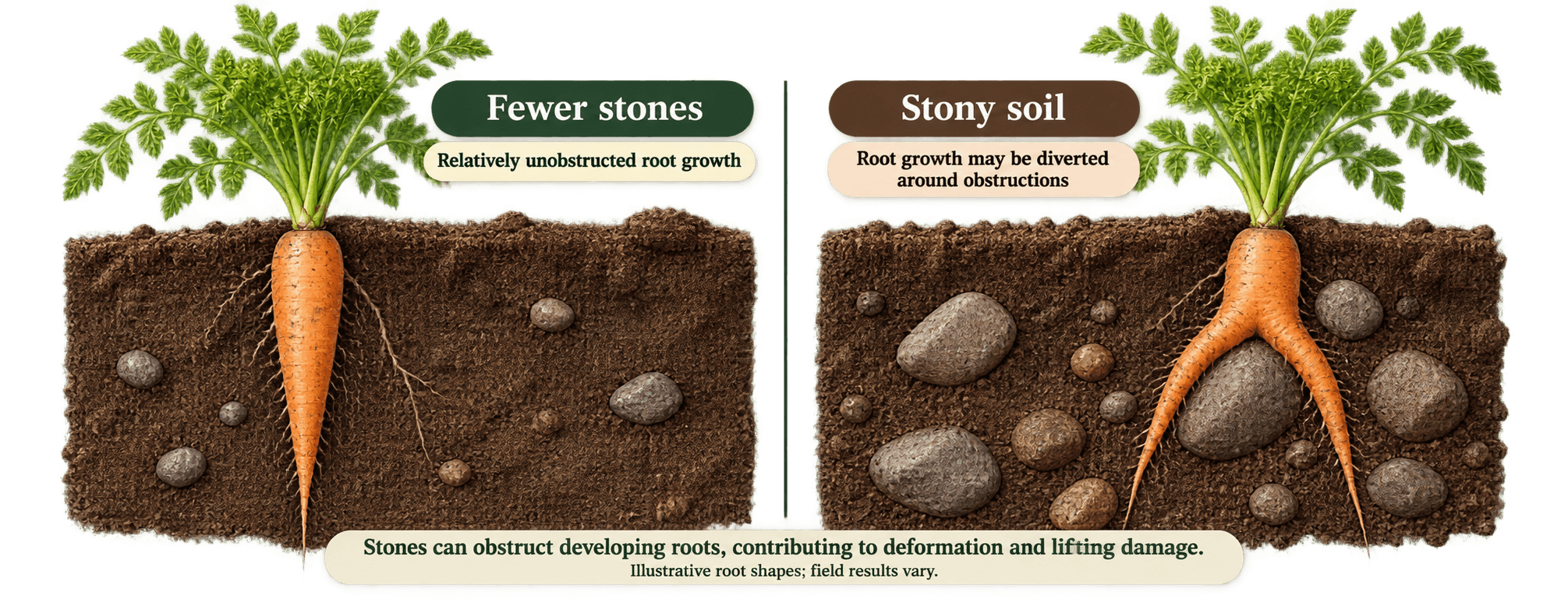
The reviewed sources describe crop systems, not a universal minimum soil depth or maximum stone size. Inspect representative soil and confirm machinery settings with an Irish crop adviser or contractor.
Step 4 of 7 · Establish
Prepare and sow: practical references
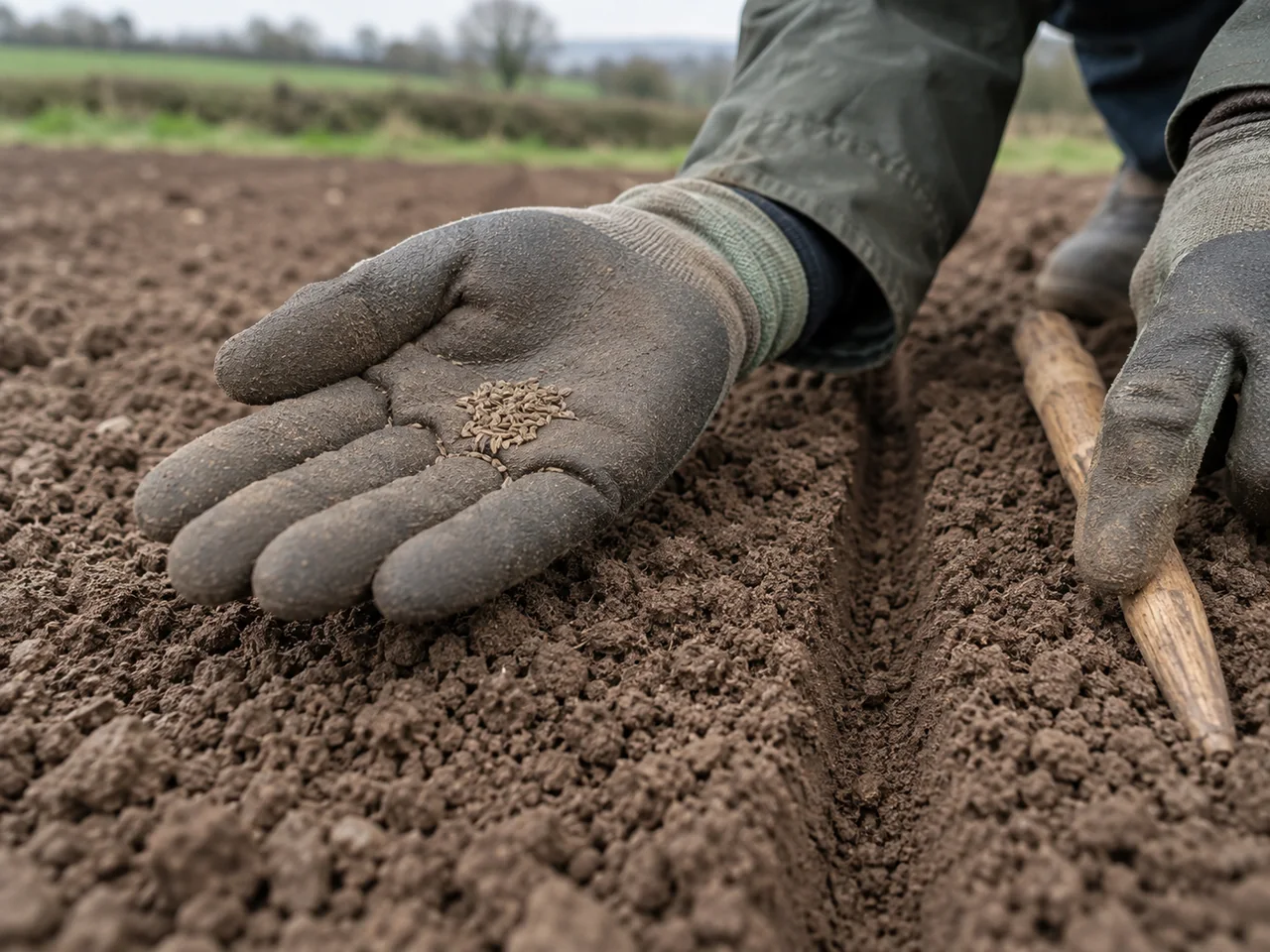
Commercial carrots are started from seed sown in the field. These field-preparation and sowing illustrations accompany measurements from two different Irish sources, not a blended recommendation.
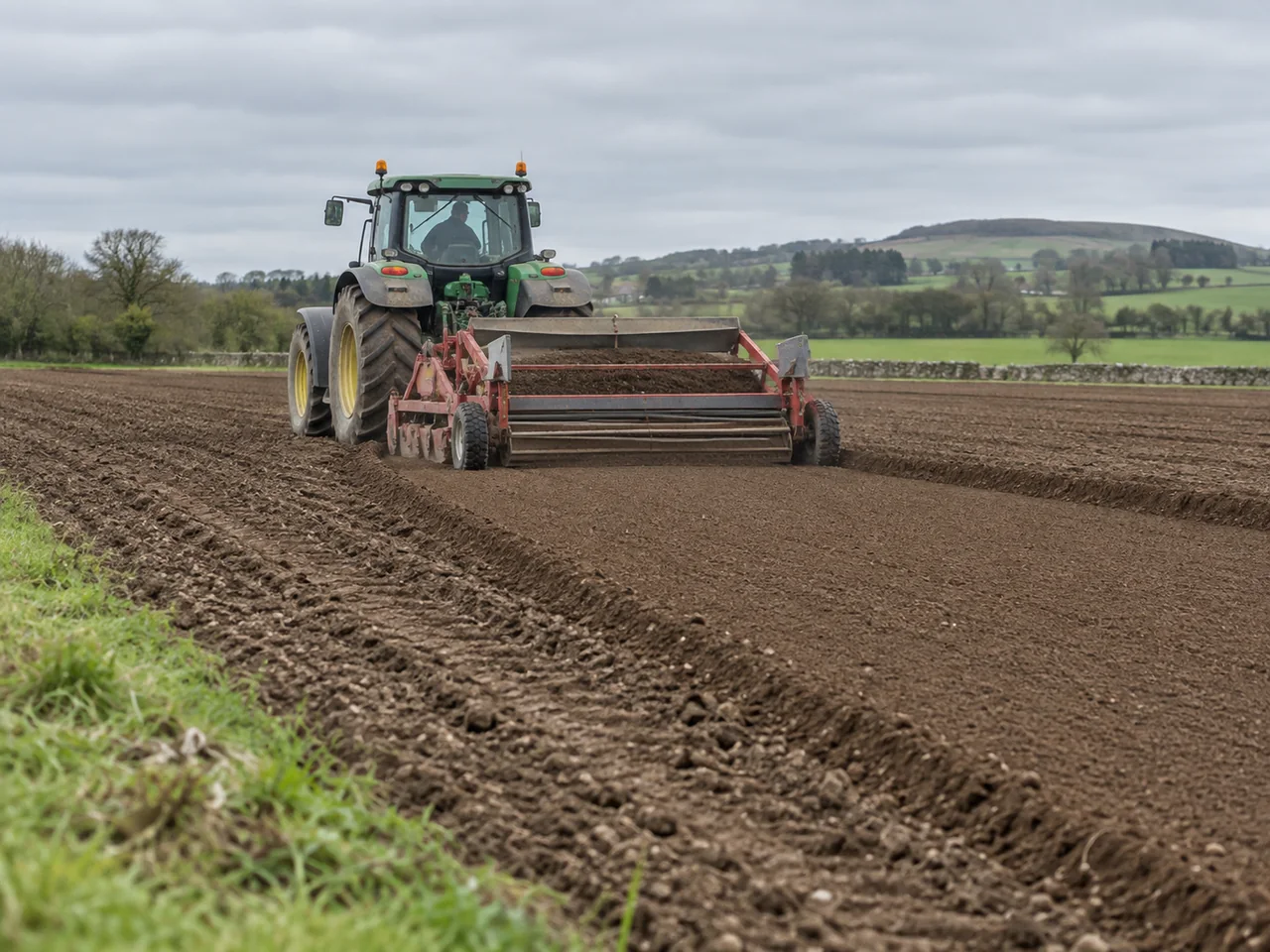
Prepare the field
A 2025 County Laois organic carrot case describes destoning and bed-forming before sowing.
Sow the seed
For a normal carrot crop, sow carrot seed directly; do not plant a harvested carrot root. The depth and spacing references below come from Irish sources.
Teagasc growing guide · 2020
- Sowing depth
- 1–2 cm (10–20 mm).
- Lines
- 15 cm apart on the flat—half the length of a standard 30 cm ruler.
- After emergence
- If seedlings are too close, thin to 5–7 cm apart; the guide does not call this an in-row precision-seeder setting.
One Irish organic farm · 2025
- Sowing depth
- 5–15 mm, adjusted in that system for soil moisture, rainfall and weed pressure.
- Spacing reported
- 38 × 1.6 cm for Nairobi carrots; the booklet does not name the axes. Its separate crop description reports 72-inch bed centres and 1.7 million seeds/ha.
- Yield figure
- 37–62 t/ha (15–25 t/ac) is shown for this farm’s organic carrot case; it is not an Irish average or forecast.
- System context
- Primed seed, pneumatic precision seeder, destoning and bed-forming. This is one grower’s organic system, not an Ireland-wide standard.
Reading the 2025 spacing pair: if 38 × 1.6 cm means row × in-row spacing, the implied seed-position density is about 1.64 million/ha, close to the grower’s separately reported 1.7 million seeds/ha. That is a transparent arithmetic cross-check, not an explicit explanation in the source; confirm the layout before setting a drill. For a physical reference, 38 cm is a 30 cm ruler plus 8 cm; 1.6 cm is 16 mm, so measure the drill setting directly.
Sources: Teagasc 2020 guide, carrot section and the 2025 Teagasc organic farm-walk booklet. The figures describe different planting systems; choose against current variety, soil and equipment advice.
Step 5 of 7 · Manage
Weather, overwintering and crop-protection pressure
Wet-season exposure
Teagasc reported that wet conditions in 2023–24 affected overwintered carrot quality and marketable yield. This is a dated report about that period, not a claim that every farm will experience the same loss.
Protection and crop management
The same report notes straw shortages among overwintered growers and describes reduced plant-protection-product availability as a wider field-vegetable-sector pressure. Check current Irish labels and adviser guidance; this page does not recommend treatments or rates.
Teagasc’s 2030 horticulture roadmap also discusses drainage, water access, extreme-weather adaptation, integrated pest management and labour-saving investment as sector issues. These are planning prompts, not carrot-specific forecasts for an individual farm.
Step 6 of 7 · Harvest
Harvest, handling and route to market
Before sowing, establish who will buy the crop, which quality specification and delivery windows apply, and how planting, lifting, transport, protection and storage fit that route. A Teagasc 2025 farm-walk booklet shows 37–62 t/ha (15–25 t/ac) for its organic carrot case. Treat it as a case-study range, not an Irish benchmark or a promise for your field; the booklet does not define in the extracted text whether the figure is marketable yield.
Teagasc’s profile of an organic grower in County Laois illustrates one Irish system that includes rotation, machinery, storage and packing. Treat that farm as a case study—not as a universal rotation or equipment prescription.
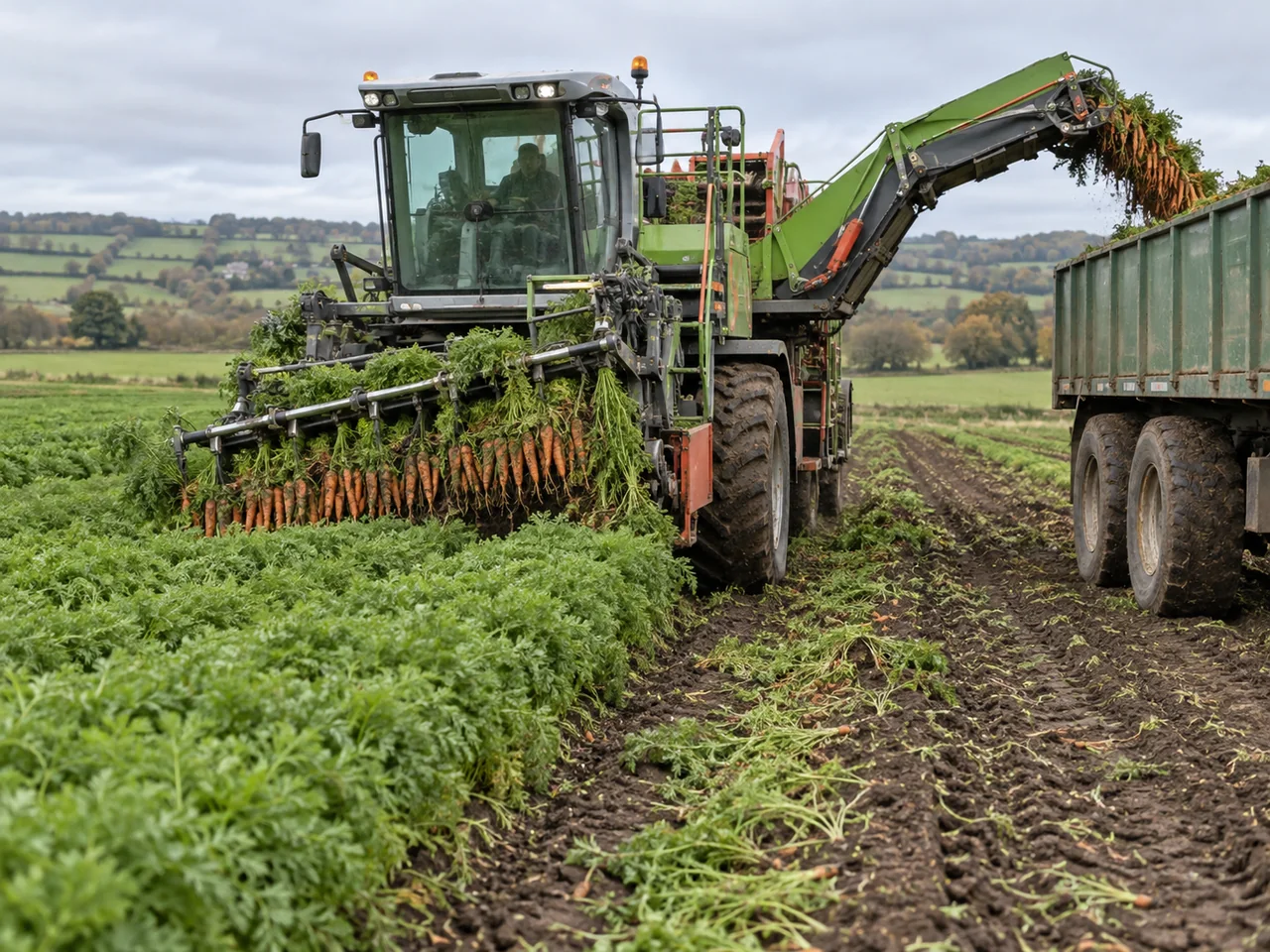
Lift and move the crop
The machinery is deliberately generic; harvester configurations vary. The 2025 Irish grower case reports using a self-propelled carrot harvester.
Read the 2025 Teagasc farm-walk booklet with its crop yield figure
Step 7 of 7 · Reference
Evidence and limits
The main calendar and soil details below come from a 2020 guide. The weather and input pressures are dated to the cited reporting periods; sector-level findings are not farm-level forecasts. Refresh agronomic and crop-protection guidance with current Irish sources before publication or operational use.
Visual note: The three fieldwork images on this page are AI-generated illustrations for orientation, not documentary photographs of a specific Irish farm or instructions for a particular machine. The soil and seed-depth diagrams are explanatory schematics; their roots and seed drawings are illustrative rather than field-scale.
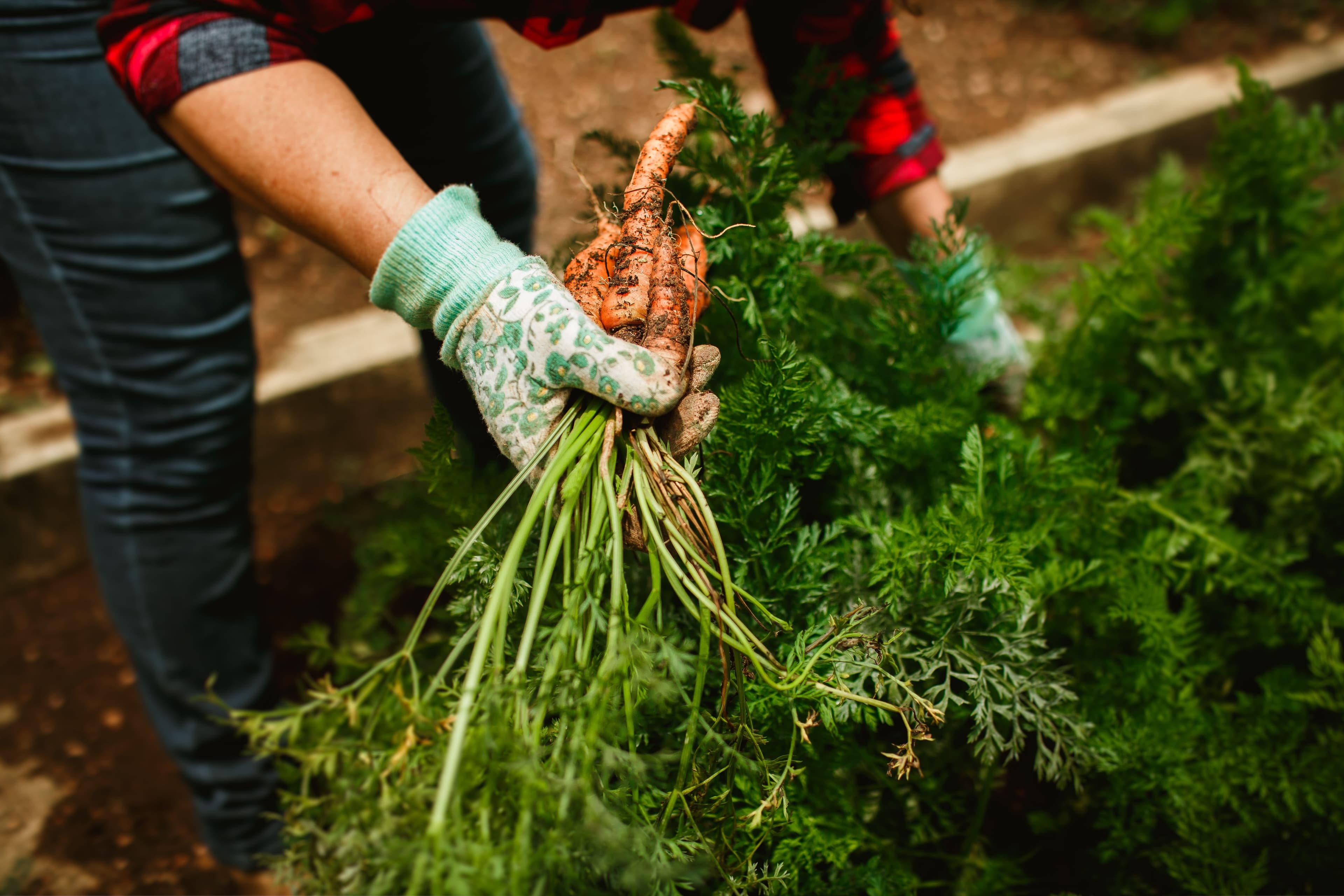
- Helena Lopes — carrot harvest photo via Pexels · used under the Pexels License; attribution is voluntary and included as a courtesy.
- Teagasc — Vegetable Production · national crop and season-extension context; accessed 23 September 2026.
- Teagasc — A Guide to Vegetable Growing, 9th edition · 2020, carrot section, pp. 144–145.
- Teagasc — Growing Organics Farm Walk, County Laois · July 2025; one farm’s organic carrot production settings.
- Teagasc — Input price inflation in the field-vegetable sector · 31 March 2025; period-specific and sector-level context.
- Teagasc — Horticulture Road Map 2030 · 2026 sector priorities.
- Teagasc — Emmett Dunne and Ó Duinn Organacha · 2025 grower case from County Laois.
This guide does not determine parcel suitability or provide a parcel-level crop budget, marketable-yield forecast, market price or return. The page remains noindex until the Irish search-intent and evidence-refresh reviews are complete.
Looking for home-garden instructions? Open the general carrot guide.