

Commercial field guide · California
Growing carrots in California
California is a major commercial carrot state, but it does not have one field calendar. This guide compares the production areas and gives growers a sourced checklist for soil, water, planting and market decisions.
For home growing, use our general carrot-growing guide.
Can carrots grow commercially in California?
Statewide crop contextYes. USDA NASS reported 51,000 California carrot acres harvested in 2024. UC’s commercial guide documents four production areas: the southern San Joaquin and Cuyama valleys, southern desert, high desert and central coast. That establishes a commercial crop context, not suitability for every field or business. See USDA’s 2024 state figures and UC ANR’s production guide.
California carrot planning starts with the production area, a workable and sufficiently uniform root zone, reliable water, a crop-protection plan, the right equipment, and a confirmed route to a buyer.
- Audience
- Commercial field growers
- Regional difference
- Four production areas with different documented calendars
- Limit
- No parcel-specific yield, margin or planting-date promise
Step 1 of 7 · Assess
Before planting: check the field and the crop plan
Use this checklist to organize discussions with a county crop adviser, agronomist, contractor or buyer. It tracks planning topics; it does not score land or predict crop performance.
6 topics still to verify· planning aid only, not a suitability score
Selections stay in this browser tab and are not saved or sent anywhere.
Step 2 of 7 · Plan
California carrot planting windows vary by production area
The commercial California guide separates four production areas. Select the closest area to see its source-published planting and harvest periods; these are historical regional ranges, not exact dates for a field or season.
Selected production area
Southern San Joaquin & Cuyama valleys
Winter–spring crop
Late-summer crop
These periods come from UC ANR Publication 7226. The UC ANR repository lists the guide as a 1997 publication. Treat the bands as a historical commercial reference and confirm current local advice before scheduling seed, labor or contracts.
How the climate engine fits
The engine compares 1996-01-01 to 2025-12-31 monthly means of ERA5-Land 0–7 cm soil-temperature estimates at one central California reference point with a controlled carrot seed study. The study tested 5–35°C and reported reduced germination at 5–10°C and above 30°C; the middle band is shown for comparison, not as an optimum. This does not cover all four production areas or establish a sowing recommendation. The point is not a statewide average, and reanalysis is not a field measurement.
Months when soil temperature fits carrot seed germination in California
Historical soil-temperature estimates place February–June, September–November inside the study's seed-germination reference range.
Soil-temperature window for carrot seed germination
Months inside the seed-germination range: February–June, September–November. This is a soil-temperature range, not a sowing calendar: frost, crop duration and harvest date set the real sowing window.
The carrot seed study found germination across 5–35°C, with slower or reduced germination at 5–10°C and above 30°C. Months above 10°C and at or below 30°C count as inside the range.
April: In seed-study range
- Monthly soil-temperature estimate
- 17.9°C
- Mean air temperature
- 16.7°C
- Historical years in estimate range
- 30 / 30
Where complete historical daily soil-temperature records are available, a month is included when at least half of its complete annual monthly means fall above 10 C and at or below 30 C. Otherwise the stored monthly soil-temperature normal is compared with that interval.
Reference period: 1996-01-01 to 2025-12-31 · Soil-temperature depth: 0-7 cm. Regional climate estimate from a representative location, not a farm measurement.
Evidence: Corbineau et al. (1995), carrot seed germination response to temperature and oxygen. This is a seed-temperature estimate, not a field emergence or yield prediction.
Step 3 of 7 · Prepare
Soil and seedbed: protect the root path
UC’s commercial guide describes the upper 30 inches (about 76 cm) as a uniform root zone without barriers and identifies silt loam as a favorable balance of drainage and water-holding capacity. It also links uneven wet–dry cycles with splitting. Treat these as field-inspection prompts from an older publication—not universal cutoffs—and check the profile, structure and irrigation plan in the actual field.
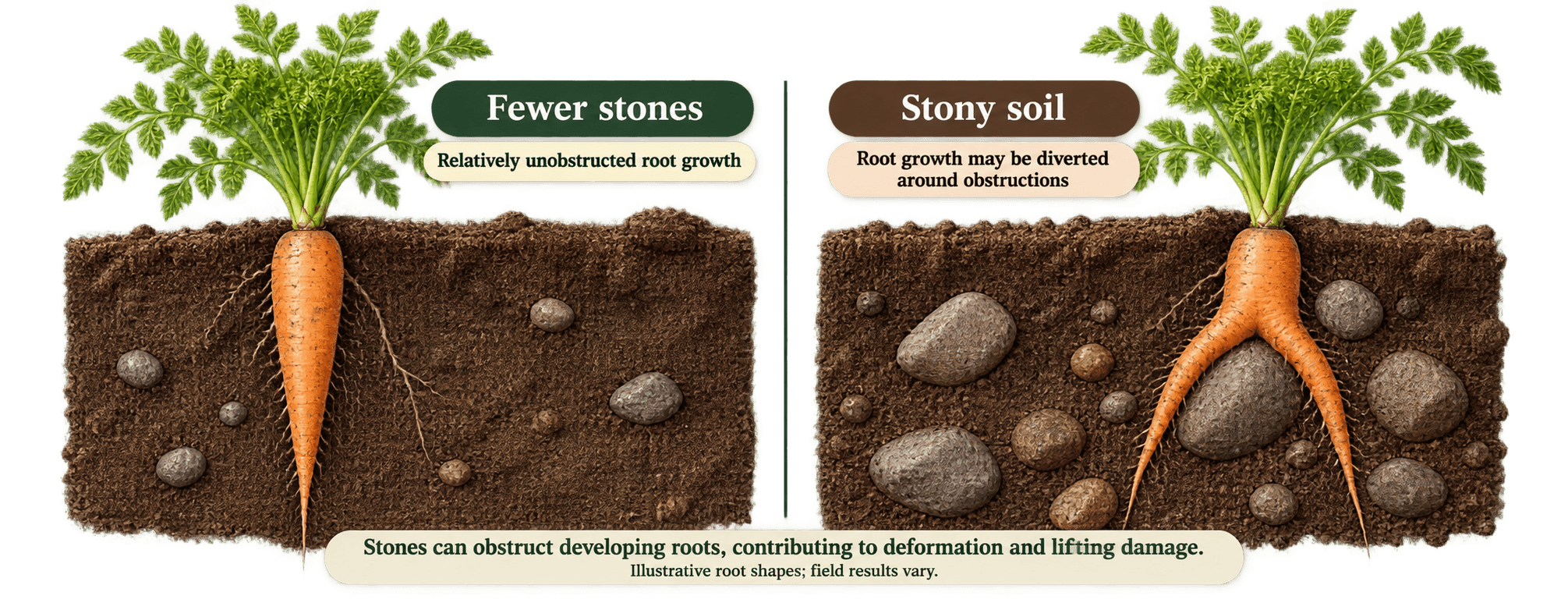
Source: UC ANR Publication 7226. Confirm present-day field preparation with a local commercial vegetable adviser.
Step 4 of 7 · Establish
Establish the crop: direct seed and match the bed to the market
California’s commercial guide describes carrots as direct-seeded. Its historical examples include 0.9–1.3 million seeds per acre and six- or eight-line layouts on 40-inch (about 102 cm) beds. It says seed is placed in a groove and lightly covered; it does not provide one current numeric sowing depth or final in-row spacing for every crop system.
What the source does document
- Establishment
- Direct-seeded in the field.
- Historical seed rate
- 0.9–1.3 million seeds per acre in the source’s original units.
- Bed example
- Six or eight lines on 40-inch (about 102 cm) beds; the source notes that cut-and-peel plantings may be denser.
What to confirm before setting the drill
- Current variety and seed-lot performance.
- Fresh-market, tops-on or processing buyer specification.
- Bed geometry, seed delivery and target stand for the chosen system.
- Numeric depth and in-row spacing from current local commercial advice.
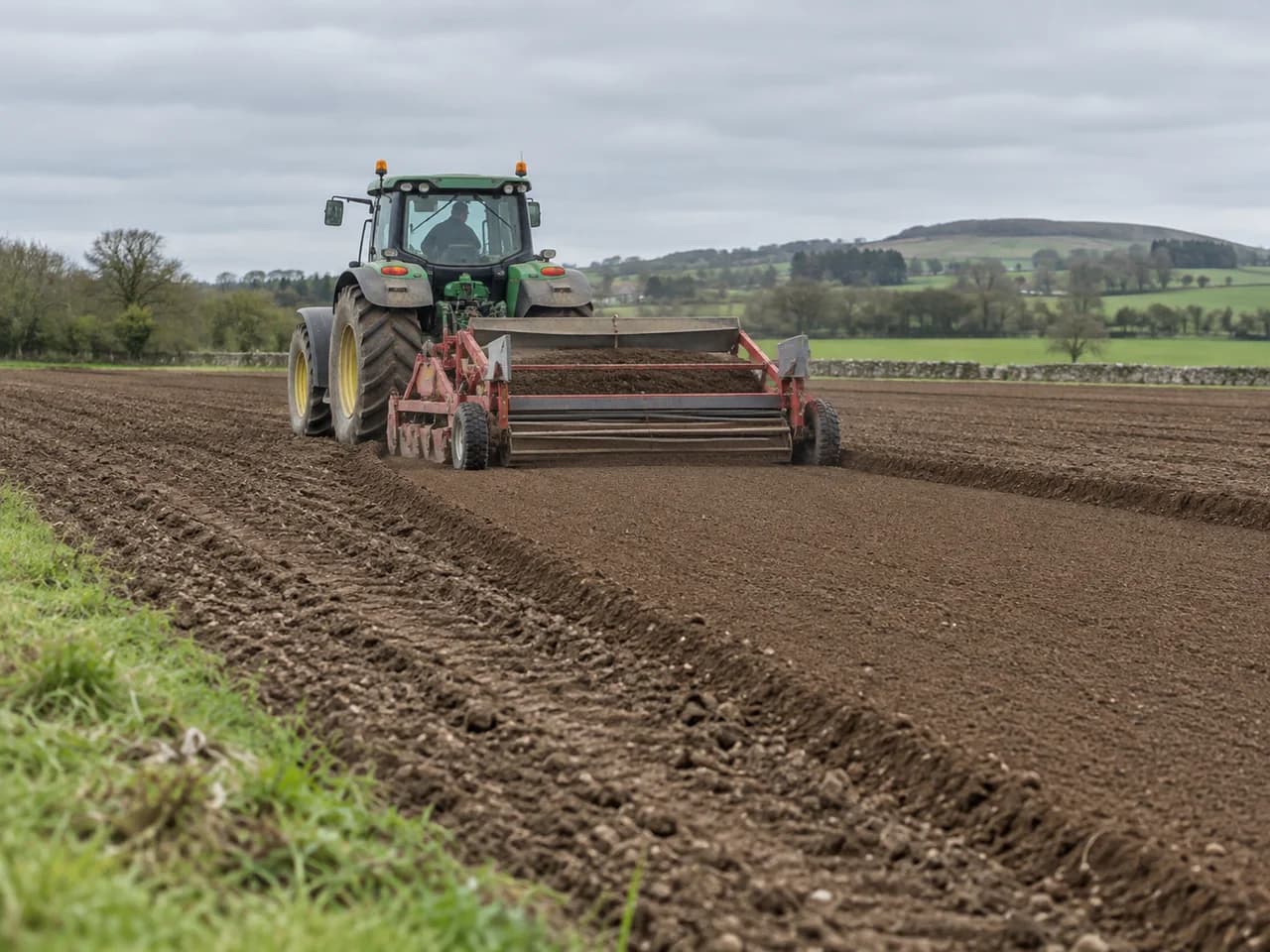
Prepare the field
Check the seedbed and the equipment plan against the field's soil structure and production system.
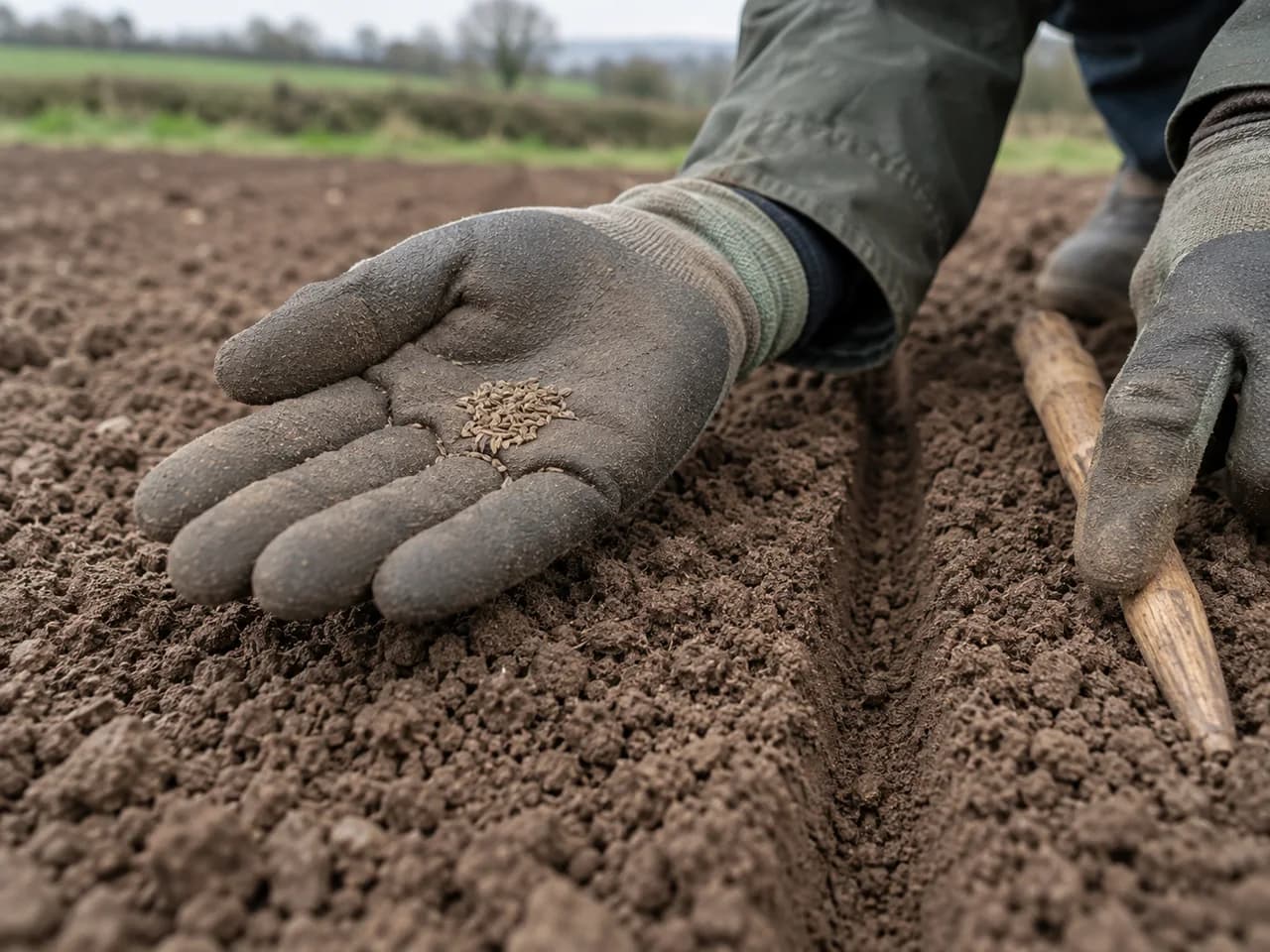
Sow carrot seed
Commercial carrots are established from seed; the correct drill setting depends on the current variety, seed lot and target market.
Source: UC ANR commercial production guide. Its published seed-rate acre/hectare conversion appears inconsistent, so this page keeps the original per-acre figure and does not supply a converted metric rate.
Step 5 of 7 · Manage
Season risks: water, nitrogen and root diagnosis
Low-desert water and nitrogen research
UC ANR reports that local trials and commercial-field observations in Imperial Valley improved the evidence on carrot water use and nitrogen uptake. The research summary reports that crop nitrogen uptake is generally low during the first 40–50 days. This is a low-desert finding, not a statewide fertilizer schedule.
Read the UC ANR research summaryDiagnose root injury before spending on control
A Kern County UCCE note explains that potato flea-beetle larval feeding can resemble cavity spot. Similar-looking symptoms can lead to a treatment aimed at the wrong cause, wasted input cost and continuing crop damage.
Read the Kern County diagnosis noteFor current pest and disease identification, use UC IPM’s agricultural carrot guidelines and a local crop adviser. This page does not name pesticide products or rates.
Step 6 of 7 · Harvest
Harvest, handling and route to market
Before planting, confirm the buyer, product specification, delivery window, grading and packing route, and who provides lifting and transport. California’s commercial guide describes staggered production periods across the state; statewide supply does not mean one field should be sown continuously.
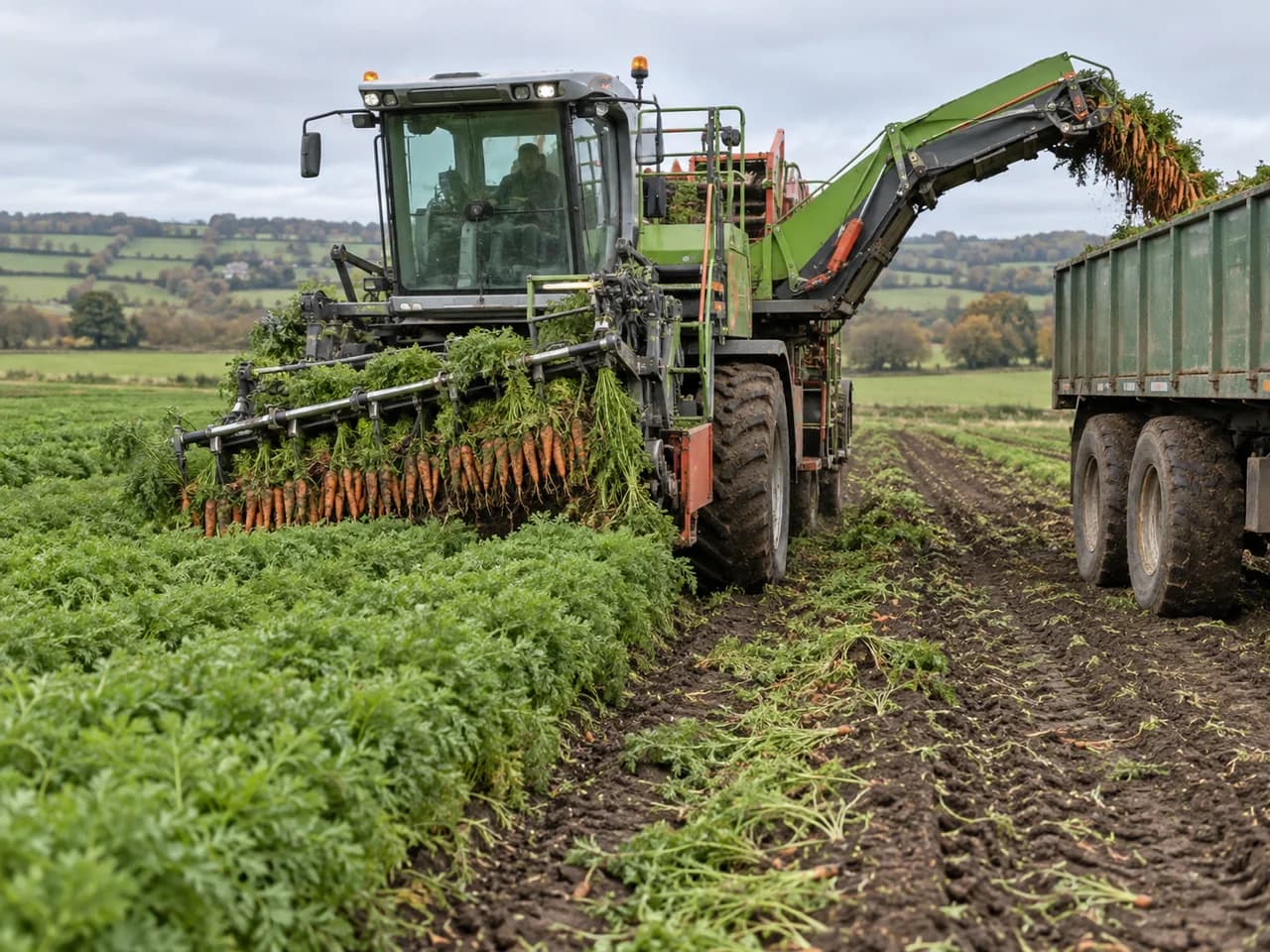
Plan lifting and handling
Match harvesting capacity and post-harvest handling to the chosen crop area, market and delivery schedule.
Questions for the buyer or contractor
- Which variety, grade and presentation are accepted?
- Who supplies and operates the harvester?
- What cooling, storage, packing and delivery timing is required?
- What happens to undersized, misshapen or damaged roots?
Step 7 of 7 · Reference
Evidence, image credits and limits
The page keeps old commercial calendar and establishment figures separate from newer low-desert research and current crop-protection guidance. None of these sources determines the condition of a specific field or guarantees an outcome.
- UC ANR — Carrot Production in California, Publication 7226 · peer-reviewed commercial guide; UC ANR repository dates its record to 1997, while UC eScholarship catalogs a 2008 version. Calendar, production-area and historical establishment context.
- USDA NASS — Vegetables 2025 Summary · published February 2026; reports 51,000 California carrot acres harvested in 2024.
- UC ANR repository record for Publication 7226 · source metadata and commercial-grower scope. UC eScholarship record · catalogs a 2008 version.
- UC ANR — California carrot water and nitrogen research summary · September 2021; Imperial low-desert research and commercial-field observations.
- Peer-reviewed Imperial Valley carrot water and nitrogen study · 2021; study results apply to the tested low-desert system.
- UC IPM — Agricultural Pest Management Guidelines: Carrot · current identification and management reference for commercial growers; check the date and label before acting.
- UC IPM — Cavity spot · describes the links between cool soil, excessive moisture, poor drainage, low spots, rain and pathogen presence; not a rainfall-only diagnosis.
- UCCE Kern County — carrot root injury and flea beetle diagnosis · regional diagnostic note on a look-alike root problem.
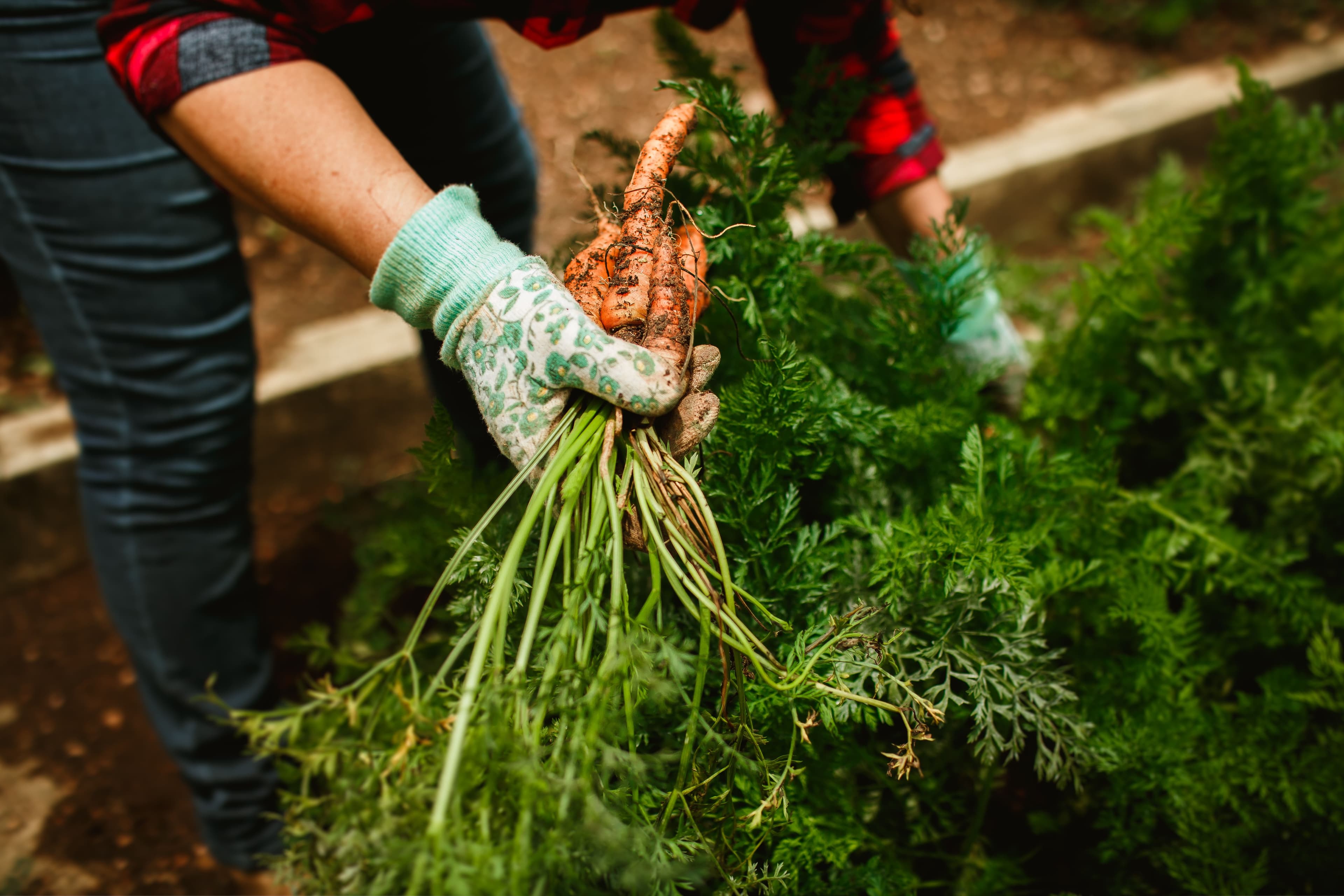
- Helena Lopes — harvest photograph via Pexels · included under the Pexels License; the image is illustrative and is not identified as a California farm.
- AgriAuditor-generated illustrations · field preparation, seed sowing, harvest and soil/root comparison assets; illustrative visuals only, not source evidence or field photographs.
The printed seed-rate conversion in the older production guide appears inconsistent between acres and hectares. This page retains the source’s original per-acre figure only. It does not provide a converted rate, a universal seed depth or a final in-row spacing recommendation.