

How to grow bread wheat commercially
Bread wheat is a seasonal cereal, but the production system changes by region: winter wheat is established ahead of winter, while spring wheat is planted for the shorter growing season. Choose the crop type, cultivar and sowing plan for local rainfall, frost, heat, soil and market requirements. Kansas, Ukraine and Australia examples should not be combined into one calendar.
Scope: General commercial field planning, using Kansas, Ukraine and Australian wheat as documented regional examples. Rates, dates, varieties and harvest systems must follow current local recommendations. Updated 2026-10-16.
At a glance
Planting and harvest calendar for Bread wheat
Use the source-backed production windows to coordinate establishment, crop care and harvest. Production districts and cultivars can have different cycles; the historical climate adds context for the field plan.
Planting: Sow by wheat type and local season1,2,3,4,5,6,7
There is no global wheat sowing month. Kansas and Ukrainian winter-wheat sources describe autumn sowing, while Australian winter wheat is commonly sown in autumn in the Southern Hemisphere. Spring wheat follows a different seasonal cycle. Select local variety, sowing zone, soil moisture and current extension guidance.
Harvest: Harvest when grain and field conditions are ready8,9,4,5,10
Harvest season follows local crop type, planting date and climate. Kansas and Ukraine harvest in summer in their Northern Hemisphere systems; Australian harvest moves across states from spring into summer. Use crop maturity, grain quality, weather and delivery capacity rather than a global month range.
Choose the wheat type, field and market
- 1
Identify the crop type
Confirm winter or spring wheat and the local adaptation zone.
- 2
Check the seasonal risk
Review rainfall, frost, heat and stored soil water.
- 3
Choose variety and market class
Match maturity, disease profile and buyer specification.
- 4
Plan operations
Align sowing, crop protection, harvest and grain delivery.
- Keep winter and spring wheat distinct
- Winter wheat and spring wheat do not share one sowing or harvest calendar. Kansas and Ukraine guidance address winter wheat in the Northern Hemisphere, while Agriculture Victoria and Australian sources describe autumn-sown winter cereals in the Southern Hemisphere. Use the local crop type and variety guide.1,11,4,5,7
Establish the stand for the local season
- 1
Read the local sowing guide
Use the zone, variety maturity and production goal.
- 2
Check seed quality
Use germination, seed size and lot purity in the rate calculation.
- 3
Check soil moisture
Place seed for reliable emergence without burying it too deep.
- 4
Verify the stand
Count plants and assess uniformity after emergence.
- Calculate seed rate from the target stand
- Seed size, germination, establishment, row spacing and sowing date all affect the seed rate. Kansas and Victorian sources give regional methods and ranges; calculate for the seed lot and local target rather than transferring kilograms per hectare or seeds per acre.2,14,7
- Place seed into suitable moisture
- Seed depth must balance moisture access with reliable emergence. Agriculture Victoria gives a local 25–50 mm range; Kansas guidance gives a separate typical depth. Soil texture, residue, moisture and coleoptile characteristics should determine placement on the farm.2,7
- Adjust for a late seasonal break
- If effective rain is late, revise variety maturity and production goals. Victorian guidance advises against forcing long-season types into a shortened window; local advice should account for stored water and field moisture.7
Manage nutrition, weeds and crop health
Prepare harvest, storage and delivery
Frequently asked questions
- When should wheat be planted?
- It depends on whether the crop is winter or spring wheat, the hemisphere, local sowing zone, rainfall and variety maturity. Use a current regional sowing guide rather than one global month.
- How deep should wheat seed be planted?
- Use local extension guidance and adjust for soil, residue, moisture and variety. Regional examples in Kansas and Victoria differ, so they should not be treated as one universal depth.
- How much wheat seed should I sow?
- Calculate from target plant population, seed size, germination, establishment and sowing date. A rate from one rainfall zone may not fit another.
- When is wheat harvested?
- Harvest follows crop type, region and maturity. It can occur in different seasons across hemispheres; check grain moisture, weather, storage and buyer requirements.
Regional guides and field planning
Sources and image credits
- 1. Kansas State University — Wheat planting: be cautious of planting too early — 27 August 2026. Optimum planting date zones in Kansas, early planting risks and wheat-free windows for wheat streak mosaic management.
- 2. Kansas State University — Wheat planting tips for good stand establishment — 10 September 2026. Seed placement, stand establishment and the relationship between moisture, date and winter survival.
- 3. The impact of sowing dates and seeding rates on the yield and grain quality of winter bread wheat in the Northern Steppe of Ukraine — 2025. Three-year Northern Steppe trial of four sowing dates and four seeding rates.
- 4. USDA FAS — Ukraine Wheat: Favorable Conditions across the Steppe Zone Prompt a Yield Increase (WAP 6-23) — June 2023. Winter wheat share of Ukrainian wheat and the typical planting and harvest windows.
- 5. Australian Government Department of Agriculture — Wheat — Accessed 7 October 2026. Australian wheat as a major winter crop, autumn sowing and spring/summer harvest; main producing states.
- 6. USDA Foreign Agricultural Service — Australia: Wheat Production — September 2023. Australian wheat production regions and state-level planting and harvest patterns, including Queensland and Western Australia timing.
- 7. Agriculture Victoria — Growing wheat in Victoria — Accessed 7 October 2026. Victorian maturity sequence, plant density and seed rate, seed depth, nutrition and crop-management guidance.
- 8. USDA NASS — 2025 State Agriculture Overview: Kansas — 2025 data; accessed 7 October 2026. Kansas planted and harvested winter wheat acres, yield and production.
- 9. USDA NASS — Crop Production 2024 Summary — 10 January 2025. Kansas winter wheat harvest progress in 2024, including acreage harvested by 14 July.
- 10. USDA Foreign Agricultural Service — Australia Grain and Feed Update — 2025. Typical Australian wheat planting April–June and harvest October–December; national timing varies by region and season.
- 11. USDA FAS — Ukraine Grain and Feed Annual (UP2026-0012) — 20 April 2026. Wheat area, production and yield for government-controlled areas, 2024/25–2026/27, fertiliser reliance and exports.
- 12. Kansas State University — Planning your wheat fertility program: start now with soil testing — 13 August 2026. Kansas soil sampling and fertility planning for wheat.
- 13. Kansas State University — Wheat in Kansas — Accessed 7 October 2026. Kansas winter wheat extension resources, production practices and local variety information.
- 14. Kansas State University — Management adjustments when planting wheat late — 1 October 2026. Kansas grain-only seeding rate ranges by rainfall zone and seed depth guidance.
Image credits
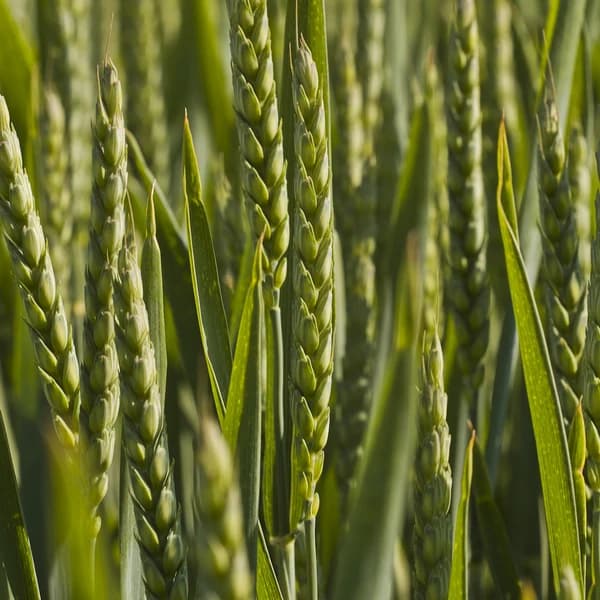
- Bread wheat. Photo: INRA DIST, via Wikimedia Commons (CC BY 2.0).
Figures are published averages or study assumptions for the places named, not guarantees for your field. Check current local recommendations and product labels before acting.
Some visuals in this guide are illustrations rather than photographs of a specific farm. See image credits.