

Growing black pepper in China
China’s black-pepper sector is concentrated in Hainan, with smaller production reported in Yunnan and Guangdong. This guide uses Hainan’s current commercial evidence and labels its field layout and seasonal events as local references, not a China-wide prescription.
Scope: Commercial Piper nigrum production, centered on documented Hainan practice. The cited calendar and mechanized layout are Hainan examples; other Chinese production areas require local guidance. Updated 2026-10-07.
At a glance
- Hainan production, reported 2025
- About 20,000 ha planted and 37,000 t produced; more than 85% of China’s area and output1
- Other reported Chinese production areas
- Yunnan and Guangdong4
- Mechanized Hainan layout example
- Two rows on a 5 m ridge; 2 m × 3 m plant/row spacing, plus a 2 m inter-ridge lane1
- Hainan phenology reference
- Main flowering September–November; harvest May–July3
Perennial growth and climate in China
A perennial planting remains in the field for multiple years. Establishment is a long-term investment; flowering, fruit development, harvest and plant care recur as the planting matures. Follow the named cultivar and production system.
Establish a long-lived planting2,3
The public summary of China’s current NY/T 969-2025 standard does not state a verified Hainan transplanting month. Establish a long-lived vine block with locally healthy planting material, suitable soil moisture, drainage and support structures; consult the full current standard and local extension service for nursery and planting requirements.
Management: Main flowering period in Hainan3
CATAS’s summary of the 2025 cultivation standard places Hainan’s main flowering in September–November. These are recurring crop-management months, not planting dates; cultivar and site can shift phenology.
Harvest: Hainan harvest period3
The same standard summary gives a May–July harvest, usually in 5–6 passes spaced 7–10 days apart, with harvest finished by the end of July. Confirm berry maturity and processing needs in each block.
Historical monthly climate
Reference period: 1996-01-01 to 2025-12-31. ERA5-Land monthly mean soil temperature at 0–7 cm, air temperature and frost days at the regional reference point (34, 113). Select a month to inspect its historical conditions.
Month tiles show mean air temperature.
September historical conditions
- Mean topsoil temperature
- 22.7°C
- Mean air temperature
- 22.0°C
- Mean frost days per month
- 0.0 days
Use this monthly history to assess winter exposure, seasonal heat and water planning. It does not calculate cultivar chill hours, flowering dates, frost damage during bloom or fruit maturity. Topsoil at 0–7 cm describes shallow soil context, not the full root zone. Harvest periods follow the production evidence above.
Climate source: Open-Meteo Historical Weather APIUse Hainan evidence within its proper scope
- Hainan share of planted area85–100 %More than 85%, per the provincial report
- Hainan share of output85–100 %More than 85%, per the provincial report
- Separate Hainan from the national map
- Hainan’s agriculture department reported roughly 300,000 mu planted and 37,000 tonnes produced in 2025, representing more than 85% of China’s area and output. The same official source identifies Yunnan and Guangdong as other production areas; Hainan timing should not be assigned to those regions.1,4
Plan the supported vine block and equipment lanes
Between rows: 3 m between rows · Within the row: 2 m between plants
Bed spacing: Two rows on a 5 m ridge
The reported mechanized layout places vines 1 m from the ridge edge and uses a 2 m narrow inter-ridge lane. It is one Hainan field system, not a universal spacing prescription; adapt it to terrain, machinery, trellis and local standard.
- Build support and access into the design
- Black pepper is trained as a perennial vine. The 2025 standard summary describes tying selected main vines to supports once new growth reaches three to four nodes, then repeating ties during framework establishment. The Hainan layout is explicitly a mechanized demonstration example.1,3
Manage moisture, nutrition and vine health
- 1
Check soil moisture
Keep establishment moisture adequate without leaving standing water.
- 2
Clear drainage before heavy rain
Remove excess water promptly and keep field lanes passable.
- 3
Tie and train main vines
Follow the support system and current standard for the selected block.
- 4
Scout disease and pests
Inspect for foot/root rot, leaf spot, nematodes and wilt; remove diseased material carefully.
- Do not copy a fertilizer rate without its context
- CATAS’s explainer summarizes age-specific fertigation amounts from the 2025 Chinese standard. Those rates depend on the source’s input definitions and local production context; use the full standard, soil and plant diagnosis, and local advice rather than treating them as a blanket schedule.3
- Keep disease controls current
- The standard summary names Phytophthora foot and root rot, bacterial leaf spot, root-knot nematodes, mosaic and wilt. Its hygiene measures include drainage, clean planting stock, avoiding vine and root injury and removing diseased debris. Pesticide choices must follow current Chinese registrations and labels.3
Harvest by berry maturity and process promptly
- 1
Inspect berry color on each spike
Use the maturity stage suited to the planned black- or white-pepper process.
- 2
Schedule repeated passes
The standard summary describes 5–6 harvest passes, 7–10 days apart.
- 3
Keep harvested spikes clean
Protect the crop from contamination during collection and transport.
- 4
Process promptly
The standard summary advises same-day processing; Hainan sources document traditional and mechanized systems.
- Treat export figures as dated local examples
- A 2026 Hainan government report says Dapo exported 1,000 tonnes to the Middle East in 2025. This is evidence of one local trade channel, not a national export total or a guaranteed outlet for new production.6
Frequently asked questions
- Where is black pepper grown commercially in China?
- A 2025 Hainan provincial report says Hainan accounts for more than 85% of Chinese planted area and output. Other official material identifies Yunnan and Guangdong as production areas.
- When does black pepper flower and harvest in Hainan?
- The CATAS summary of China’s current standard gives main flowering in September–November and harvest in May–July. These are Hainan phenology references, not planting dates.
- What spacing is used for Hainan black pepper?
- One documented mechanized layout uses two rows on a 5 m ridge, 2 m between plants, 3 m between rows and a separate 2 m inter-ridge lane. Adapt it to the field and machinery.
- Can Hainan’s black-pepper schedule be used across China?
- No. The page centers on Hainan; Yunnan and Guangdong have different local conditions and need region-specific guidance.
- How often is black pepper harvested in the Hainan example?
- The 2025 standard summary describes five to six passes, seven to ten days apart, with harvesting completed by the end of July.
Regional black pepper guides
Local dates, soil-temperature history and sources for specific regions:
Sources and image credits
- 1. Hainan Provincial Department of Agriculture and Rural Affairs — 2025 black-pepper industry and mechanization report — 2025. Hainan area, output, China share, mechanized ridge layout and production challenges.
- 2. State Administration for Market Regulation — NY/T 969-2025 cultivation standard record — Effective 2025-05-01. Official record for the current national pepper cultivation technical code; it replaced NY/T 969-2013.
- 3. CATAS Spice and Beverage Research Institute — NY/T 969-2025 technical summary — 2025. Accessible summary of establishment, vine care, Hainan and Yunnan phenology, water, disease and harvest guidance.
- 4. Hainan Provincial Department of Agriculture and Rural Affairs — Chinese pepper production areas — 2024. Identifies Hainan, Yunnan and Guangdong as Chinese production areas.
- 5. Hainan Provincial Department of Agriculture and Rural Affairs — pepper processing overview — 2023. Dated local black, white and green pepper processing context.
- 6. Hainan Provincial Department of Agriculture and Rural Affairs — Dapo export example — 2026 report on 2025 exports. One local export example; not a national trade statistic.
- 7. CATAS Spice and Beverage Research Institute — Qionghai field demonstration — Accessed 7 October 2026. Reyin 1 cultivar use at a local demonstration site; not a national cultivar recommendation.
- 8. Hainan DB46/T 630-2024 — official standard record — 2024. Official record for the Hainan pepper full-chain standard; full technical text was not quoted.
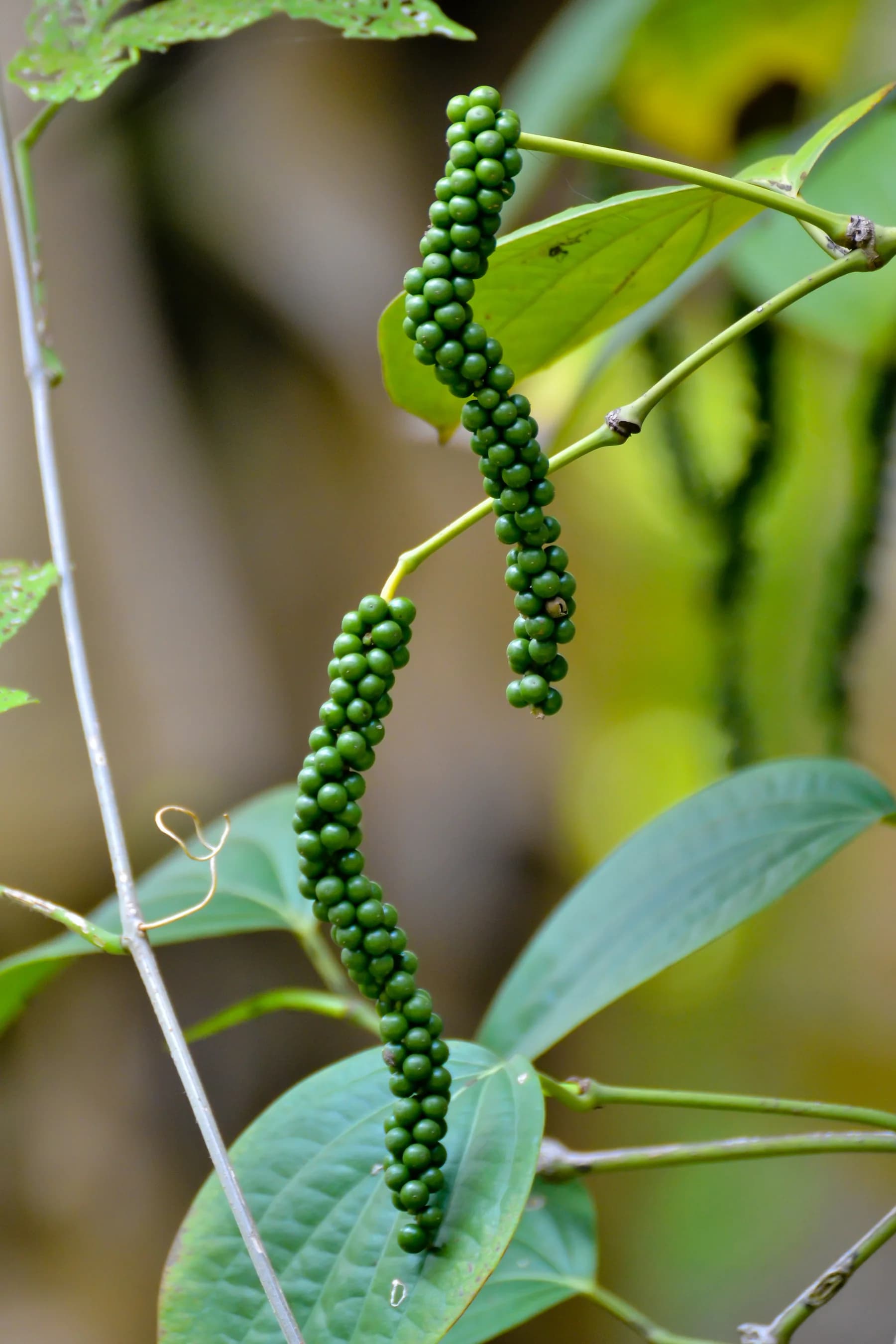
- 9. Black-pepper photograph — K Hari Krishnan — CC BY-SA 3.0. Unripe black-pepper fruit in Kerala, India. Photo: K Hari Krishnan, CC BY-SA 3.0; resized under the same license. Crop reference, not a photograph of the named region.
- 10. Black-pepper photograph license — CC BY-SA 3.0. Reuse terms for the credited photograph; resizing is noted in its caption.
Image credits
- Unripe black-pepper fruit in Kerala, India. Photo: K Hari Krishnan, CC BY-SA 3.0; resized under the same license. Crop reference, not a photograph of the named region.
Figures are published averages or study assumptions for the places named, not guarantees for your field. Check current local recommendations and product labels before acting.