

Black pepper farming in California: site feasibility
Before investing in black pepper in California, confirm that your planting stock is Piper nigrum and assess the site for this tropical perennial vine. California chile-pepper recommendations concern Capsicum and cannot establish a black-pepper production plan. Use a monitored local trial to evaluate survival, flowering, yield, disease and buyer demand before expanding.
Scope: California-specific commercial field feasibility for Piper nigrum. Tropical production guidance from other regions is not treated as California-tested practice. Updated 2026-10-07.
At a glance
Perennial growth and climate in California
A perennial planting remains in the field for multiple years. Establishment is a long-term investment; flowering, fruit development, harvest and plant care recur as the planting matures. Follow the named cultivar and production system.
Establish a long-lived planting1,2,3
No California-specific commercial establishment window or field protocol was found in the reviewed sources. Before investment, seek county-level university or extension assessment and document winter temperature, humidity, water, protected-production needs, disease pressure and market access in a monitored local trial.
Historical monthly climate
Reference period: 1996-01-01 to 2025-12-31. ERA5-Land monthly mean soil temperature at 0–7 cm, air temperature and frost days at the regional reference point (37, -120). Select a month to inspect its historical conditions.
Month tiles show mean air temperature.
January historical conditions
- Mean topsoil temperature
- 8.9°C
- Mean air temperature
- 9.4°C
- Mean frost days per month
- 3.5 days
Use this monthly history to assess winter exposure, seasonal heat and water planning. It does not calculate cultivar chill hours, flowering dates, frost damage during bloom or fruit maturity. Topsoil at 0–7 cm describes shallow soil context, not the full root zone. The monthly history does not establish a local flowering, maturity or harvest period.
Climate source: Open-Meteo Historical Weather APIKeep black pepper separate from chile pepper
- 1
Confirm the crop identity
Black pepper is Piper nigrum, a tropical perennial vine; chile pepper is Capsicum annuum.
- 2
Select a specific county and site
California includes multiple climate regions; assess the actual field or protected structure.
- 3
Find locally evaluated planting material
Do not assume tropical varieties or support systems have been tested in California.
- 4
Run a measured production trial
Track plant survival, growth, flowering, fruit set, disease, yield, labor and buyer interest.
- Do not use the wrong crop’s guide
- UC ANR’s California manual called “Chile Pepper Production” is about Capsicum annuum. It cannot support planting or management recommendations for the black-pepper vine Piper nigrum.1
- Read the climate panel as context only
- California’s official adaptation strategy divides the state into nine climate regions. A statewide representative point cannot establish conditions for every county, elevation, coastal zone or protected site.2
Treat tropical requirements as research questions
- Do not import another region’s thresholds
- Singapore NParks describes Piper nigrum as a tropical vine, and Tamil Nadu Agricultural University describes humid-tropics conditions. Those sources provide species context, not evidence that a California field meets a commercial crop threshold.3,4
- No California spacing or calendar is verified
- The reviewed material did not establish California-specific cultivar choice, trellis spacing, establishment dates, irrigation, yield, harvest months or a market chain. Absence of a guide is not proof that no experimental plants exist, but it is not enough to prescribe a commercial system.1,2
Build a local evidence package before scaling
- 1
Record site climate
Measure seasonal temperature, humidity, wind and cold events at the plot.
- 2
Characterize water and soil
Test drainage, irrigation supply, water quality and root-zone conditions.
- 3
Track vine performance
Measure survival, support needs, flowering, fruit set and disease over multiple seasons.
- 4
Confirm economics
Document labor, energy or protected-culture costs, processing and buyer specifications.
- Use a county-level review
- A California pilot should be reviewed with the local Cooperative Extension office and qualified crop specialists before planting commercial acreage. Evaluate open-field and protected-site assumptions separately.2
Frequently asked questions
- Is black pepper grown commercially in California?
- The sources reviewed did not identify a California commercial field guide, trial or production statistic for Piper nigrum. That does not rule out individual experimental plants.
- Is California chile-pepper guidance relevant to black pepper?
- No. UC ANR’s California chile-pepper manual covers Capsicum annuum, while black pepper is Piper nigrum.
- Can tropical black-pepper spacing be used in California?
- The sources reviewed do not validate a California trellis or field layout. Assess the chosen county, cultivar, protected-production needs and machinery before designing a pilot.
- When should black pepper be planted in California?
- No locally verified commercial establishment month was found. Ask county-level crop specialists to assess a specific site before planting.
- Does the climate chart prove that California can or cannot grow black pepper?
- No. It shows historical conditions at one representative location and cannot establish performance across California’s diverse climate regions.
Regional black pepper guides
Local dates, soil-temperature history and sources for specific regions:
Sources and image credits
- 1. UC ANR — Chile Pepper Production in California — Accessed 7 October 2026. Clarifies that the California production manual concerns Capsicum annuum, not Piper nigrum.
- 2. California Climate Adaptation Strategy — regional summaries — Accessed 7 October 2026. State climate diversity and regional context; not black-pepper production evidence.
- 3. Singapore National Parks Board — Piper nigrum profile — Accessed 7 October 2026. Species identity and tropical-vine context; not California field guidance.
- 4. Tamil Nadu Agricultural University — black-pepper cultivation — Accessed 7 October 2026. General humid-tropics context only; not a California-tested crop threshold or practice.
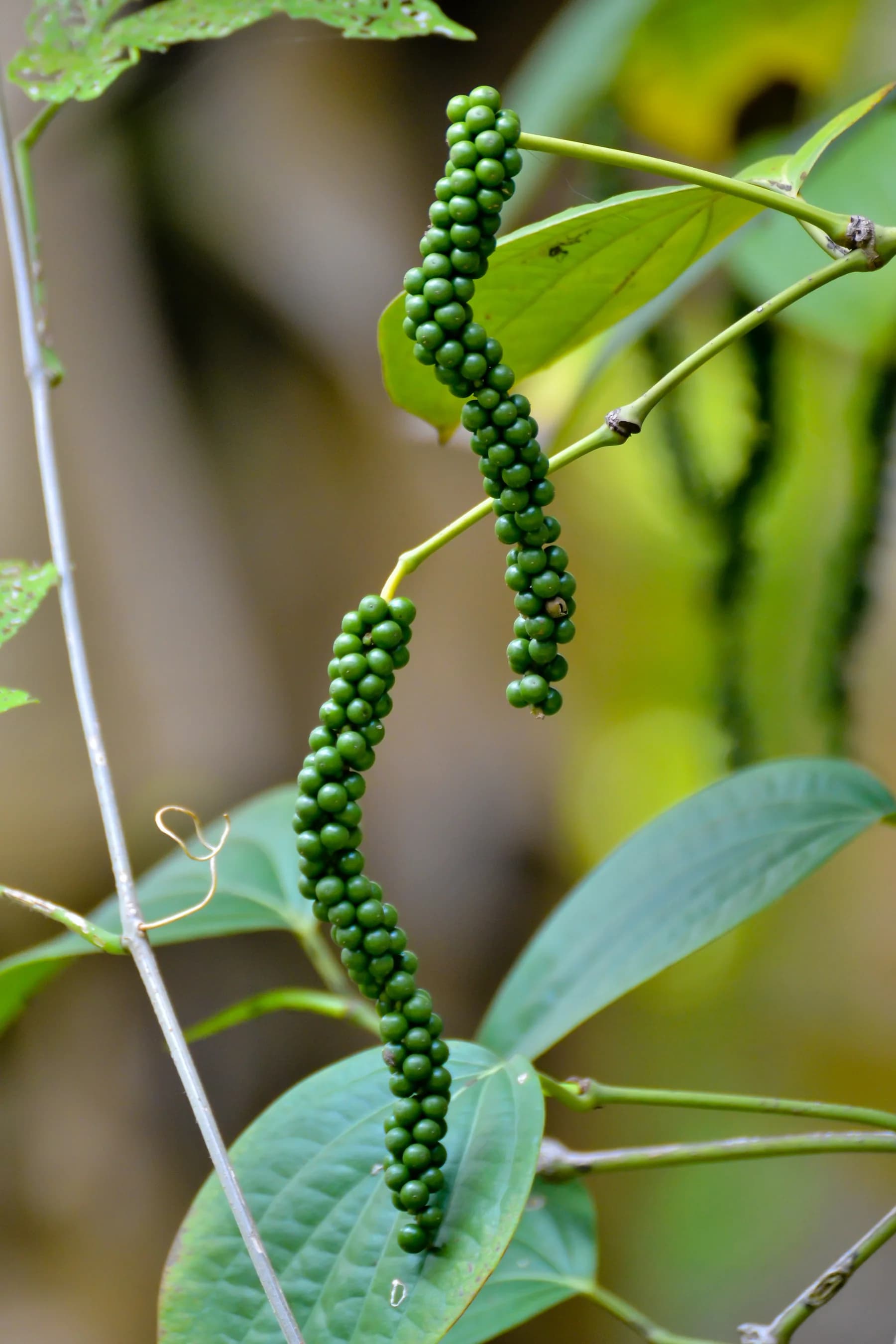
- 5. Black-pepper photograph — K Hari Krishnan — CC BY-SA 3.0. Unripe black-pepper fruit in Kerala, India. Photo: K Hari Krishnan, CC BY-SA 3.0; resized under the same license. Crop reference, not a photograph of the named region.
- 6. Black-pepper photograph license — CC BY-SA 3.0. Reuse terms for the credited photograph; resizing is noted in its caption.
Image credits
- Unripe black-pepper fruit in Kerala, India. Photo: K Hari Krishnan, CC BY-SA 3.0; resized under the same license. Crop reference, not a photograph of the named region.
Figures are published averages or study assumptions for the places named, not guarantees for your field. Check current local recommendations and product labels before acting.