

Growing beetroot in Australia
Australia’s beetroot supply includes Queensland fresh-market production and inland processing crops. Cowra and Hillston in New South Wales provide field examples for sowing, bed layout and harvest planning. Match those practices to your district, fresh or processing market, soil and machinery before using them on your farm.
Scope: Commercial table beet for fresh and processing markets. National market figures are dated to 2023/24; detailed operational examples are from inland New South Wales. Updated 2026-10-07.
At a glance
- Australian production, year ending June 2024
- 17,300 t of beetroot, valued at A$16.9 million1
- Reported market split
- About 60% processing and 37% fresh supply in the 2023/24 handbook1
- Historical Queensland share
- 85% of reported national production in year ending June 2020; not a current share2
- Cool-season temperature context
- The 2012 review cites mean daily conditions around 15–19°C as favorable for many varieties3
- Cowra trial bed examples
- 1.5 m flat bed with 3 rows at 37 cm; or 0.76 m raised bed with 2 rows3
Planting and harvest calendar for Australia
Use the source-backed production windows to coordinate establishment, crop care and harvest. Production districts and cultivars can have different cycles; the historical climate adds context for the field plan.
Planting: Historical Cowra/Hillston sowing example4
A 2013 NSW DPI processing budget records direct seeding from mid-January to early March in inland Cowra/Hillston systems. This is an old regional processing example, not a current schedule for Queensland or all Australian farms. Use the crop’s cool-season response, local forecast, irrigation and buyer program to set a field date.
Harvest: Historical Cowra/Hillston processing harvest4,3
The same budget places harvest around April–May after about 14–18 weeks. Trial observations varied from 105–140 days with season and target root size. Harvest to measured size and processor grade, not a fixed date.
Historical monthly climate
Reference period: 1996-01-01 to 2025-12-31. ERA5-Land monthly mean soil temperature at 0–7 cm, air temperature and frost days at the regional reference point (-34.5, 147). Select a month to inspect its historical conditions.
Month tiles show mean topsoil temperature.
January historical conditions
- Mean topsoil temperature
- 29.1°C
- Mean air temperature
- 25.7°C
- Mean frost days per month
- 0.0 days
These are monthly means at one reference location. They describe seasonal field conditions, not crop maturity, actual seed-zone conditions, frost forecasts or a planting recommendation. Harvest bands follow the crop-specific production sources above.
Climate source: Open-Meteo Historical Weather APIMatch the production system to the buyer
- National production17,300–17,300 tonnesIndustry handbook estimate
- Processing allocation (approx.)10,380–17,300 tonnesAbout 60% of reported supply
- Fresh allocation (approx.)6,401–17,300 tonnesAbout 37% of reported supply
- Keep national market data in date
- Hort Innovation’s 2023/24 handbook reports 17,300 t and A$16.9 million for the year ending June 2024, with about 60% allocated to processing and 37% to fresh supply. These industry totals are not a census of every farm or a current price forecast.1
- Separate Queensland fresh markets from inland processing
- A 2021 industry review attributes 85% of year-ending-June-2020 production to Queensland, especially the Lockyer and Fassifern valleys, and describes year-round fresh supply. Treat those production shares as 2020 data. The detailed processing layout and calendar in this guide come from inland NSW.2,3,4
Plant for cool, steady growth
- 1
Choose the market
Set a fresh-market or processor target before selecting seed and harvest equipment.
- 2
Prepare the seedbed
Use a fine, uniform seedbed and calibrate the precision seeder.
- 3
Maintain even moisture
Avoid prolonged dryness, waterlogging and uneven emergence.
- 4
Measure root size
Schedule lifting from the crop and buyer specification.
- Use the temperature range as context
- The 2012 NSW research review describes beetroot as a cool-season crop and cites mean daily temperatures around 15–19°C as favorable for many varieties; it says conditions above 25°C can reduce root size. These are crop-response references, not a soil-temperature threshold or planting-date rule.3
- Read the historical climate chart carefully
- The monthly record shows air and shallow-soil means at one representative point. It does not classify beetroot planting as feasible or infeasible because the reviewed commercial sources do not provide a validated seed-zone threshold for that test.3
Treat Cowra layouts as mechanized trial examples
Between rows: 1.5 m bed centres · Within the row: 37 cm between rows
Bed spacing: Three rows on a flat bed
Commercial farm trial layout. The study compares systems; this is not a universal Australian spacing prescription.
Between rows: 0.76 m raised bed · Within the row: Two rows, 10 cm from bed edges
Bed spacing: 15 cm bed height
A separate study farm used this bed system. Match bed shape, seeder and harvester to field conditions and target root size.
- Fit row geometry to machinery
- Cowra trials compared a 1.5 m flat bed with three 37 cm rows against a 0.76 m raised bed with two rows near the bed edges. Results varied by system and desired processing size; the report recommends fitting row spacing to the planter and harvester.3
- Do not copy old input budgets
- The 2013 budget includes historical water and input-cost assumptions. Rebuild the budget with current irrigation, labor, fuel, seed, factory or packhouse terms and farm-specific field records.4
Keep emergence and root growth even
- Avoid moisture swings
- The Cowra trials describe uniform moisture as helpful for establishment and steady growth, while waterlogging and prolonged dryness can harm emergence and root development. The cooperating farms managed irrigation under their own systems, so the trial does not provide a transferable schedule.3
- Use water and nutrient tests
- The 2013 inland NSW budget estimated 4–6 ML/ha water use and listed several fertilizer inputs, but it is not a current soil-test-based program. Use field soil and water tests and current local agronomy advice; do not copy old rates.4
Lift to grade and protect processing quality
Frequently asked questions
- Where is commercial beetroot grown in Australia?
- The sources describe Queensland as a major fresh-market production state and also document processing production in inland NSW and other districts. The detailed planting and layout examples here are from Cowra/Hillston, not a national production schedule.
- When do farms sow beetroot in Australia?
- The historical Cowra/Hillston processing budget gives mid-January to early March. It is not a current schedule for Queensland or every Australian production area.
- What temperature suits beetroot?
- A 2012 research review cites mean daily temperatures around 15–19°C as favorable for many varieties and notes reduced root size above 25°C. These air-temperature references do not establish a seed-zone planting threshold.
- How are commercial beetroot rows laid out?
- A Cowra study compared a 1.5 m flat bed with three 37 cm rows and a separate 0.76 m raised bed with two rows. Fit spacing to the planter, harvester, soil and target market.
- How much water does beetroot need in Australia?
- The historical Cowra/Hillston budget used 4–6 ML/ha, while trials described irrigation managed under each farm’s normal practice. Use current field water balance and local advice rather than treating the old budget as a prescription.
Regional beetroot guides
Local dates, soil-temperature history and sources for specific regions:
Sources and image credits
- 1. Hort Innovation — Australian Horticulture Statistics Handbook 2023/24, vegetables — 2023/24 edition; year ending June 2024. Australian beetroot production value, production volume and reported fresh/processing supply allocation.
- 2. Hort Innovation — Beetroot Strategic Agrichemical Review Process — August 2021; production shares refer to 2020. Historical Queensland production share and supply seasonality context; not a current agronomy or crop calendar.
- 3. NSW DPI / Horticulture Australia — Beetroot Stand Management, project VG06117 — Published 2012; field trials 2008–2011. Cool-season response context, Cowra commercial stand/layout trials, soil moisture and harvest observations.
- 4. NSW DPI — Beetroot processing gross margin budget — 2013 budget using historical 2012 prices. Cowra/Hillston sowing, harvest, water and processing examples; not current national guidance or prices.
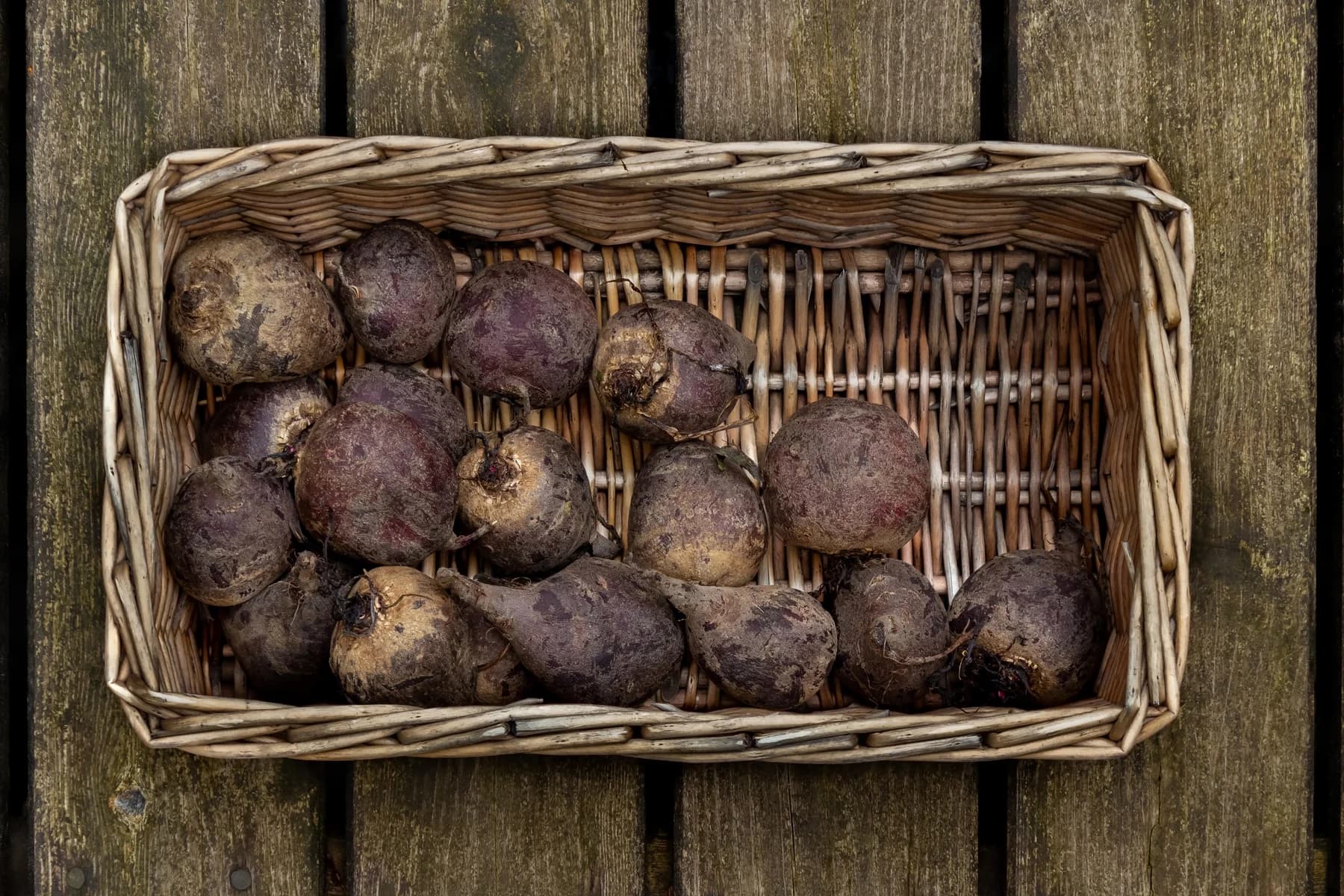
- 5. Beetroots in a basket — W.carter — Photographed October 5, 2021; CC BY-SA 4.0. Newly harvested Beta vulgaris in Tuntorp, Sweden. The source is focus-stacked and retouched; this resized derivative retains CC BY-SA 4.0. Not a photograph of Australian or Spanish production.
- 6. Beetroot photo license — CC BY-SA 4.0 — Creative Commons Attribution-ShareAlike 4.0. The resized W.carter photograph retains this license.
Image credits
- Newly harvested beetroot in Tuntorp, Sweden. Photo: W.carter, CC BY-SA 4.0; resized under the same license. Harvested-crop reference, not a local field or grading standard.
Figures are published averages or study assumptions for the places named, not guarantees for your field. Check current local recommendations and product labels before acting.