

Growing common bean in Australia
The crop record identifies Phaseolus beans, and Australian commercial evidence supports fresh-pod green beans rather than faba beans. Queensland is the clearest production center in the reviewed sources, with different subtropical seasons; the guide keeps regional records separate from a national planting calendar.
Scope: Commercial fresh-pod common bean (Phaseolus vulgaris) in Australia. Dry bean and faba bean systems are not combined with green-bean production. Updated 2026-10-07.
At a glance
Planting and harvest calendar for Australia
Use the source-backed production windows to coordinate establishment, crop care and harvest. Production districts and cultivars can have different cycles; the historical climate adds context for the field plan.
Planting: Regional planting window not established1,2,3,4
Plan dates with local crop advice and field observations in Australia. No region-wide month band is shown here. The historical climate tiles describe one reference location and cannot determine when your field is ready for planting or harvest.
Historical monthly climate
Reference period: 1996-01-01 to 2025-12-31. ERA5-Land monthly mean soil temperature at 0–7 cm, air temperature and frost days at the regional reference point (-34.5, 147). Select a month to inspect its historical conditions.
Month tiles show mean topsoil temperature.
January historical conditions
- Mean topsoil temperature
- 29.1°C
- Mean air temperature
- 25.7°C
- Mean frost days per month
- 0.0 days
These are monthly means at one reference location. They describe seasonal field conditions, not crop maturity, actual seed-zone conditions, frost forecasts or a planting recommendation. Harvest bands follow the crop-specific production sources above.
Climate source: Open-Meteo Historical Weather APIChoose fresh-pod or processing production
- 1
Specify fresh or processing use
Confirm pod type, size and harvest method.
- 2
Select regional variety
Trial new cultivars alongside the local standard.
- 3
Schedule planting by district
Queensland production seasons differ between subtropical regions.
- 4
Book a buyer route
Match expected harvest dates and volume to demand.
- Secure the buyer and product type first
- Queensland industry research describes most Australian production as fresh domestic supply, with production also for processing. Cultivar, harvest frequency, field cleanliness and delivery schedule depend on the buyer; the 2017–18 production baseline is historical rather than a current market total.1
Manage temperature risk through pod fill
- 1
Record sowing and emergence
Track dates, cultivar and field location.
- 2
Estimate flowering and pod fill
Use crop records to identify the heat-sensitive period.
- 3
Monitor temperature
Compare local conditions with the Queensland crop threshold source.
- 4
Review yield response
Use farm harvest data to adjust the next planting.
- Heat timing matters more than a statewide month band
- A 2025 Queensland analysis modeled sowing dates, phenology, weather and fresh yield; it found lower yield associations with high temperatures during pod fill. The 18–25°C range is a crop threshold reference, not a monthly planting-feasibility map for all Australian regions.2,3
Build the layout around local equipment
- 1
Check soil and drainage
Use local field history and soil tests.
- 2
Calibrate the planter
Match seed rate and row plan to cultivar and machinery.
- 3
Schedule water
Use local soil-moisture monitoring, especially around flowering and pod fill.
- 4
Scout crop health
Record disease, pest and weather events by block.
- No universal Australian spacing was verified
- The reviewed sources establish crop geography, temperature risk and yield modeling, but do not form a complete national recommendation for row spacing, plant population, irrigation and fertility. Follow current state extension or replicated local trials for the intended field system.1,2,3
Predict and protect the harvest window
- 1
Sample pods before harvest
Check size, tenderness and buyer specification.
- 2
Coordinate labor
Align crew and machinery with expected picking dates.
- 3
Cool and move quickly
Protect fresh quality along the delivery route.
- 4
Compare predicted and actual harvest
Refine farm phenology records season by season.
- Use local maturity records, not a national date
- The 2025 study demonstrates harvest-time prediction from local crop and weather records. It does not validate a universal Australian harvest month. Pick to pod maturity and buyer requirements, and keep labor and cooling capacity aligned with a short, perishable harvest.2
Frequently asked questions
- Which beans does this Australian guide cover?
- It covers fresh green common beans, Phaseolus vulgaris. Dry beans and faba beans (Vicia faba) are separate systems.
- Where are green beans grown in Australia?
- The reviewed 2017–18 industry baseline identifies Queensland as the largest production state, with production also in Tasmania and Victoria. The figures are dated.
- What temperature is suitable for green beans?
- A Queensland crop-threshold guide gives 18–25°C as an optimal growth range. Crop stage and local conditions still matter; this is not a nationwide monthly planting calendar.
- When should green beans be planted in Australia?
- The Queensland evidence describes different regional seasons. Use current state and district advice, cultivar, buyer schedule and crop-stage heat risk rather than one national month.
Regional common bean guides
Local dates, soil-temperature history and sources for specific regions:
Sources and image credits
- 1. Queensland Department of Agriculture and Fisheries / Hort Innovation — Characterisation of a Carlavirus from French Bean — Final report published 2018; production baseline 2017–18. Australian green-bean geography, market destination and historical production baseline.
- 2. Mortlock et al. — Queensland commercial green-bean phenology and yield modelling — 2025. Commercial records, sowing dates, phenology, weather and fresh yield association.
- 3. Queensland Government / DCAP — Green Beans Critical Temperature Thresholds — Queensland crop-threshold guide. Optimal growth temperature and stage-specific temperature context; not a calendar.
- 4. Australian Pesticides and Veterinary Medicines Authority — Pulses crop-group definitions — Current crop-group reference. Crop-group distinction among Phaseolus beans and faba bean.
- 5. Common bean crop-identification photo — Jamain — Wikimedia Commons; CC BY-SA 3.0. Crop-identification image only; it is not a photograph of the named region or a production recommendation.
Image credits
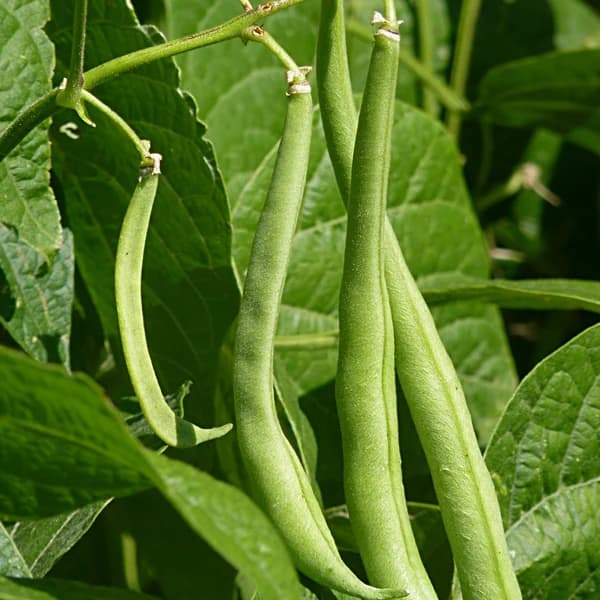
- Crop-identification photo; not a Australia production field. Photo: Jamain, CC BY-SA 3.0.
Figures are published averages or study assumptions for the places named, not guarantees for your field. Check current local recommendations and product labels before acting.