

Growing amaranth in Germany
German food-amaranth production is a small grain and pseudocereal sector, distinct from leafy amaranth and experimental biogas crops. The strongest local evidence combines South German field trials, regional extension guidance and a recent three-grower survey; it does not support a national yield promise or a uniform planting calendar.
Scope: Grain amaranth for food in Germany, with South German observations identified by region, year and sample size. Biomass crops require a separate harvest and market plan from food grain. Updated 2026-10-07.
At a glance
- Documented grain type
- Amaranthus cruentus; Bärnkrafft is identified by Bavarian TFZ as the approved grain cultivar at publication1
- Production scale
- Three amaranth growers and 4.5 ha in the 2025 survey’s Franken-Hohenlohe region2
- Surveyed farm yield
- Self-reported mean 1.65 t/ha; range 0.8–3.5 t/ha among three farms only2
- Typical maturity reference
- About 100–150 days in regional extension material; genotype and season change duration3
Planting and harvest calendar for Germany
Use the source-backed production windows to coordinate establishment, crop care and harvest. Production districts and cultivars can have different cycles; the historical climate adds context for the field plan.
Planting climate heatmap
Reference period: 1996-01-01 to 2025-12-31. ERA5-Land monthly mean soil temperature at 0–7 cm, air temperature and frost days at the regional reference point (51, 10). Select a month to inspect its historical conditions.
Kaul et al. (1996) report high field emergence above 15°C. The soil-temperature screen uses that historical emergence reference as a planning proxy, not a directly measured seed-zone threshold or a validated planting forecast. Check actual field temperature, frost and seedbed conditions before sowing.5
Muted green: the temperature meets the sourced minimum and no mean frost days recorded. Neutral tiles name the temperature or frost constraint. Gray: missing data. No upper soil-temperature limit is assessed. This screen does not assess the full growing season, field drainage or crop maturity.
May: Too cold
The monthly mean is outside the lower planting limit of 15.0°C.
- Mean topsoil temperature
- 12.4°C
- Mean air temperature
- 12.0°C
- Mean frost days per month
- 0.2 days
These are monthly means at one reference location. They describe seasonal field conditions, not crop maturity, actual seed-zone conditions, frost forecasts or a planting recommendation. Harvest bands follow the crop-specific production sources above.
Climate source: Open-Meteo Historical Weather APIKeep grain amaranth distinct from leaf and energy crops
- 1
Select the grain crop
TFZ identifies Amaranthus cruentus and Bärnkrafft for German food-grain production.
- 2
Confirm the buyer
Small lots may need cleaning, drying and specialist handling.
- 3
Match the field
Favour a warm, frost-free site with a fine, stable seedbed and manageable weed pressure.
- 4
Plan combine and drying
Arrange equipment and grain handling before the crop reaches maturity.
- Grain is the documented food-crop system
- TFZ describes German amaranth as sporadic production primarily for grain and identifies Bärnkrafft (*A. cruentus*) as the approved grain cultivar at the time of its guidance. Experimental whole-plant biogas production is a separate system, and TFZ says a practical recommendation for it is premature.1
- Treat the market as a small regional chain
- The 2025 Franken-Hohenlohe survey includes three amaranth growers on 4.5 ha. Its report describes small lots, handling costs and a developing regional value chain; it does not establish nationwide demand or a dependable margin.2
Wait for a warm, frost-free seedbed
- 1
Check frost risk
Amaranth is frost-sensitive; wait until the local field is past damaging frost conditions.
- 2
Measure seed-zone warmth
The historical Kaul et al. paper reports high field emergence above 15°C.
- 3
Prepare a fine, stable seedbed
Regional extension guidance stresses shallow drilling and consistent seed placement.
- 4
Assess weeds and equipment
Slow early growth makes weed control and suitable mechanical access important.
- Use the soil temperature as a trial finding
- Kaul et al. report high field emergence above 15°C. This is a historical temperature reference, not a validated nationwide soil-temperature cutoff. Field sowing depends on current seedbed warmth, moisture, frost and cultivar; historical Stuttgart trial dates are not a current national calendar.3,5
- Do not map monthly climate averages to seedbed readiness
- The crop needs field-level frost and soil-temperature checks. A regional climate normal cannot show current seed-zone conditions, field drainage, weed pressure or machinery access, so this evidence does not justify a month-by-month feasible/not-feasible heatmap.3,4
Establish a uniform stand and control weeds early
- Historical German field trial40 seeds/m²Target density in one set of trials; achieved stands varied.
- Regional extension range60 seeds/m²Upper end of a 40–60 seeds/m² regional grain reference.
- Use the seed-rate reference only with its source context
- RegiopAKT gives 40–60 seeds/m² for grain production; older South German experiments compared 40 and 100 seeds/m² and reported target stands near 40 plants/m². Seed size, germination, drill calibration and local weed-control equipment affect the final plan.3,4
- Do not borrow an energy-crop fertilizer rate
- The reviewed sources do not establish a current grain-specific nitrogen recommendation. TFZ’s energy-crop figures target whole-plant biomass; they should not be transferred to food grain. Use soil tests and current local advice, and avoid excess nitrogen that may increase lodging or delay maturity.1,3,5
Reduce shattering and dry grain promptly
- 1
Watch crop maturity
Regional extension gives about 100–150 days, with substantial genotype and season effects.
- 2
Check seed loss risk
Mature seed can shatter before harvest; inspect the crop and combine timing closely.
- 3
Harvest and clean
Coordinate machinery and cleaning capacity for a small-lot crop.
- 4
Dry promptly
The regional guidance calls for prompt drying to about 10% moisture.
- Keep the three-farm yield range in context
- The 2025 regional survey reports a self-reported mean of 1.65 t/ha and range of 0.8–3.5 t/ha among three amaranth growers. This small sample is evidence that a local food-grain chain exists, not a yield target or farm budget assumption.2
Frequently asked questions
- What type of amaranth is grown for grain in Germany?
- Bavarian TFZ identifies Amaranthus cruentus cultivar Bärnkrafft as the German grain cultivar at the time of its guidance. Grain production should be kept distinct from leafy vegetables and experimental biogas crops.
- When is grain amaranth sown in Germany?
- Regional sources describe May sowing and a historical South German field-emergence reference above 15°C. These are source- and site-specific references, not a national planting calendar.
- What yield can a German amaranth farm expect?
- A 2025 survey of three growers reported a self-reported mean of 1.65 t/ha and range of 0.8–3.5 t/ha. The small sample does not support a national yield promise.
- How is amaranth grain harvested in Germany?
- Regional guidance describes combine harvest around September–October, followed by cleaning and prompt drying. Watch for seed shattering and follow the buyer’s moisture specification.
- Does the energy-crop nitrogen guidance apply to grain amaranth?
- No. TFZ’s biomass guidance targets whole-plant energy crops. The reviewed sources do not establish a current grain-specific nitrogen rate.
Regional amaranth guides
Local dates, soil-temperature history and sources for specific regions:
Sources and image credits
- 1. Bavarian Technology and Support Centre (TFZ) — Amaranth — State technical guidance. German production context, named grain cultivar and distinction between grain and experimental energy-crop systems.
- 2. Schiele, Walther & Fuchs — Regional niche crop production in South Germany — 2025. Three amaranth-growing farms in the Franken-Hohenlohe sample, reported area, self-reported yields and regional value-chain limits.
- 3. RegiopAKT — Amaranth crop guidance — Regional knowledge-transfer project. Grain seed-rate range, seedbed, weed control, maturity and harvest handling; regional rather than national practice.
- 4. Aufhammer et al. — Grain yield formation and nitrogen uptake of amaranth — 1995. Historical Stuttgart grain trials; genotype, sowing-date and stand-density comparisons.
- 5. Kaul et al. — Suitability of amaranth genotypes for grain and fodder use in Central Europe — 1996. South German field-trial results, emergence, stand, weather and genotype effects.
- 6. Bavarian LfL — Market potential of plant products for innovative foods — State market study. Historical Bavaria area records; these are not national area statistics.
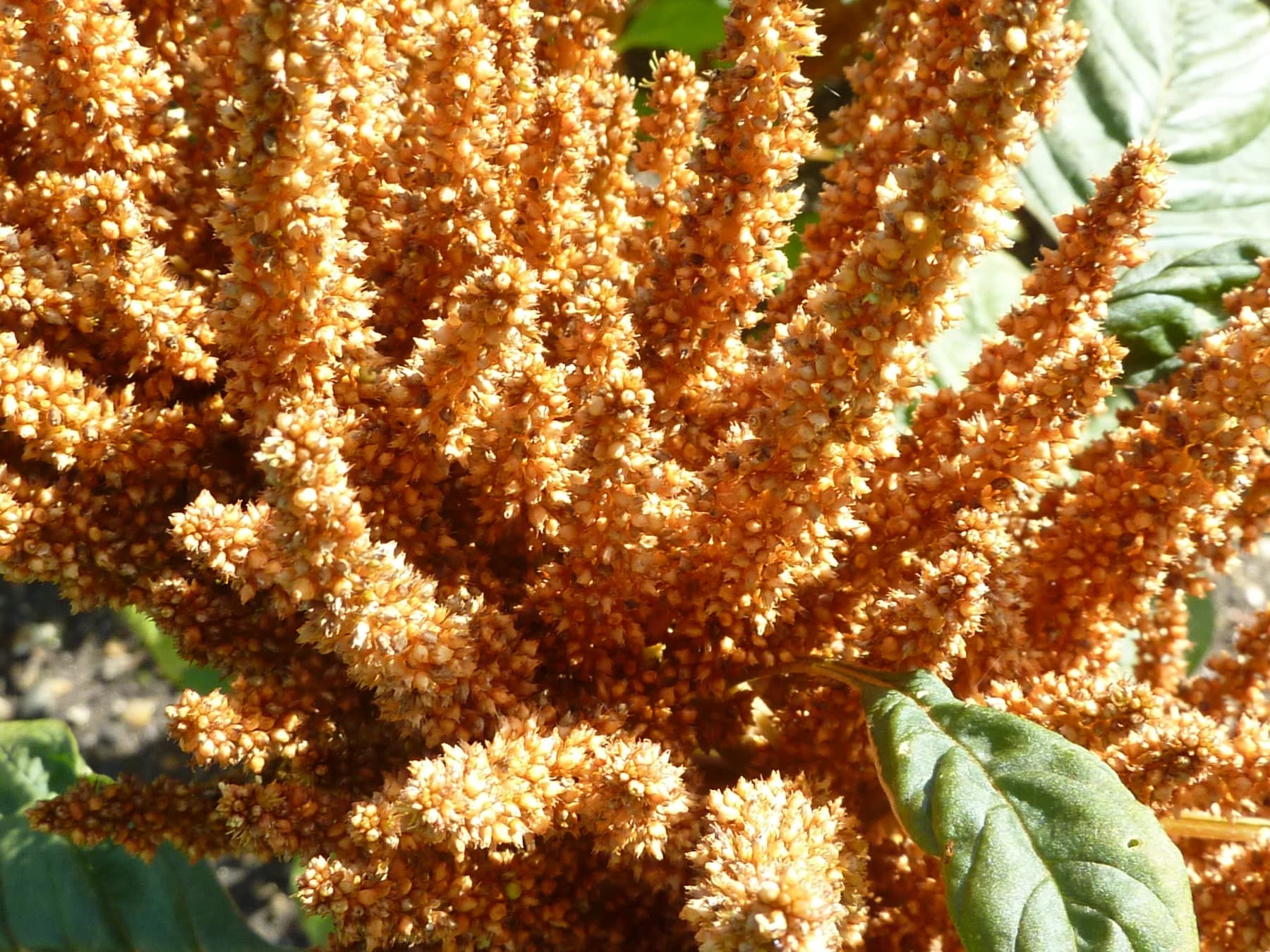
- 7. Grain-amaranth species photograph — Magnus Manske — CC BY-SA 3.0. Species identification at Cambridge University Botanic Garden; resized derivative retains CC BY-SA 3.0. Does not establish a cultivar or German field performance.
- 8. Grain-amaranth photograph license — CC BY-SA 3.0 — Creative Commons Attribution-ShareAlike 3.0. Reuse terms for the credited Magnus Manske photograph.
Image credits
- Amaranthus hypochondriacus at Cambridge University Botanic Garden, UK. Photo: Magnus Manske, CC BY-SA 3.0; resized under the same license. Grain-species identification, not a German farm or a named local cultivar.
Figures are published averages or study assumptions for the places named, not guarantees for your field. Check current local recommendations and product labels before acting.