

Growing almonds in California
California grows nearly all US almonds on irrigated orchards in the Central Valley. The choices that matter are variety mix for bloom overlap, a water and nitrogen plan that rises with orchard age, two bee hives per acre once trees are mature, and costs that take years to repay.
Scope: Almonds in the San Joaquin Valley, based on the 2024 UC cost study and USDA NASS statewide data. Metric first, with the original US units in brackets. Updated 2026-10-03.
At a glance
- Bearing area, 2025
- 567,000 ha (1.40 million acres)2
- Tree spacing
- 4.9 × 6.7 m (16 × 22 ft), 320 trees/ha (130 per acre); commercial range 185–445 trees/ha (75–180 per acre)1
- Pollination
- Two or more varieties with overlapping bloom; mature orchards rent 2 hives/acre (about 4.9 per ha)1
- Water, mature
- 1,067 mm (42 acre-inches) applied, about 10,700 m³/ha1
- Nitrogen, mature
- 202 kg N/ha (180 lb/acre) a year1
- Yield by age
- 560 kg/ha in year 3, 1,120 in year 4, 2,130 in year 5, 2,470 from year 6 (kernel weight)1
- Harvest
- Mechanical shaking from August; varieties are harvested separately1
- California yield, 2025
- 2.17 t/ha shelled (1,940 lb/acre); price $5.73/kg ($2.60/lb)2
Perennial growth and climate in California
A perennial planting remains in the field for multiple years. Establishment is a long-term investment; flowering, fruit development, harvest and plant care recur as the planting matures. Follow the named cultivar and production system.
Establish a long-lived planting1
Establish an orchard with suitable rootstock, variety and pollinizer arrangement, drainage and irrigation. Tree establishment and the transition to bearing take several years; mature-orchard operations recur each year.
Management: Bloom and pollination: northern San Joaquin Valley1
The cost study places pollination in February–mid-March. Monitor actual bloom and frost forecasts; monthly frost averages do not predict blossom injury.
Management: Irrigation monitoring1
The study irrigates approximately mid-March–mid-October. Account for stored soil water, weather, crop development and system efficiency.
Management: Winter sanitation and maintenance1
The study schedules sanitation and maintenance pruning in November–January. Remove mummy nuts and review orchard condition before the next bloom.
Harvest: Separate variety harvest passes1
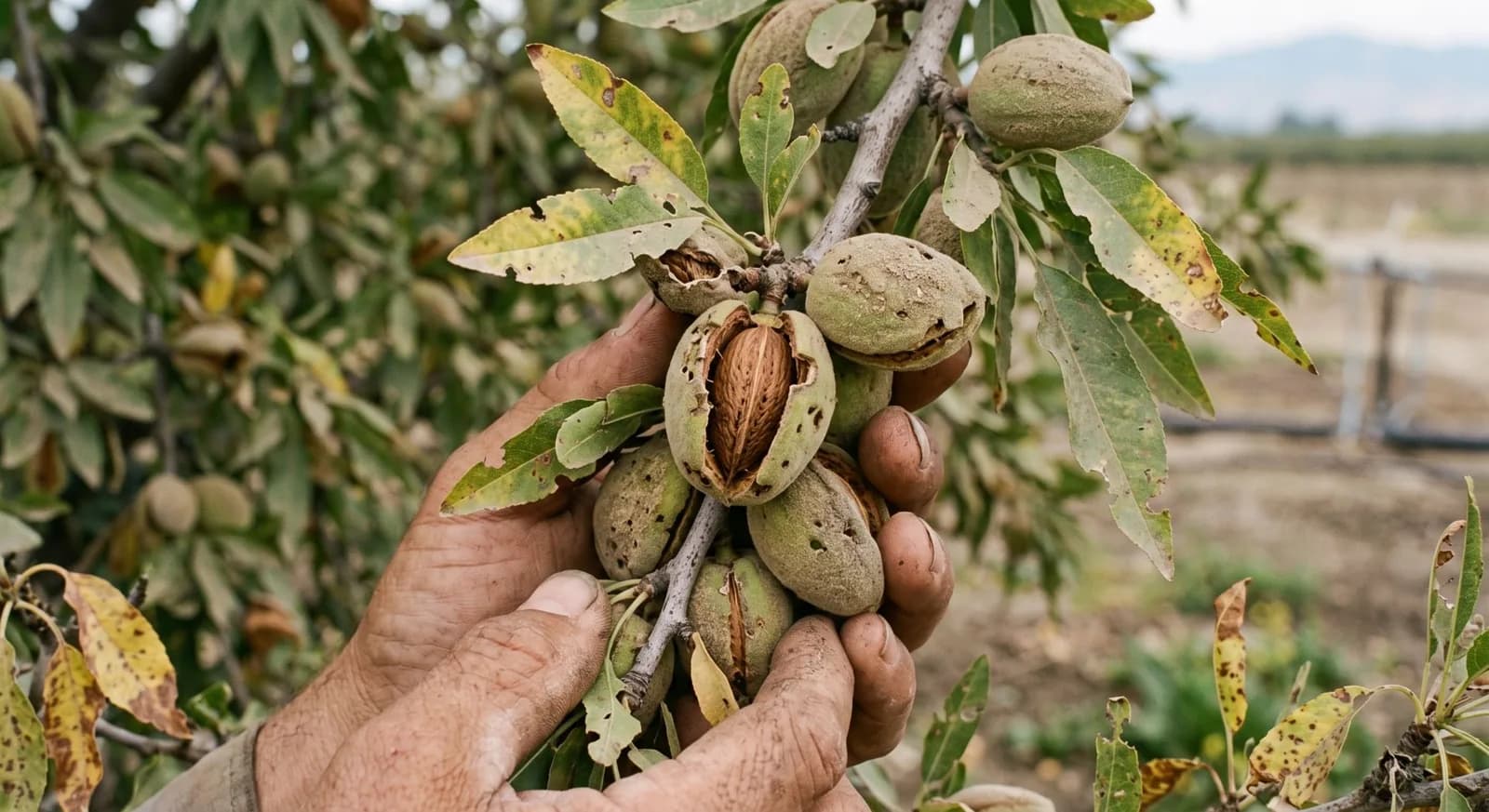
Early varieties begin in August and later varieties continue into October in the northern San Joaquin Valley study. Use hull split, crop maturity and variety-specific passes for field decisions.
Historical monthly climate
Reference period: 1996-01-01 to 2025-12-31. ERA5-Land monthly mean soil temperature at 0–7 cm, air temperature and frost days at the regional reference point (37, -120). Select a month to inspect its historical conditions.
Month tiles show mean air temperature.
February historical conditions
- Mean topsoil temperature
- 10.4°C
- Mean air temperature
- 10.7°C
- Mean frost days per month
- 1.6 days
Use this monthly history to assess winter exposure, seasonal heat and water planning. It does not calculate cultivar chill hours, flowering dates, frost damage during bloom or fruit maturity. Topsoil at 0–7 cm describes shallow soil context, not the full root zone. Harvest periods follow the production evidence above.
Climate source: Open-Meteo Historical Weather APIPlant a compatible variety mix
- Spacing
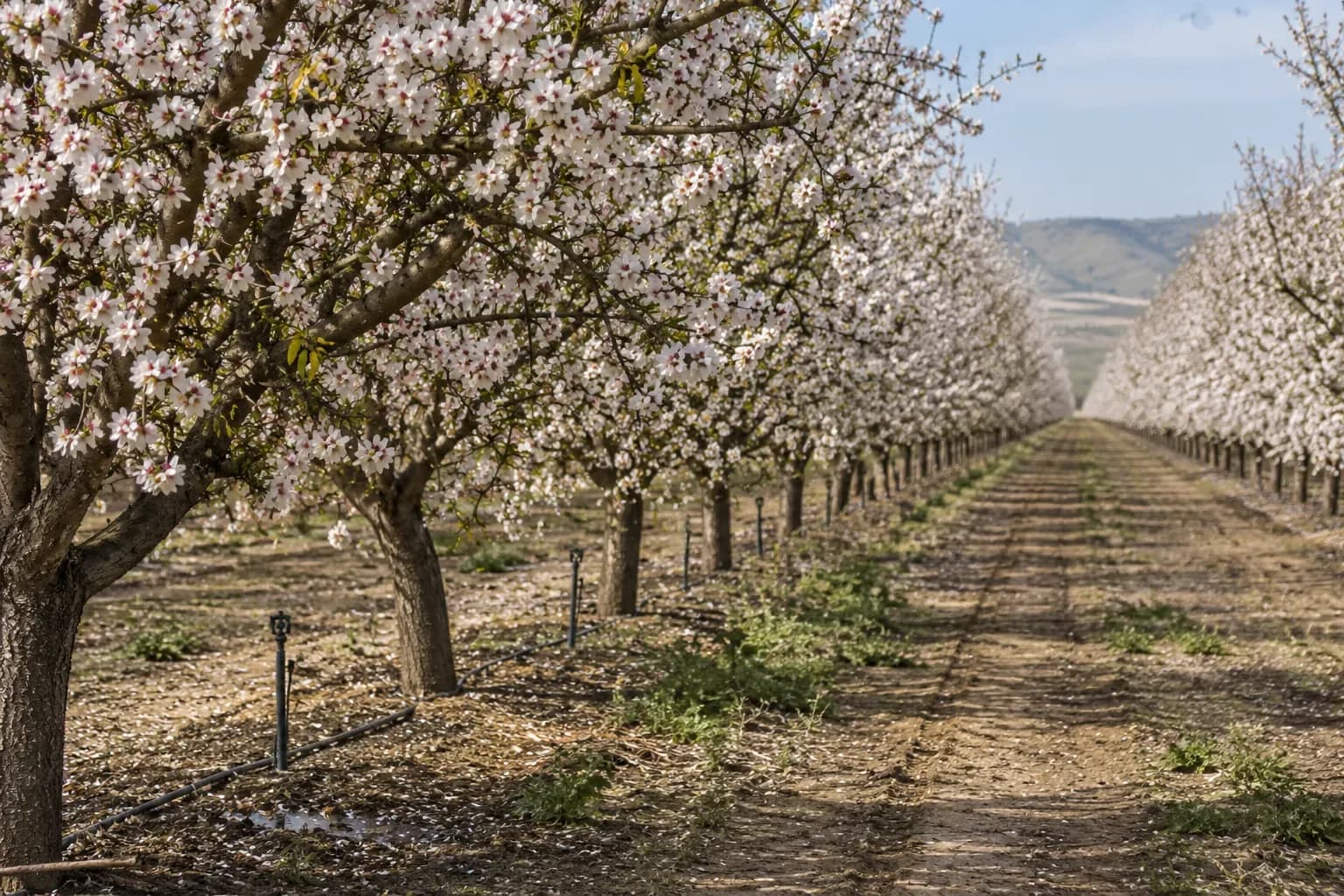
- The UC study plants 130 trees per acre (320 per hectare) on a 16 × 22 ft spacing (4.9 × 6.7 m). Commercial plantings run from 75 to 180 trees per acre (185–445 per hectare).1
- Bloom overlap
- Almonds need cross-pollination from varieties whose bloom periods overlap. A mixed orchard also complicates harvest because varieties mature at different times and the custom crew harvests each in turn. Self-fertile varieties have been shown to yield more with bee pollination.1
- Replacement
- One or more trees per acre may die each year and are replaced in late winter.1
Water and feed by orchard age
- Year 1279 mm
- Year 2533 mm
- Year 3813 mm
- Years 4+1,067 mm
- Year 134 kg N/ha
- Year 262 kg N/ha
- Year 372 kg N/ha
- Year 4112 kg N/ha
- Year 5179 kg N/ha
- Year 6+202 kg N/ha
- Irrigation
- Water is pumped from a well through a filter into micro-sprinklers about twice a week from mid-March to mid-October. Mature orchards receive 1,067 mm (42 acre-inches) at 90% application efficiency. Pumping was costed at $200 per acre-foot (about $0.16 per m³).1
- Nitrogen and potassium
- Nitrogen rises from 34 kg/ha (30 lb/acre) in year 1 to 202 kg/ha (180 lb/acre) from year 6, applied monthly March to May with one post-harvest application through the irrigation system. Potassium sulfate is applied after harvest, 350 lb/acre (390 kg/ha) in mature orchards, and boron at 0.45 kg/ha. Adjust nitrogen to expected yield and leaf and hull analysis.1
Rent bees for bloom
- Hive numbers
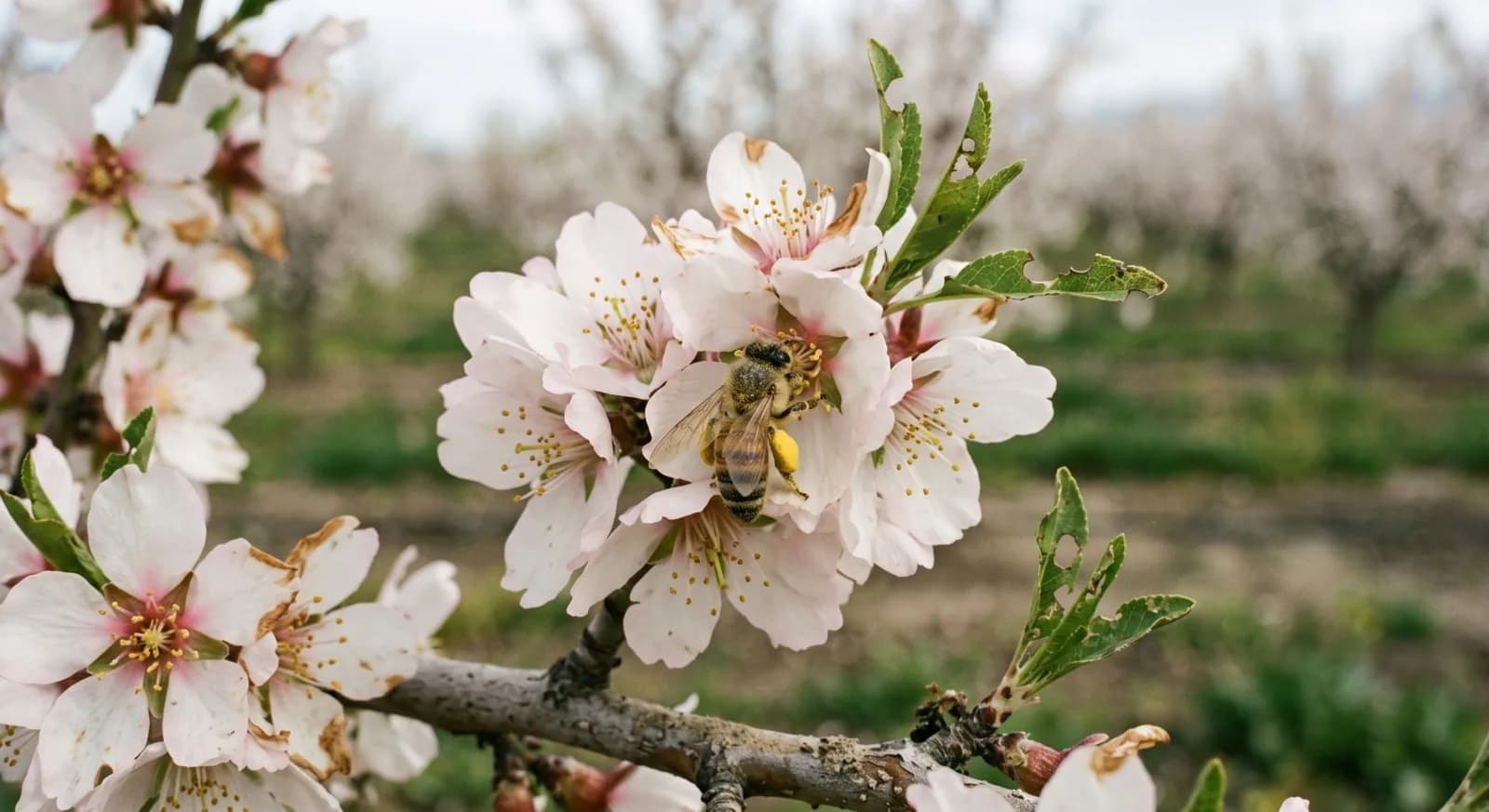
- The study rents one-half hive per acre in year 3, one hive in year 4 and two hives per acre from year 5, each with at least eight frames of bees, at $210 per hive. That is about 4.9 hives per hectare in mature orchards.1
- Protect the bees
- Bees are sensitive to pesticides, so spray timing has to be coordinated with bee activity. Brown rot is sprayed at 60–80% bloom in February.1
Harvest and yield
- Year 30.56 t/ha
- Year 41.12 t/ha
- Year 52.13 t/ha
- Year 6+2.47 t/ha
- Mechanical harvest
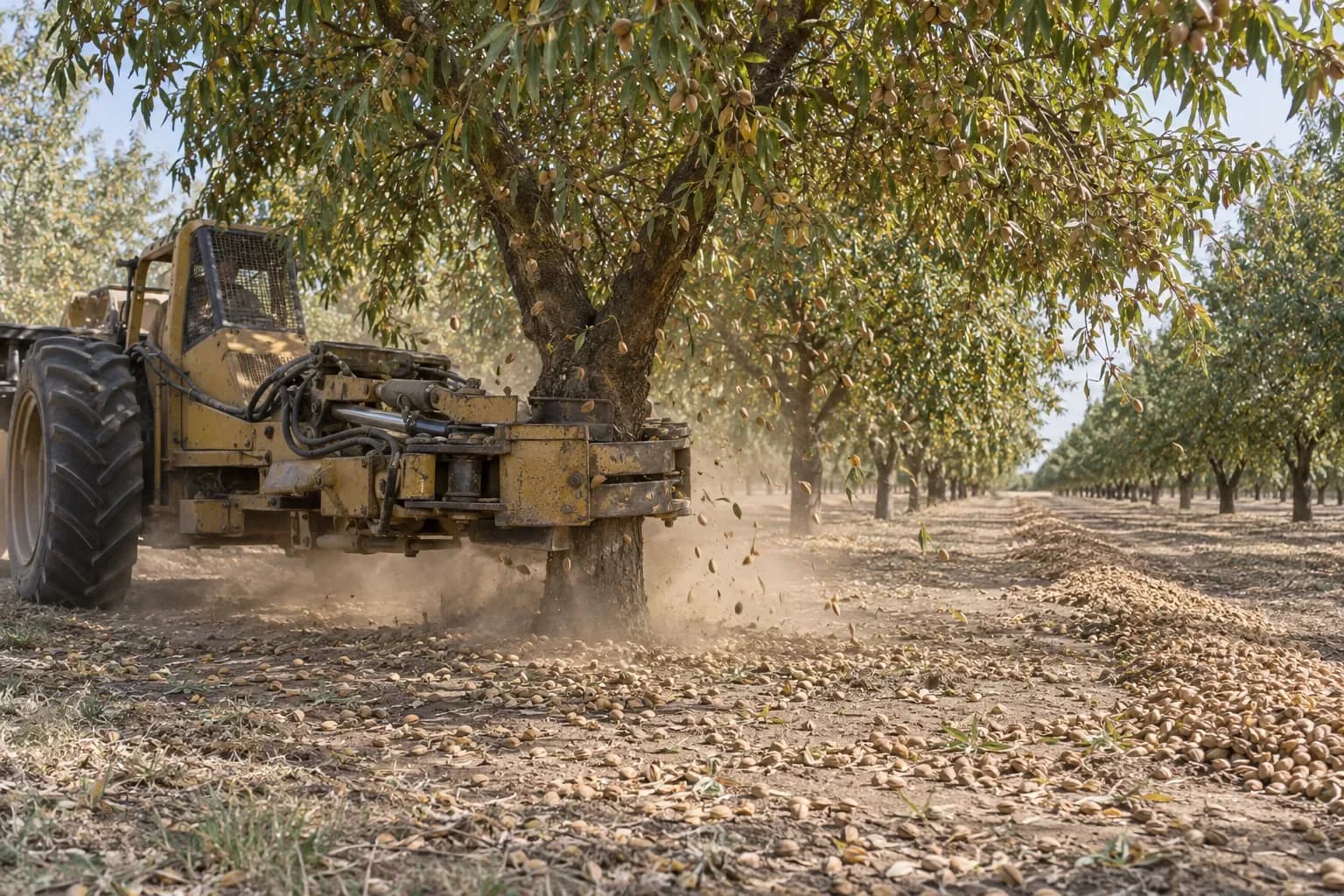
- A custom operator shakes and picks up the crop, starting in August with the earliest variety and returning for later ones; custom harvest was costed at $465 per acre ($1,150 per hectare).1
Costs and returns
- Establishment
- The study puts establishing a 100-acre almond orchard at $17,292 per acre ($42,700 per hectare), repaid over the orchard life. Together with land at $25,000 per acre, an established orchard is valued near $42,292 per acre.1
- Price decides the result
- At the study price of $1.60 per lb ($3.53 per kg) and 2,200 lb per acre, returns above total cost were negative at about −$5,095 per acre. USDA recorded an average price of $2.60 per lb ($5.73 per kg) in 2025, so a grower should model several prices; the study ranges 1,600–3,400 lb per acre at $1.00–3.00 per lb.1,2
- State scale
- California produced about 1.20 million t (2.64 billion lb) of shelled almonds in 2025, worth $6.87 billion.2
Frequently asked questions
- How many almond trees per acre in California?
- The UC study uses 130 trees per acre on 16 × 22 ft spacing (about 320 per hectare). Commercial plantings range from 75 to 180 per acre.
- How much water do almonds need?
- A mature orchard in the UC study receives 42 acre-inches (about 1,067 mm) a year through micro-sprinklers from mid-March to mid-October.
- How many bee hives do almonds need?
- The UC study rents 2 hives per acre (about 4.9 per hectare) from year 5, after one-half hive per acre in year 3 and one in year 4.
- How much nitrogen do almonds need?
- 180 lb N per acre (about 202 kg/ha) per year in mature orchards, rising from 30 lb per acre (34 kg/ha) in year 1.
- What is the average almond yield in California?
- USDA recorded 1,940 lb of shelled kernels per acre (about 2.17 t/ha) in 2025, from 1.40 million bearing acres.
- How much does it cost to establish an almond orchard?
- The 2024 UC study estimated $17,292 per acre (about $42,700 per hectare) for a 100-acre orchard in the northern San Joaquin Valley.
Regional almond guides
Local dates, soil-temperature history and sources for specific regions:
Sources and image credits
- 1. UC Cooperative Extension and UC Davis — Sample Costs to Establish an Orchard and Produce Almonds, San Joaquin Valley North, Micro-Sprinkler Irrigation, 2024 — 2024. Spacing, bees, irrigation, fertiliser by year, yields, harvest, establishment cost and returns.
- 2. USDA NASS — Noncitrus Fruits and Nuts 2025 Summary — Published May 2026. US and state bearing acreage, yield, production, price and value for avocados, almonds, olives and other fruit and nut crops, 2023–2025.
Image credits
- An almond orchard in February bloom, with micro-sprinklers along the tree row.
- Honeybees do the pollinating: the study rents two hives per acre in mature orchards.
- Mechanical shaking: a custom operator shakes each tree and the nuts dry in windrows before pick-up.
- Hull split signals the start of harvest; varieties mature at different times, so the crew returns for later ones.
Figures are published averages or study assumptions for the places named, not guarantees for your field. Check current local recommendations and product labels before acting.
Some visuals in this guide are illustrations rather than photographs of a specific farm. See image credits.