

How to grow almonds commercially
Almonds are a perennial orchard crop. Before planting, match the site and cultivar mix to winter chill, spring frost risk, pollination, water supply and a buyer. Establishment and mature-orchard practices in this guide use a northern San Joaquin Valley cost study as a worked example, not as a universal almond program.
Scope: Commercial orchard planning. Numeric spacing, irrigation, nutrition, yield and cost figures are from a 2024 UC San Joaquin Valley North study and California USDA data; apply them only with local advice and a farm budget. Updated 2026-10-16.
At a glance
- Crop life cycle
- Perennial orchard; plan establishment, years to bearing and recurring mature-tree operations1
- First orchard decisions
- Site, variety and rootstock, bloom overlap, pollination, irrigation capacity and market1
- California spacing example
- 4.9 × 6.7 m (16 × 22 ft), about 320 trees/ha (130/acre) in the cited UC study1
- Bloom management
- Choose varieties with overlapping bloom and protect pollinator activity1
- Harvest signal
- Variety-specific hull split and maturity; harvest passes may be staggered1
Perennial almond growth calendar
A perennial planting remains in the field for multiple years. Establishment is a long-term investment; flowering, fruit development, harvest and plant care recur as the planting matures. Follow the named cultivar and production system.
Establish a long-lived planting1
Almonds are not replanted every season. Set the planting date from nursery stock, soil workability, local frost exposure and irrigation readiness. The California study describes its own winter planting operations; do not turn that schedule into a global month recommendation.
Management: Bloom and pollination1
Confirm compatible varieties and overlapping bloom, monitor the actual bloom stage, and coordinate pollination and any crop protection with bee activity. California bloom dates are local observations.
Management: Irrigation and nutrition1
Set water and nutrient plans by orchard age, soil and water tests, crop load, weather and local extension guidance. The UC study gives one micro-sprinkler budget, not a transferable requirement.
Harvest: Harvest at variety-specific hull split and maturity1
Use hull split and kernel maturity to schedule separate harvest passes. California study dates are not a general harvest calendar.
Screen the site before ordering trees
An orchard is a long-lived investment. Confirm the land, water and pollination plan before committing to varieties or planting density.
- Check winter chill and spring frost exposure
- Almond varieties differ in bloom timing and adaptation. Compare the local chill pattern and frost risk with current regional variety guidance; a regional climate average cannot predict blossom survival in an individual block.1
- Verify drainage and irrigation capacity
- Map soil depth, drainage, salinity risk and water availability. Test soil and irrigation water, then confirm the proposed system can meet the farm’s seasonal demand without relying on a study’s local application rate.1
- Build the market plan early
- Confirm processor access, quality requirements, harvest services and storage or delivery arrangements. Orchard costs continue for years before mature production, so model establishment and cash flow before planting.1
Design variety, pollination and orchard layout
Between rows: 6.7 m (22 ft) · Within the row: 4.9 m (16 ft)
This is the spacing in one UC cost study, not a general prescription. Match density to cultivar, rootstock, soil, equipment and local production advice. Schematic, not to scale.
- 1
Select the market
Check processor, quality and harvest requirements.
- 2
Match varieties
Confirm local adaptation and compatible bloom overlap.
- 3
Plan pollination
Arrange bee access and protect activity during bloom.
- 4
Fit the layout
Design rows and headlands around terrain, irrigation and harvest equipment.
- Do not copy one spacing figure blindly
- The UC study uses 16 × 22 ft (4.9 × 6.7 m) spacing and reports a wider commercial range. Treat that as a California comparison point; tree vigor, rootstock, equipment and the intended orchard system determine the farm layout.1
- Plan bloom overlap and bee access
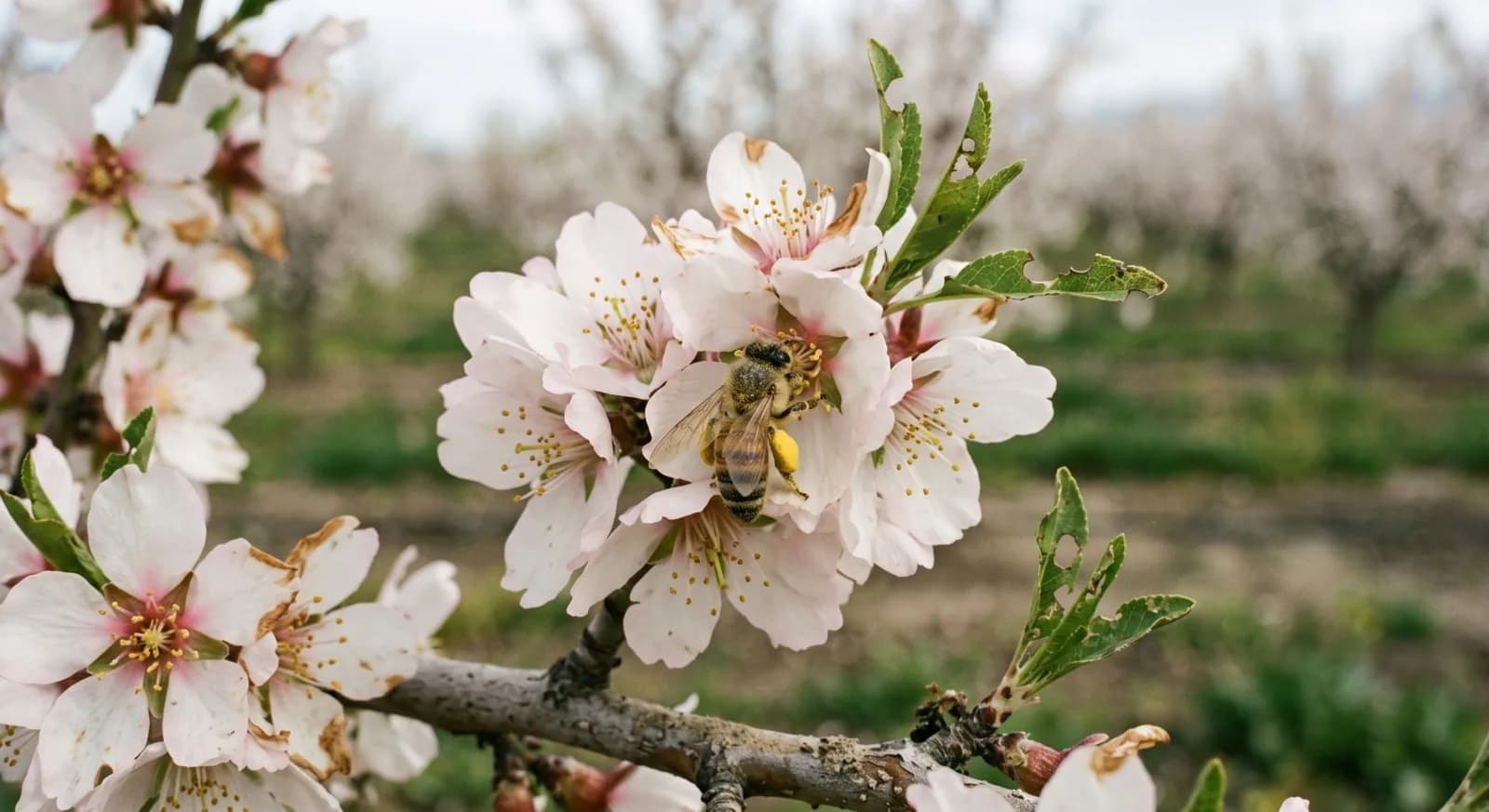
- Many almond blocks rely on compatible varieties flowering together. Coordinate hive supply, placement and any crop-protection work with bloom and bee activity; confirm current local pollination requirements.1
Manage water and nutrition as the orchard matures
- 1
Young trees
Establish roots, canopy and irrigation uniformity.
- 2
Bearing transition
Adjust crop-load, nutrition and pollination plans as production starts.
- 3
Mature blocks
Use soil and tissue tests, crop load and water records to tune inputs.
- 4
Postharvest
Review tree condition and prepare the next season’s bloom and harvest plan.
- Scale inputs to tree age and evidence
- The 2024 UC study increases water and nitrogen assumptions as its orchard develops. Those numbers describe a defined San Joaquin Valley micro-sprinkler budget. Build the actual program from soil tests, leaf and hull analysis, crop load, irrigation efficiency and local recommendations.1
- Track the block, not just the orchard average
- Record irrigation, nutrient applications, bloom, bee activity, crop load, tree loss and yield by variety and block. Use the records to find uneven performance before adjusting a whole farm.1
Harvest by variety, then budget the whole cycle
- Use hull split and kernel condition
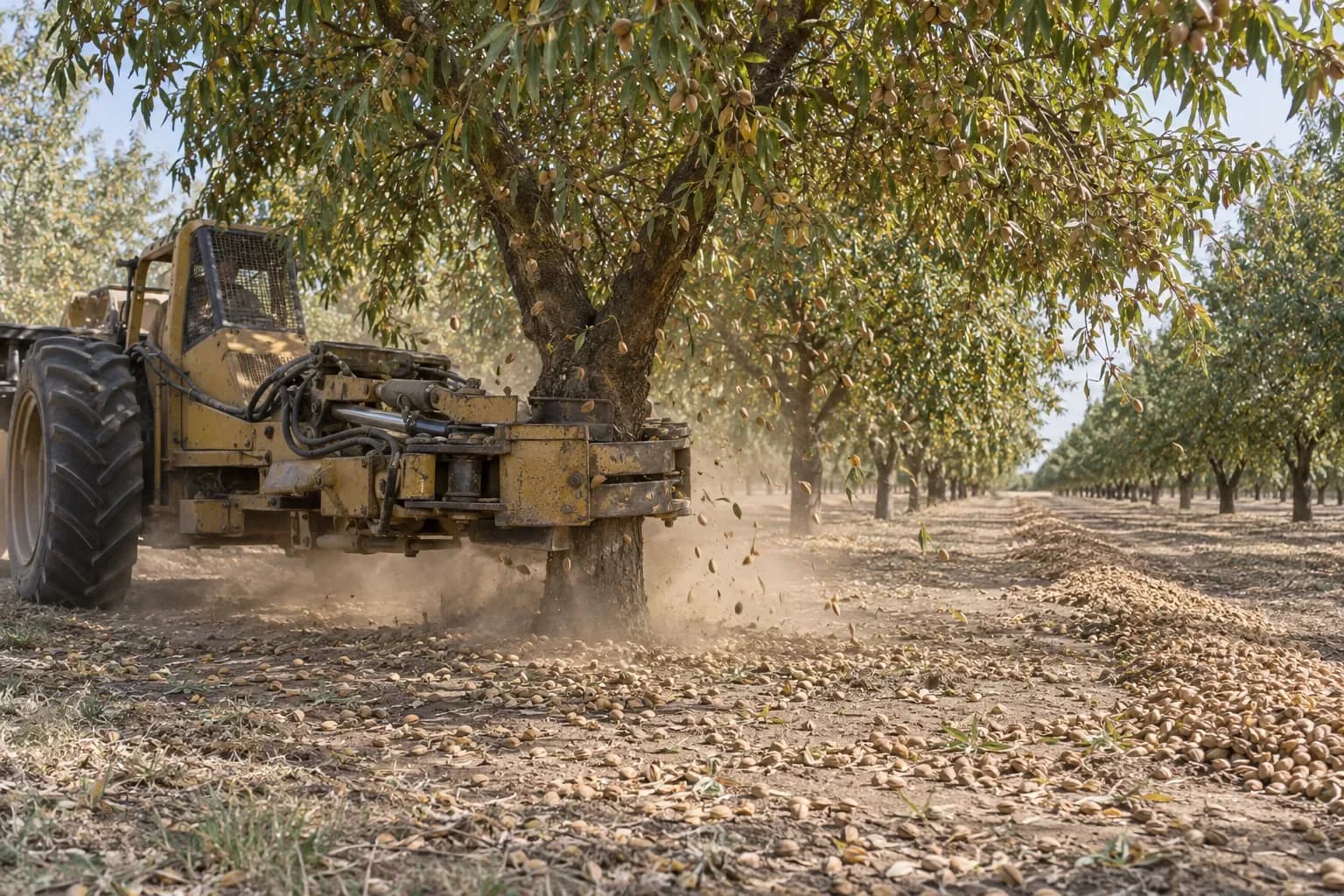
- The California study schedules shaking from August and returns for varieties that mature later. Let field maturity and processor requirements set the actual operation, not a calendar copied from another region.1
- Treat regional yields and prices as scenarios
- The UC cost study and USDA California figures are useful benchmarks, but neither predicts a new block’s marketable yield or return. Update local establishment, water, bee, custom-harvest, processing and price assumptions before making a conversion decision.1,2
Frequently asked questions
- When should almond trees be planted?
- Use locally appropriate nursery stock and plant when the soil, frost risk and irrigation system are ready. The California study describes a local operation and does not set a universal planting month.
- Do almond varieties need to cross-pollinate?
- Many commercial plantings use compatible varieties with overlapping bloom and managed bee pollination. Confirm the chosen varieties and local pollination plan before ordering trees.
- How far apart should almond trees be planted?
- There is no one spacing for every orchard. A 2024 northern San Joaquin Valley UC study uses 4.9 × 6.7 m (16 × 22 ft); choose a local design for rootstock, vigor, equipment and water.
- When are almonds harvested?
- Harvest follows variety-specific hull split and kernel maturity. Regions and cultivars differ, and one orchard may need multiple passes.
Regional guides and field planning
Sources and image credits
- 1. UC Cooperative Extension and UC Davis — Sample Costs to Establish an Orchard and Produce Almonds, San Joaquin Valley North, Micro-Sprinkler Irrigation, 2024 — 2024. Spacing, bees, irrigation, fertiliser by year, yields, harvest, establishment cost and returns.
- 2. USDA NASS — Noncitrus Fruits and Nuts 2025 Summary — Published May 2026. US and state bearing acreage, yield, production, price and value for avocados, almonds, olives and other fruit and nut crops, 2023–2025.
Image credits
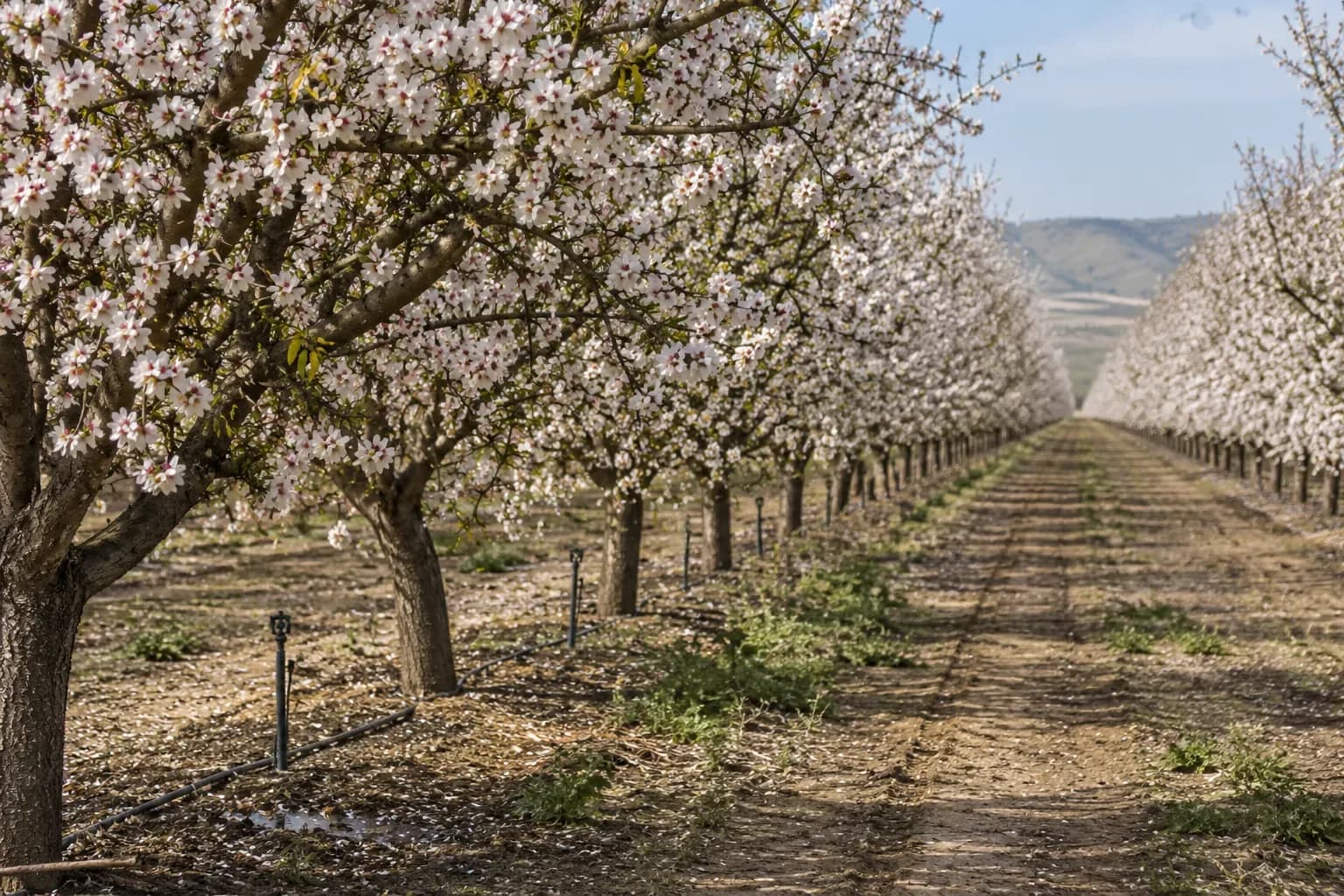
- An almond orchard in February bloom, with micro-sprinklers along the tree row.
- Honeybees do the pollinating: the study rents two hives per acre in mature orchards.
- Mechanical shaking: a custom operator shakes each tree and the nuts dry in windrows before pick-up.
Figures are published averages or study assumptions for the places named, not guarantees for your field. Check current local recommendations and product labels before acting.
Some visuals in this guide are illustrations rather than photographs of a specific farm. See image credits.