

How to grow onions: a commercial guide
Onions form bulbs in response to day length, so choosing the right type for your latitude comes first. Then the crop is made by establishment, nitrogen timing, disease control and, for storage onions, curing and a cold, dry store. Figures are Midwest US unless stated.
Scope: Commercial bulb onions (long-day types), Midwest US; Pacific Northwest storage guidance where noted. Updated 2026-10-16.
At a glance
- Type
- Long-day varieties grow best in the Midwest; some intermediate-day types also work1
- Plant when
- Seed or transplant about a month before the frost-free date, or as soon as soil can be worked1
- Seeding and stand
- 4.5 kg seed/ha (4 lb seed/acre); about 12 seeds or 9.8–13.1 transplants per m (3–4 transplants per foot) on beds with rows 36 cm (14 in) apart1
- Soil pH
- 6.0–6.8 on mineral soil1
- Total nitrogen
- About 215 kg N/ha (190 lb N/acre) for bulb onions on mineral soil, 56 kg/ha (50 lb/acre) less on muck1
- Time to harvest
- 100–125 days from seeding for storage types1
- US average yield, 2025
- About 67.1 t/ha (599 cwt/acre); 3.72 million t (82.1 million cwt) from 55,400 ha harvested (137,000 acres)3
Choose the type for your latitude and market
- 1
Seed or transplant
About a month before the frost-free date, or as soon as soil can be worked.
- 2
Grow
100–125 days from seeding for pungent storage types.
- 3
Tops fall
Harvest after tops have naturally fallen and dried; rolling and undercutting hasten dormancy.
- 4
Field cure
Normally 6–20 days.
- 5
Dry and top
24–27°C (75–80°F) and 70–80% humidity; cut tops 2.5 cm (1 in) above the bulb.
- 6
Store
At or near 1°C (33°F) with 60–70% humidity.
- Day length
- Bulb onions are long-day, intermediate-day or short-day depending on the day length that triggers bulbing. Long-day varieties grow best in the Midwest, and some intermediate-day onions also do well.1
- Sweet or storage
- Sweet onions contain more sugar, are harvested at the size wanted and do not store as well. Pungent storage onions are dried and held. Pick the type from the buyer’s specification before ordering seed.1
- Green onions versus red, yellow and white onions
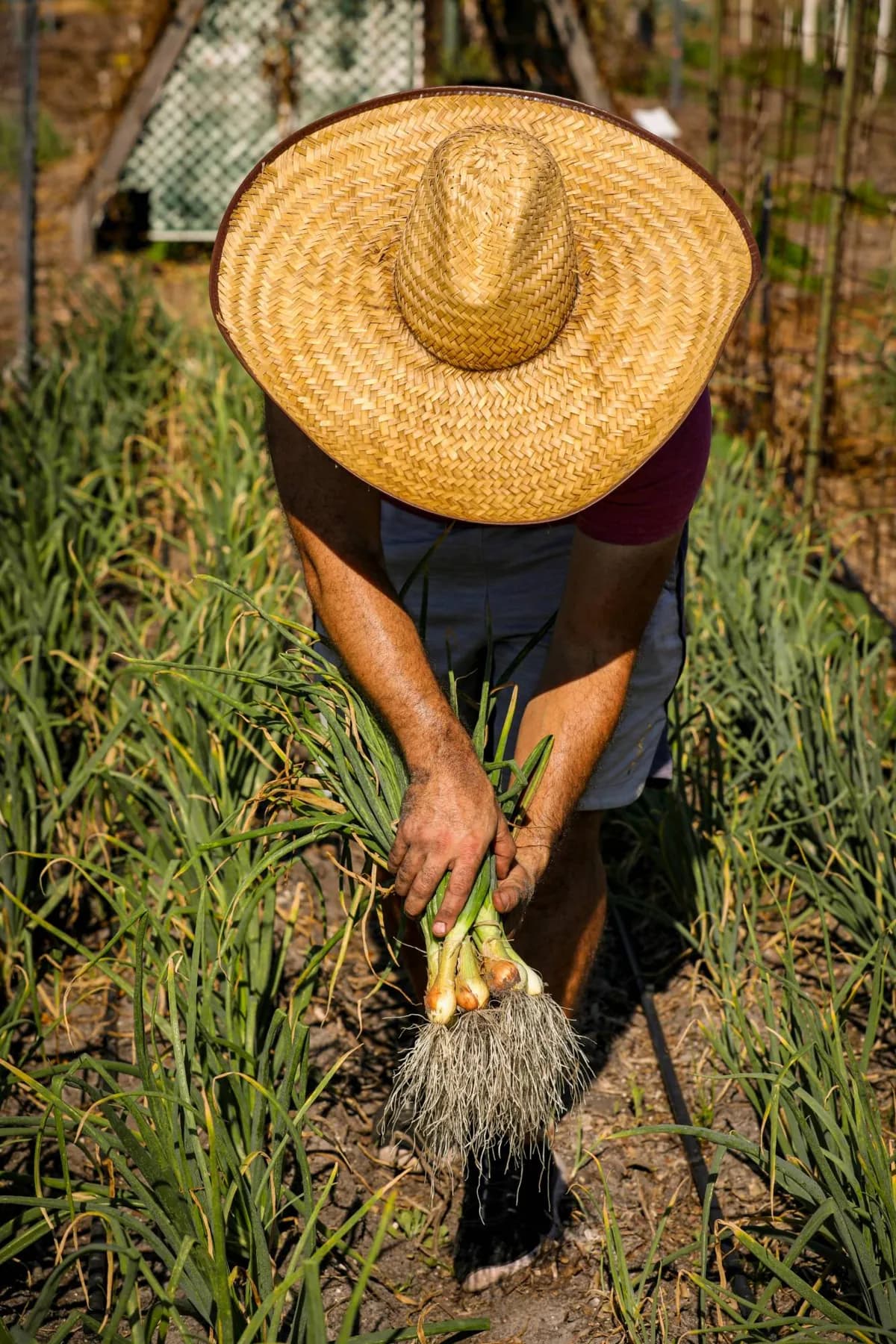
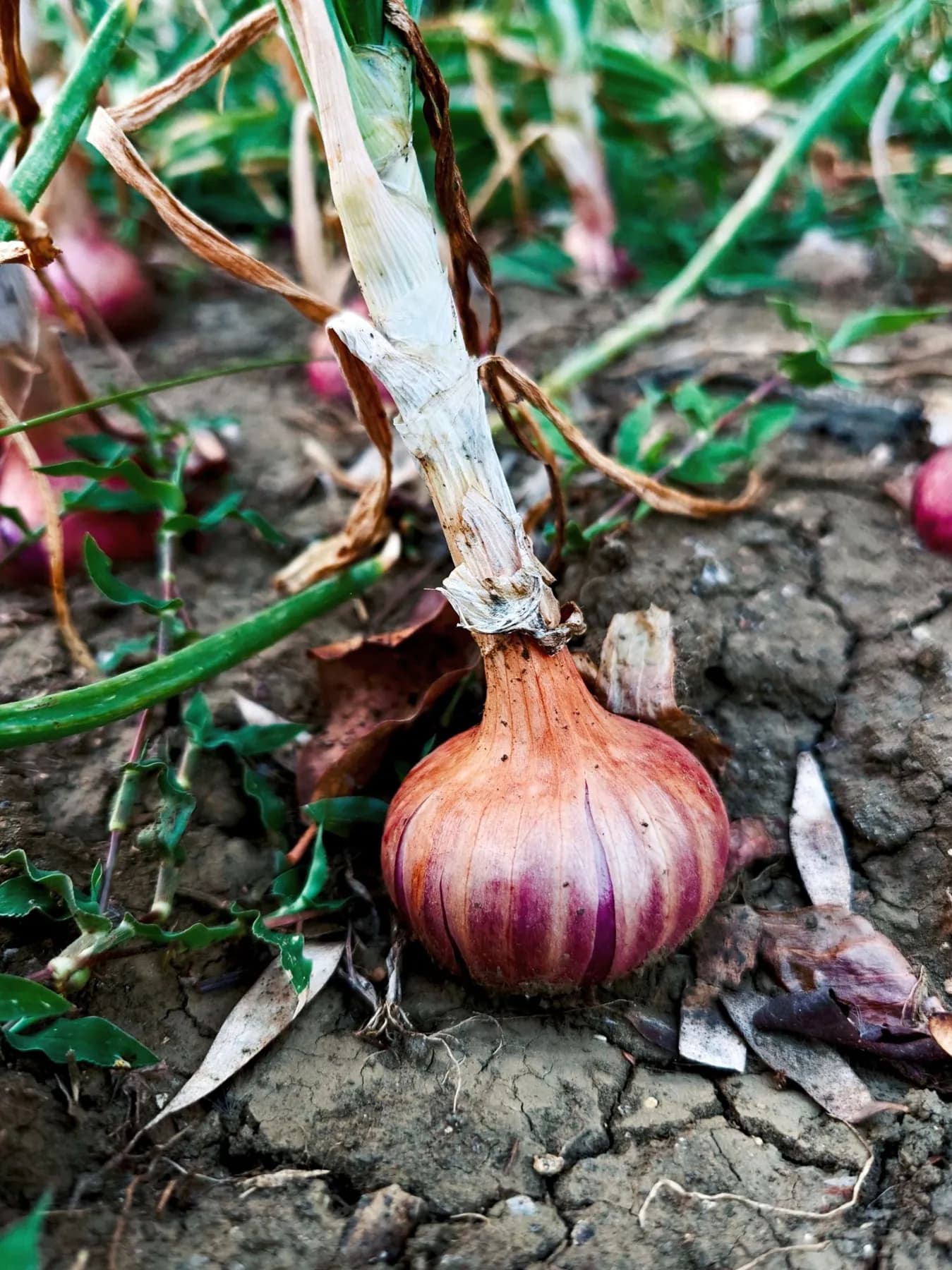
- Red, yellow and white are skin colours of bulb onions, which are grown to maturity. A green onion (scallion or spring onion) is not a separate colour class: it is any onion pulled young, once the bulb base is thicker than a pencil but before bulbing. Allium fistulosum, which does not make a large bulb, is the usual bunching species. Harvest takes 60–70 days from seeding.1
- Shallots
- Shallots form clusters of smaller, milder bulbs, are very winter hardy and can be fall-planted like garlic.1
Establish the stand
Between rows: 36 cm (14 in) · Within the row: 9.8–13.1 per m (3–4/ft)
About 12 seeds or 9.8–13.1 transplants per m (3–4 transplants per foot), rows 36 cm (14 in) apart on top of the bed. Schematic, not to scale.
- Timing
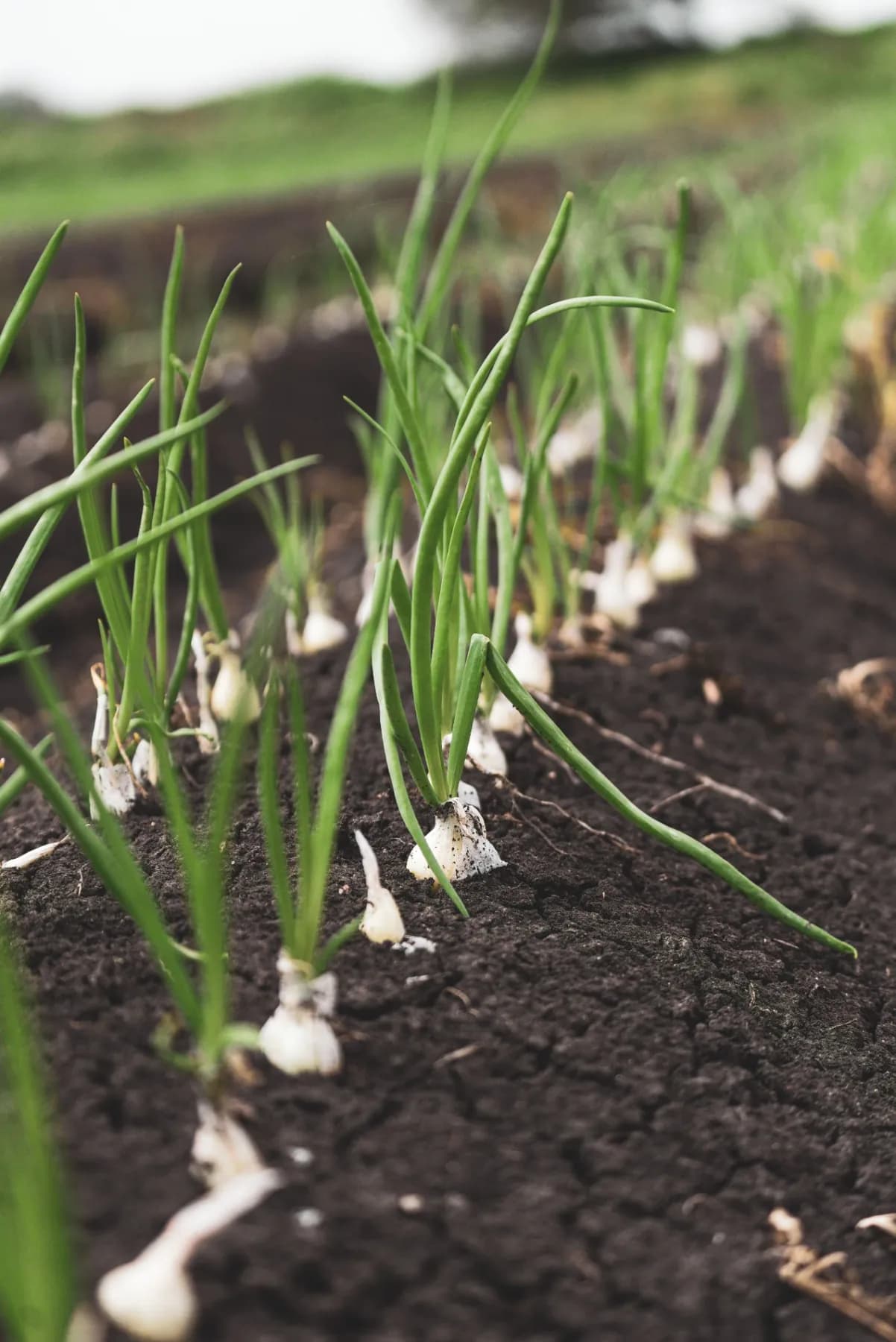
- Seed or transplant outdoors about a month before the frost-free date, or as early as soil can be worked. Young onions tolerate several overnight lows between 23 and 0°C (32°F), but less so in wind.1
- Layout
- Use raised beds with two double rows or wide rows 36 cm (14 inches) apart on top, with about 39 seeds per m (12 seeds per foot) or 9.8–13.1 transplants per m (3–4 transplants per foot). On hand-weeded farms a popular method is to plant groups of four that grow out in a clover shape.1
- Seed rate and nurse crop
- Use 4.5 kg of onion seed/ha (4 lb of onion seed per acre). Broadcasting about 87 L/ha (1 bushel per acre) of oats or barley as a nurse crop can protect young onions from sandblasting and hard frosts; kill it with a graminicide when 12.5–15 cm (5–6 inches) tall.1
- Maggot timing
- Plant after the peak flight and egg-laying of the first onion-maggot generation, about 700 growing degree days (base 4°C (40°F)), and handle seed gently to avoid cracking.1
Feed on a split schedule
- Before planting78 kg N/ha
- Sidedress, mid-June100–110 kg N/ha
- Total target, with credits215 kg N/ha
- Before planting
- Apply 80 kg N/ha (70 lb N/acre), 0–280 kg/ha (0–250 lb/acre) P2O5 and 0–280 kg/ha (0–250 lb/acre) K2O by soil test. Alternatively broadcast half the N and most K2O, and band the rest of N and all P2O5 at least 5 cm (2 inches) below and to the side of the row.1
- Sidedress
- Sidedress bulb onions with 100–110 kg N/ha (90–100 lb N/acre) in mid-June, or split it between early and late June. Reduce N by credits from legumes, manure, compost and soils above 3% organic matter.1
- Total and muck soils
- Total N from fertilizer and credits should be about 215 kg/ha (190 lb/acre) for bulb onions on mineral soil, and 56 kg/ha (50 lb/acre) less on muck. On muck above pH 6.0, add manganese in the starter band.1
Protect against thrips, maggot and rots
- Thrips
- Onion and western flower thrips spike in hot, dry weather and when nearby small grains or alfalfa are harvested. Damage looks like white flecks; the treatment threshold for several products is 1 thrips per leaf (3 per leaf for others). Overhead irrigation or rain washes thrips out.1
- Rotation
- Rotate to non-host crops for 4 years for Fusarium basal rot and 3 years for botrytis neck rot. Avoid late-season fertilizer and overhead irrigation, and destroy the finished crop promptly with tillage.1
- Other diseases
- Downy mildew, Stemphylium leaf blight, botrytis leaf blight, white rot and black mold (mostly a storage loss, favoured by heat) all occur; resistant varieties and clean seed are the first line of defence.1
Harvest, cure and store
- When
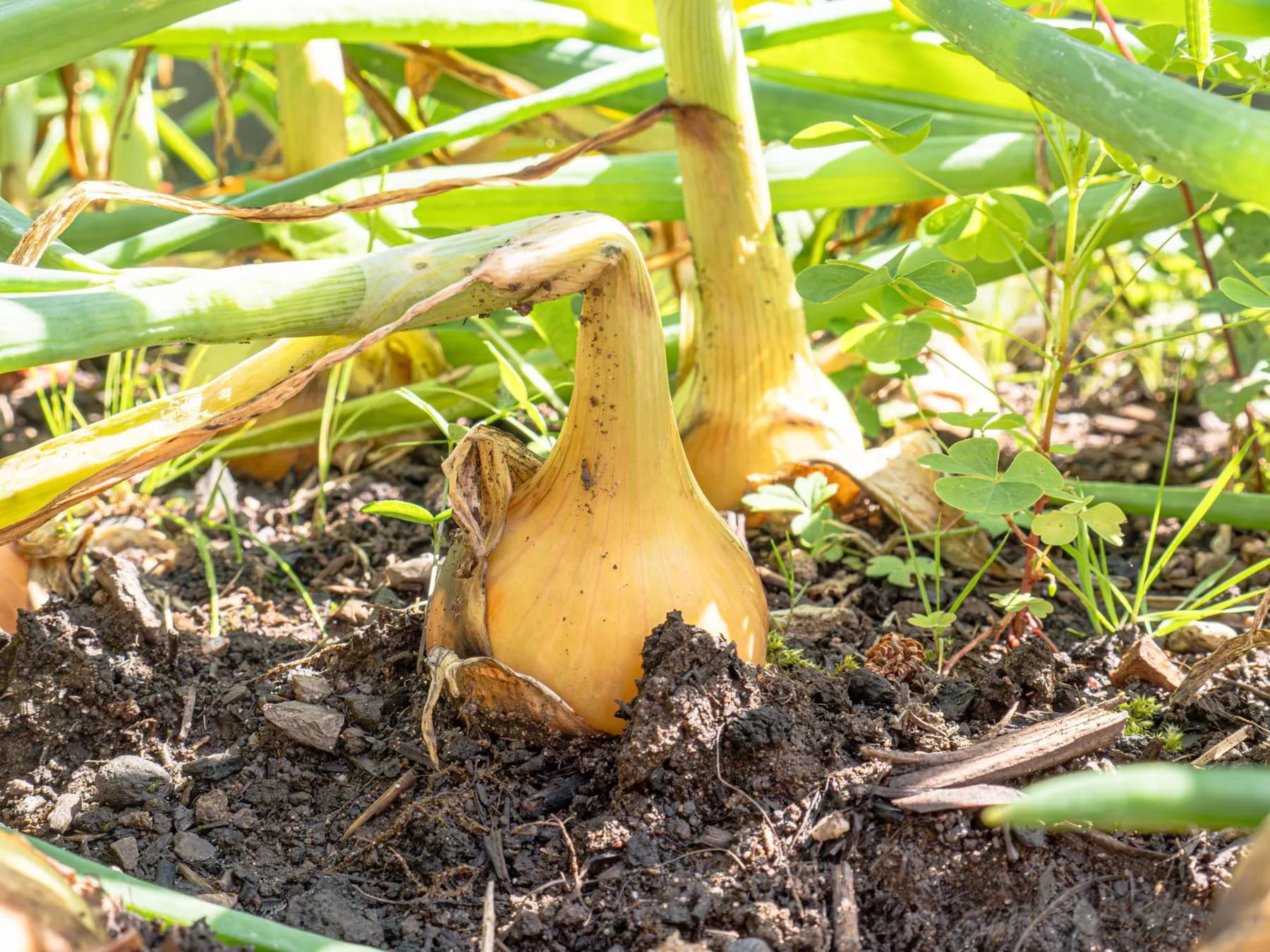
- Harvest pungent storage onions after tops have naturally fallen and dried. Sweet onions can be dug at any size: 60–80 days from transplanting for cipollini or pearl sizes, 90–115 for larger.1
- Dry and top
- Rolling leaves and undercutting several days before harvest can hasten dormancy. Dig, then dry in the field or indoors at 24–27°C (75–80°F) and 70–80% relative humidity. Cut tops about 2.5 cm (1 inch) from the bulb. Field curing normally takes 6–20 days.1,2
- Storage
- The best holding temperature is at or near 1°C (33°F) with 60–70% relative humidity. Higher humidity promotes root growth and rot. Cool the pile gradually and keep drops under 46 cm (18 inches) (ideally under 12) to limit bruising. Immature onions store poorly.2
Yield and economics
The US averaged about 67.1 t/ha (599 cwt per acre) in 2025, a national figure across fresh, storage and processing crops in many climates. It is context, not a target for your field.
- Price risk is large
- The 2025 US onion crop value fell 25% from 2024 even as production rose 8%. Contract price and storage capacity usually decide margin more than yield. Use the crop ROI estimator with your own seed, labour, drying and storage costs.3
Frequently asked questions
- Is a green onion different from a red onion?
- Not as a crop. Red, yellow and white are bulb-onion colours; a green onion (scallion or spring onion) is any onion harvested young, before the bulb swells, usually about 60–70 days from seeding. Allium fistulosum is the species most often grown for bunching.
- When should I plant onions?
- Seed or transplant about a month before the frost-free date, or as soon as soil can be worked. Young plants tolerate several lows between 23 and 0°C (32°F).
- What type of onion grows best in the north?
- Long-day varieties grow best in the Midwest; some intermediate-day types also do well. Short-day types will not bulb properly at northern latitudes.
- How far apart do you plant onions?
- About 12 seeds or 9.8–13.1 transplants per m (3–4 transplants per foot) on beds with rows 36 cm (14 inches) apart; seed at about 4.5 kg/ha (4 lb per acre).
- How long do onions take to grow?
- Pungent storage onions take 100–125 days from seeding; sweet onions 90–115 days from transplanting (60–80 for pearl sizes); green onions 60–70 days from seeding.
- How do you cure and store onions?
- Dig after tops fall, dry at 24–27°C (75–80°F) and 70–80% humidity (field curing 6–20 days), cut tops 2.5 cm (1 inch) above the bulb, then store near 1°C (33°F) at 60–70% humidity.
- How much nitrogen do onions need?
- About 215 kg N/ha (190 lb N per acre) in total on mineral soil: roughly 70 before planting and 90–100 sidedressed in June, less credits from legumes, manure and organic matter.
Regional guides and field planning
Sources and image credits
- 1. Midwest Vegetable Production Guide 2026 — Onions and Related Crops: Horticulture, Diseases and Insects — 2026 edition; horticulture reviewed 2022, diseases 2023, insects 2024. Midwest commercial garlic, onion, leek and shallot: planting, spacing, fertility, harvest, diseases and thrips/maggot thresholds.
- 2. Oregon State University / PNW Extension — Onion Storage Guidelines for Commercial Growers (PNW 277) — May 1985 (storage physics are unchanged; equipment is older). Field curing time, holding temperature and humidity, handling to limit bruising. Written for Pacific Northwest sweet Spanish and Danvers onions.
- 3. USDA NASS — Vegetables 2025 Summary — Published February 2026. US onion planted and harvested area, production and value; the per-acre yield is derived from production ÷ harvested acres.
Image credits
- Young onions establishing in a row. Photo: Cristian Rojas / Pexels.
- A yellow storage onion with its top fallen over, the sign that the crop is ready to lift. Photo: Thomas Fuhrmann / Pexels.
- Red bulb onion with dry neck and tops. Red, yellow and white onions are colours of the same bulb-onion species and are cured the same way. Photo: Costarlord / Pexels.
- Hand-pulling a bunch of green (spring) onions. Green onions are harvested before the bulb swells. Photo: Mick Haupt / Unsplash.
Figures are published averages or study assumptions for the places named, not guarantees for your field. Check current local recommendations and product labels before acting.