

How to grow okra: a commercial guide
Okra is a subtropical, hibiscus-family crop grown for its young green pods. It wants warm soil, a steady picking schedule every two to three days, and soil that is not acidic. Figures are Midwest commercial practice with Georgia figures alongside for the South.
Scope: Commercial fresh-market okra, Midwest and Southeast US. Updated 2026-10-16.
At a glance
- Plant when
- Soil 18–21°C (65–70°F) for several days; transplants for early or northern crops1
- Spacing
- Midwest: seed 30–46 cm (12–18 in) apart in rows 91 cm (36 in) apart. Georgia: rows 71–97 cm (28–38 in), plants 20–30 cm (8–12 in)1,2
- Soil pH
- 6.0–6.5; very sensitive to low pH1
- Nitrogen
- 45 kg/ha (40 lb/acre) N before planting, 45 kg/ha (40 lb/acre) sidedressed after first harvest1
- Picking
- Every 2–3 days at 5–10 cm (2–4 in) pods1
- Time to harvest
- 50–65 days from seed; 30–40 days from transplants1
- Yield
- 8,970–11,210 kg/ha (8,000–10,000 lb/acre) (Midwest guide)1
Choose a type and a start method
- Spiny, spineless or red
- Some okra varieties have many small spines, like vine crops, that can irritate skin during picking. Spineless and red-fruiting varieties are also available.1
- A crop of its own
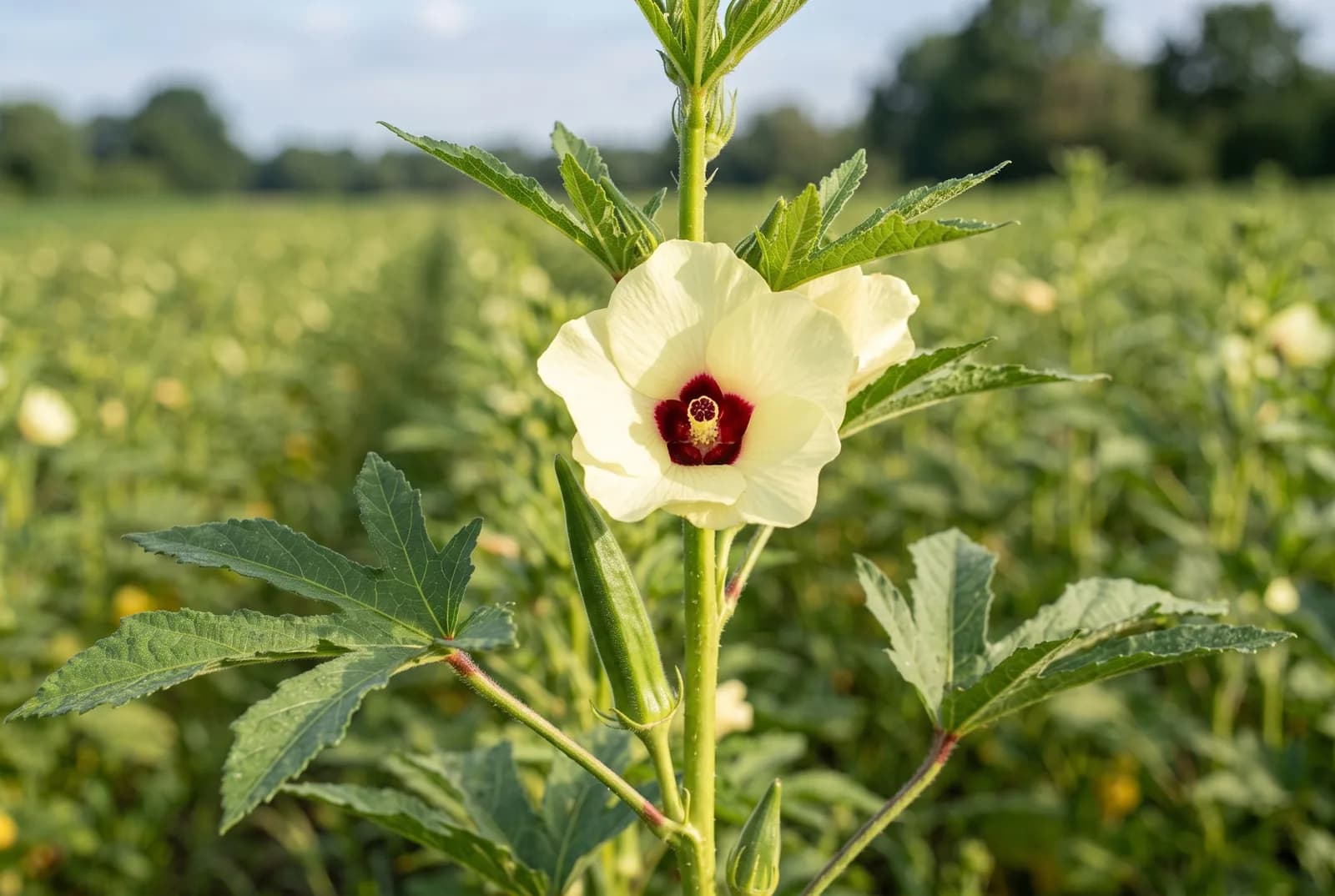
- Okra is related to hibiscus, not to eggplant, pepper or tomato, even though pesticide labels often list them together, and shares few pests with them.1
- Transplants in the North
- Okra is a warm-season crop that is nearly always started with transplants in northern climates. Transplants produce pods in 30–40 days against 50–65 days from seed.1
Plant into warm soil
Between rows: 91 cm (36 in) · Within the row: 30–46 cm (12–18 in)
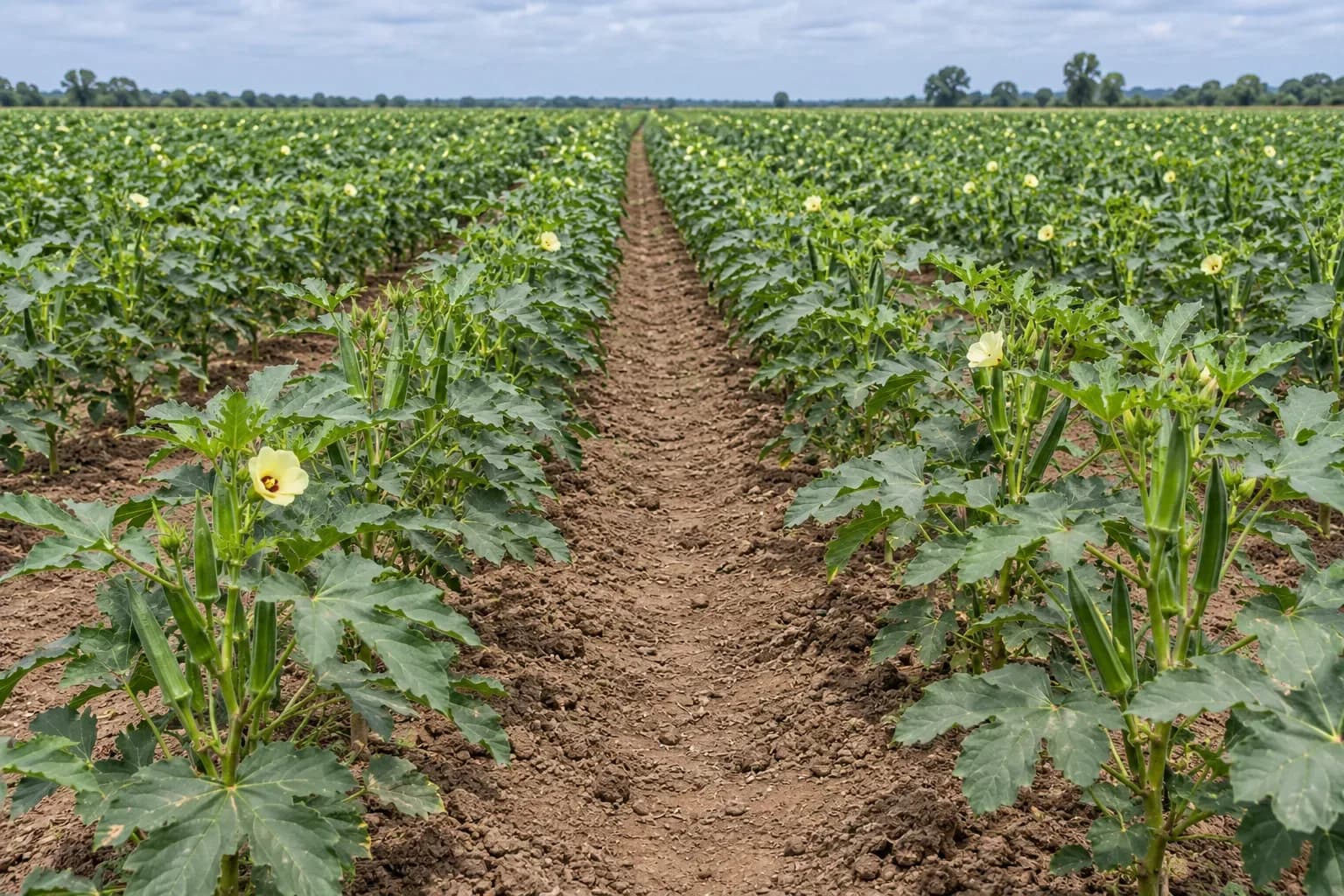
Seed 30–46 cm (12–18 in) apart in rows 91 cm (36 in) apart (Midwest guide). Georgia uses rows 71–97 cm (28–38 in) and plants thinned to 20–30 cm (8–12 in). Schematic, not to scale.
- Soil temperature
- Seed only after the soil has warmed to 18–21°C (65–70°F) for several days. Black plastic mulch with drip irrigation increases yields.1
- Georgia seed rate
- University of Georgia sows 13.5–16.8 kg of seed/ha (12–15 lb of seed per acre), 13.1–19.7 seeds per m (4–6 seeds per foot) at 4–5 cm (1½–2 inches) deep, with rows 71–97 cm (28–38 inches) apart and plants thinned to 20–30 cm (8–12 inches).2
Lime and feed
- pH first
- Hold pH at 6.0–6.5. Okra is very sensitive to low-pH soils.1
- Nitrogen schedule
- Before planting apply 45 kg N/ha (40 lb N per acre), 0–225 kg/ha (0–200 lb/acre) P2O5 and 0–335 kg/ha (0–300 lb/acre) K2O according to soil test, then sidedress 45 kg N/ha (40 lb N per acre) after the first harvest. University of Georgia sidedresses 37 kg/ha (33 lb/acre) N per application.1,2
- Do not overdo N
- Aphid populations spike in hot weather and when plants have excess nitrogen.1
Protect against aphids, nematodes and wilt
- Aphids and mites
- Scout both leaf surfaces for aphids, shed skins and honeydew. Aphids transmit viruses; treatment limits spread but does not reverse symptoms. Mites spike in hot, dry weather and show as white flecks with webbing.1
- Fusarium wilt and rotation
- Use disease-free seed and transplants, avoid fields with a history of wilt and rotate to non-solanaceous, non-cucurbit crops for more than 6 years. Raised beds and mulch improve drainage and reduce splash.1
- Nematodes
- Okra is very susceptible to nematode damage, and Fusarium wilt increases significantly where root-knot nematodes are present (University of Georgia).2
- Weeds and caterpillars
- Postemergence broadleaf herbicides are limited, so combine preemergence herbicides with mechanical control. Corn earworm and other caterpillars and stink bugs also feed on okra; check labels for registered products.1
Pick often
- 1
Warm the soil
Wait for 18–21°C (65–70°F) soil; black plastic helps.
- 2
Establish
Seed 30–46 cm (12–18 in) apart or set transplants.
- 3
First pods
50–65 days from seed, 30–40 from transplants.
- 4
Pick every 2–3 days
Pods 5–10 cm (2–4 in) long; frequent picking makes the plant reset pods faster.
- 5
Feed once
Sidedress 45 kg/ha (40 lb/acre) N after the first harvest.
- Frequency and size
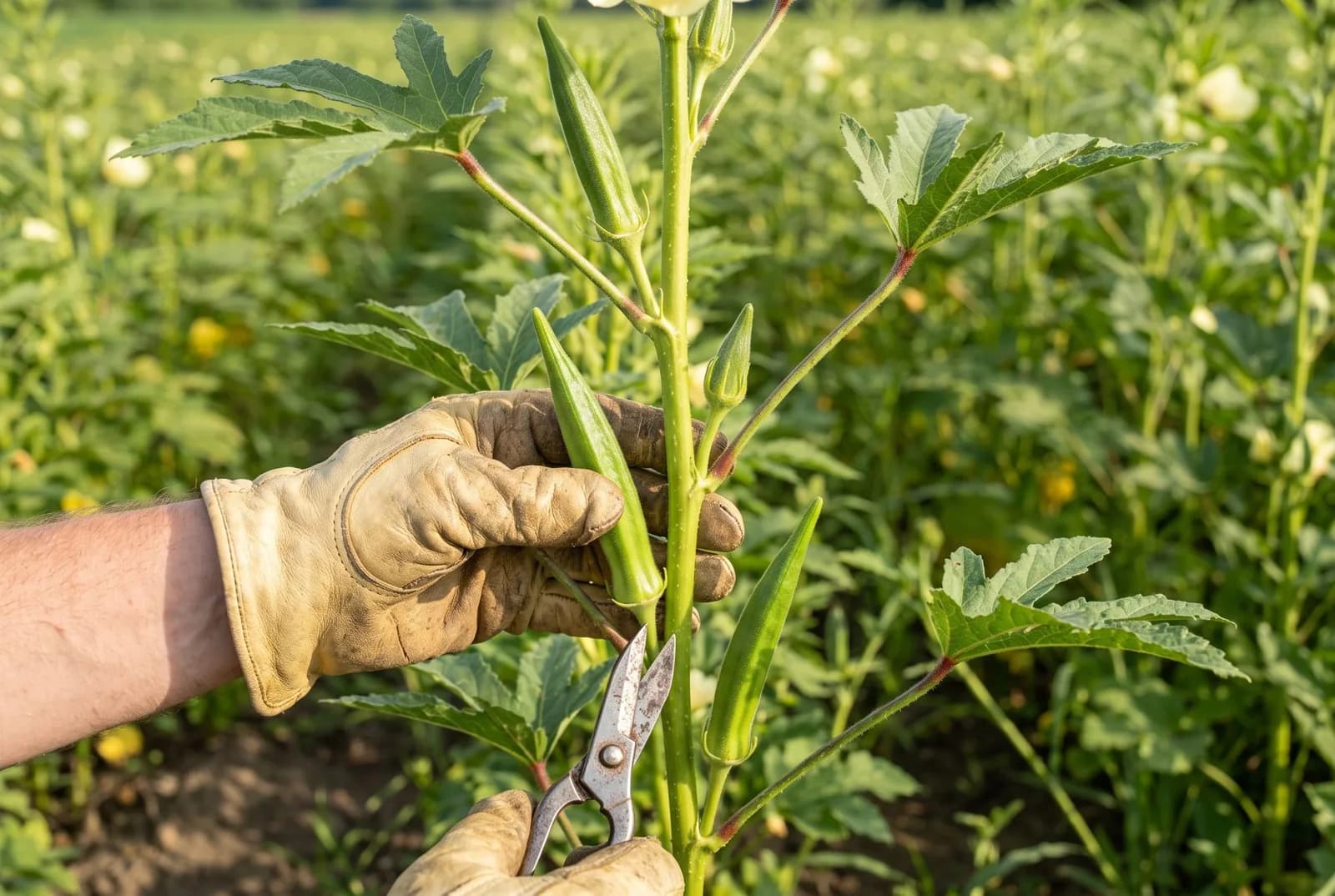
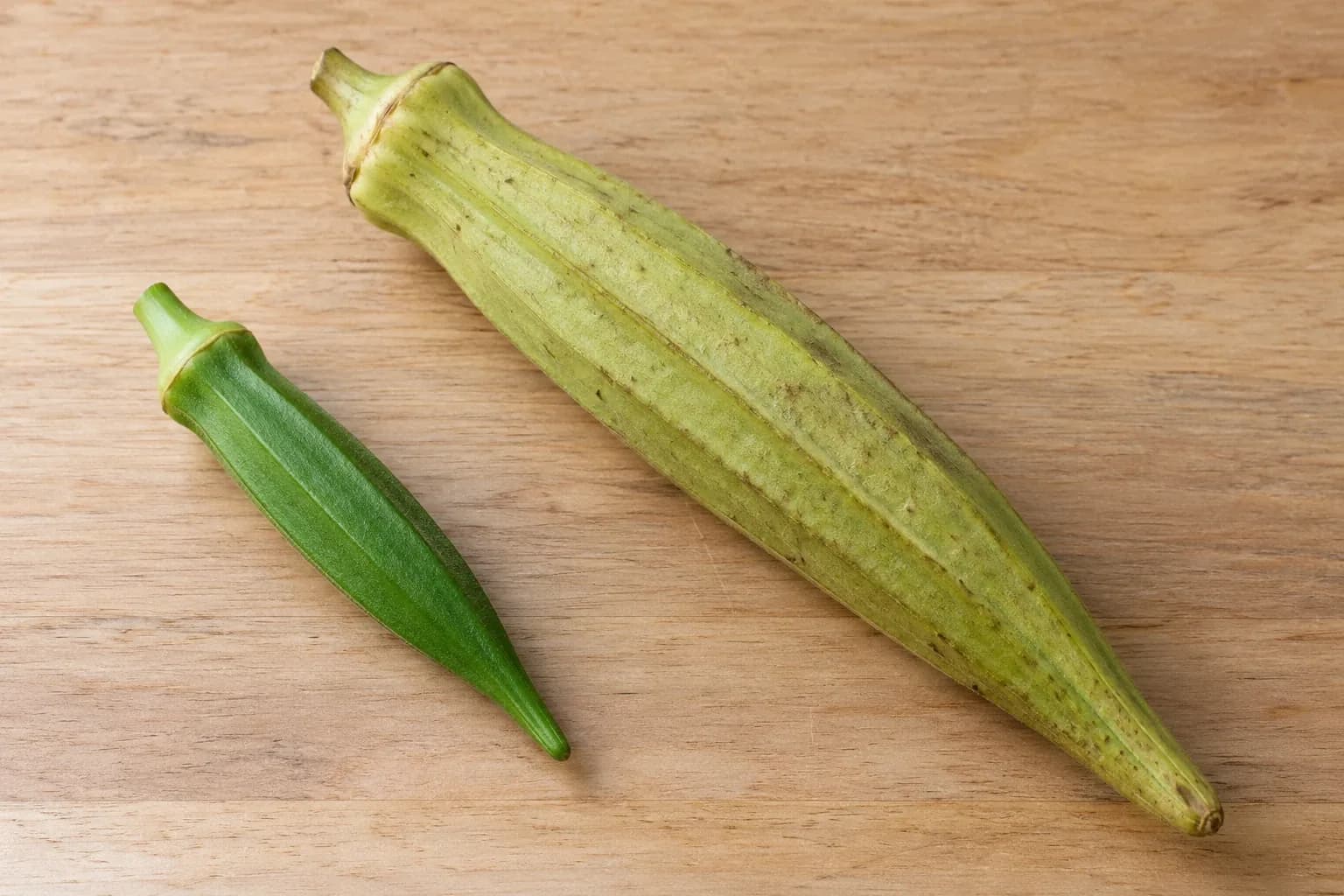
- Harvest every 2–3 days to keep pods at the best market size of 5–10 cm (2–4 inches). Frequent harvesting increases total yield. University of Georgia picks fresh-market okra daily and grades pods as Fancy (up to 9 cm (3.5 in)), Choice (9–11.5 cm (3.5–4.5 in)) and Jumbo (over 11.5 cm (4.5 in)).1,2
- Protect your hands
- Spiny varieties can irritate skin, so use gloves or choose a spineless variety.1
Yield and economics
The Midwest guide gives a yield of 8,970–11,210 kg/ha (8,000–10,000 pounds per acre). USDA NASS does not publish a national okra yield in its vegetable summary, so use local buyers and your own picking labour to set price and margin.
- Labour is the cost
- Picking every 2–3 days over many weeks makes harvest labour the largest cost. Enter your own wage, price and yield in the crop ROI estimator.1
Frequently asked questions
- When do you plant okra?
- Only after the soil has warmed to 18–21°C (65–70°F) for several days. In northern climates most growers start with transplants.
- How far apart do you plant okra?
- The Midwest guide seeds 30–46 cm (12–18 inches) apart in rows 91 cm (36 inches) apart. University of Georgia uses rows 71–97 cm (28–38 inches) apart with plants thinned to 20–30 cm (8–12 inches).
- How long does okra take to grow?
- About 50–65 days from seed to first harvest, or 30–40 days from transplants.
- How often should you pick okra?
- Every 2 to 3 days, when pods are 5–10 cm (2–4 inches) long. Frequent picking increases yield.
- What pH does okra need?
- pH 6.0–6.5. It is very sensitive to acidic soil.
- How much does okra yield per hectare?
- The Midwest guide gives 8,970–11,210 kg/ha (8,000–10,000 pounds per acre).
Regional guides and field planning
Sources and image credits
- 1. Midwest Vegetable Production Guide 2026 — Okra: Horticulture, Diseases, Insects and Weeds — 2026 edition; horticulture reviewed 2024, diseases 2023, insects 2025. Midwest planting, spacing, pH, fertility, picking, yield, Fusarium wilt, aphids, mites and weeds.
- 2. University of Georgia Extension — Commercial Okra Production (C627) — Accessed 1 October 2026. Southern spacing, seed rate, sidedress rate, grades and nematode cautions. Georgia conditions.
Image credits
- Okra is a hibiscus relative: each pale-yellow flower with a dark red centre is followed by a pod.
- Okra in rows with a clear path between them for picking.
- Pick young pods every two to three days; the cut goes through the short stem above the pod.
- A young pod (left) next to an overgrown one (right). Pods that are left too long turn fibrous.
Figures are published averages or study assumptions for the places named, not guarantees for your field. Check current local recommendations and product labels before acting.
Some visuals in this guide are illustrations rather than photographs of a specific farm. See image credits.