

Planning an English-walnut orchard in Brazil
Before planting an English-walnut orchard in Brazil, check soil drainage, winter chill, spring frost and cultivar performance at comparable local sites. Order trees identified as Juglans regia and confirm a buyer for their nuts. Pecan (Carya illinoinensis), also sold as “noz” in Brazil, is a different crop with its own orchard requirements.
Scope: Use this guide to assess your site, choose planting material and plan pollination and harvest for a perennial English-walnut orchard. Updated 2026-10-07.
At a glance
- Statistics caution
- IBGE’s “Noz” category does not itself verify Juglans regia species4
Perennial growth and climate in Brazil
A perennial planting remains in the field for multiple years. Establishment is a long-term investment; flowering, fruit development, harvest and plant care recur as the planting matures. Follow the named cultivar and production system.
Establish a long-lived planting5,6
Match nursery delivery and field preparation to the selected cultivar and local conditions. Confirm drainage, rooting depth and water access before planting. Ask your local adviser to set planting dates for your district.
Management: Track dormancy, bloom and pollination5,6
Compare local winter chill and frost exposure with cultivar performance. Record male and female flowering overlap; arrange a suitable pollen source if needed. Use observed tree stages rather than a national month band.
Harvest: Confirm local maturity and handling5
Use cultivar and orchard observations to schedule harvest equipment, drying and storage. Confirm the picking season from mature orchards with the same cultivar in your district.
Historical monthly climate
Reference period: 1996-01-01 to 2025-12-31. ERA5-Land monthly mean soil temperature at 0–7 cm, air temperature and frost days at the regional reference point (-15, -50). Select a month to inspect its historical conditions.
Month tiles show mean air temperature.
January historical conditions
- Mean topsoil temperature
- 26.0°C
- Mean air temperature
- 25.0°C
- Mean frost days per month
- 0.0 days
Use this monthly history to assess winter exposure, seasonal heat and water planning. It does not calculate cultivar chill hours, flowering dates, frost damage during bloom or fruit maturity. Topsoil at 0–7 cm describes shallow soil context, not the full root zone. Harvest periods follow the production evidence above.
Climate source: Open-Meteo Historical Weather APIConfirm the crop before ordering trees
- 1
Read the scientific name
Confirm Juglans regia for English walnut.
- 2
Keep pecan separate
Carya illinoinensis is a different crop.
- 3
Verify market terminology
Do not rely on a generic “noz” label alone.
- 4
Match the farm plan
Use cultivar and production records for the intended species.
- Pecan is not English walnut
- Embrapa’s Brazilian orchard and production publications identify pecan as Carya illinoinensis. English walnut is Juglans regia. The species differ in climate needs, orchard practices, processing and market, so the nursery order, orchard plan and sales contract must name the intended crop.1,2,3
Check soil, winter chill and flowering
- 1
Inspect the soil profile
Check drainage, permeable rooting depth and water-table constraints.
- 2
Compare cultivar records
Review local dormancy release, frost exposure and fruiting.
- 3
Match rootstock and scion
Consider soil conditions and known disease risks together.
- 4
Check bloom overlap
Arrange a compatible pollen source where needed.
- Match the cultivar and rootstock to the field
- English walnut needs deep, permeable soil with good drainage; shallow soil and a high water table are poor orchard conditions. Winter chill supports dormancy release, while spring frost can damage flowers and young nuts. UC Davis cautions that exact chill requirements are poorly established for many cultivars. Compare local flowering and fruiting records rather than applying one chill-hour number across Brazil. Choose the rootstock for the soil and disease risks, and confirm overlapping pollen release and receptive female flowers.5,6
Treat generic walnut statistics with caution
- 1
Check source taxonomy
Look for a species-specific label, not only “Noz”.
- 2
Separate pecan supply
Keep Carya statistics out of walnut totals.
- 3
Find verified buyers
Confirm product, kernel quality and price.
- 4
Update production data
Use current regional statistics after species validation.
- IBGE’s commodity label is not species proof
- The IBGE “Noz” production category does not by itself establish that reported crop area and output are Juglans regia. Verify which species the totals cover before using them to estimate competing supply, regional acreage or market size.4
Validate the orchard plan before scaling
- 1
Clarify the intended crop
Confirm English walnut versus pecan.
- 2
Locate local field evidence
Seek documented Juglans regia commercial plantings.
- 3
Check climate and stock
Verify cultivar, chill, pollination and nursery access.
- 4
Build buyer and cost evidence
Confirm quality, handling and viable demand.
- Require local performance records
- Before committing acreage, ask the nursery and local adviser for cultivar-specific records of winter chill, spring frost, flowering overlap, tree survival, harvest and kernel quality at comparable Brazilian sites. Confirm the water supply, handling equipment and buyer specification. A pecan orchard’s performance cannot establish expected English-walnut yield or profit.1,2,3,4
Frequently asked questions
- Can I establish a commercial English-walnut orchard in Brazil?
- Assess your site and cultivar before investing. Ask a local adviser and nursery for records from Juglans regia orchards or trials with comparable soil and climate, including tree survival, flowering, yield and kernel quality. Brazilian pecan production figures cannot establish the expected performance of your walnut orchard.
- Is pecan the same as walnut?
- No. Pecan is Carya illinoinensis; English walnut is Juglans regia. Do not transfer their orchard guidance or statistics.
- What spacing should an English-walnut orchard use in Brazil?
- Choose spacing with a local adviser using the walnut cultivar, rootstock, canopy system and machinery access. Allow room for the mature canopy and harvest equipment. Use an English-walnut layout suited to your site rather than copying a pecan orchard.
- Does IBGE’s “Noz” data refer to English walnut?
- The category label alone does not prove that the totals are Juglans regia. Confirm the statistical classification before using it for English walnut.
Put your own numbers in
Sources and image credits
- 1. Embrapa — Panorama da produção, processamento e comercialização de noz-pecã — 2023. Brazilian pecan production, processing and marketing; explicitly Carya illinoinensis, not English walnut.
- 2. Embrapa — Basic practices from pecan planting to harvest — Technical circular. Pecan orchard practices, cited to distinguish the crop from Juglans regia.
- 3. Embrapa — Bases for sustainable pecan production in Brazil — Research program. Brazilian pecan research and geographic context; not an English-walnut protocol.
- 4. IBGE — Agricultural production: Noz — Current commodity page. Commodity category requires species verification before use as Juglans regia data.
- 5. UC Davis — Walnut rootstock and scion selection — Updated March 23, 2022. English-walnut cultivar, rootstock, winter chill and pollination principles from California. Does not establish Brazilian cultivar performance or planting and harvest months.
- 6. UC Davis — Walnuts in California — Updated March 23, 2022. Juglans regia identity, soil drainage, frost and flowering biology. California calendar, cultivar and production figures are not presented as Brazilian recommendations.
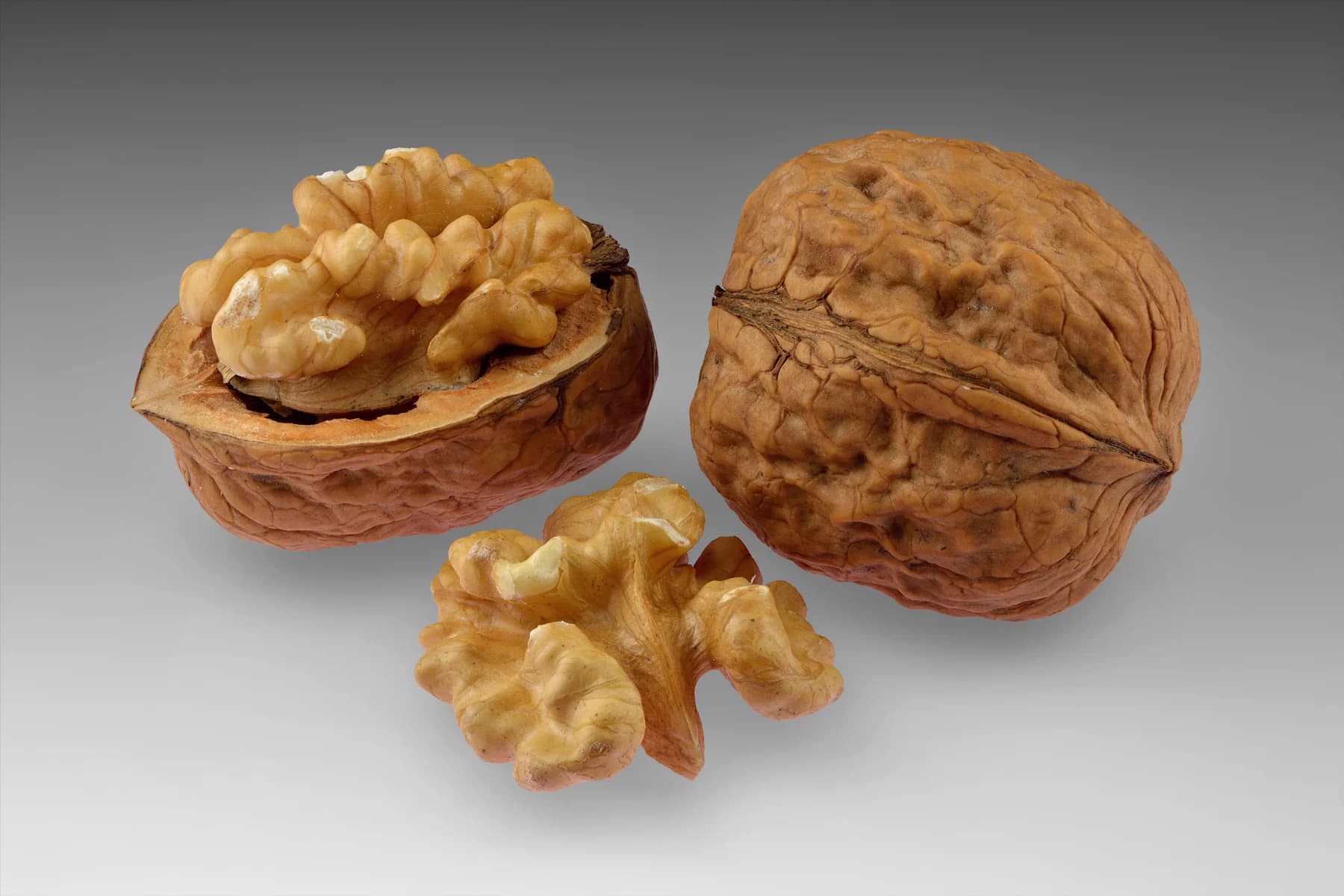
- 7. Walnuts — whole and open with halved kernel — Ivar Leidus — January 6, 2021; CC BY-SA 4.0. Walnut product photograph. Does not document Brazilian production, local cultivars or an orchard harvest system.
- 8. Fruit photograph license — CC BY-SA 4.0 — Creative Commons Attribution-ShareAlike 4.0. The resized fruit photograph retains its original share-alike license.
Image credits
- Walnuts and kernels. Photo: Ivar Leidus, CC BY-SA 4.0; resized under the same license. Product reference, not a Brazilian orchard or pecan fruit.
Figures are published averages or study assumptions for the places named, not guarantees for your field. Check current local recommendations and product labels before acting.