

Pomelo farming in India: Northeast evidence
Pomelo (Citrus maxima, also called pummelo) is a real northeastern Indian fruit, but recent ICAR material describes most Indian production as household-scale. Meghalaya’s public production and planting-material records are useful local context; they do not establish a current scalable commercial orchard package.
Scope: Pomelo in Meghalaya and Northeast India, not true grapefruit or a pan-India commercial recommendation. Historical state figures and local genotype work are dated and labeled. Updated 2026-10-07.
At a glance
Perennial growth and climate in India
A perennial planting remains in the field for multiple years. Establishment is a long-term investment; flowering, fruit development, harvest and plant care recur as the planting matures. Follow the named cultivar and production system.
Establish a long-lived planting1,2,3,4,5
Choose establishment timing with a local adviser using your cultivar, planting material and field conditions in India. A single month cannot cover every site and production system. The historical climate display describes one regional reference point.
Historical monthly climate
Reference period: 1996-01-01 to 2025-12-31. ERA5-Land monthly mean soil temperature at 0–7 cm, air temperature and frost days at the regional reference point (22, 79). Select a month to inspect its historical conditions.
Month tiles show mean air temperature.
January historical conditions
- Mean topsoil temperature
- 19.8°C
- Mean air temperature
- 18.5°C
- Mean frost days per month
- 0.0 days
Use this monthly history to assess winter exposure, seasonal heat and water planning. It does not calculate cultivar chill hours, flowering dates, frost damage during bloom or fruit maturity. Topsoil at 0–7 cm describes shallow soil context, not the full root zone. The monthly history does not establish a local flowering, maturity or harvest period.
Climate source: Open-Meteo Historical Weather APIKeep pomelo separate from grapefruit
- 1
Confirm species
Use Citrus maxima planting material and record local cultivar names.
- 2
Identify local production area
Use Meghalaya and Northeast records only within their dates and scope.
- 3
Separate household and commercial scale
Do not assume tree presence equals a market-oriented orchard.
- 4
Find a buyer pathway
Verify aggregation, grading and transport for intended volume.
Use state statistics as historical context
- 1
Check district data year
Date the state statistics when using them.
- 2
Verify planting material
The 2018–19 list shows nursery context from that period only.
- 3
Record genotype response
Use the ICAR evaluation as research, not a universal cultivar ranking.
- 4
Update farm records
Seek current acreage, harvest and buyer data before expansion.
- Old area data do not establish current farm scale
- Meghalaya’s public area/production table covers 2013–14 and 2014–15. It can show historic district presence, but should not be presented as current output or used to forecast an orchard’s yield.1
Build local evidence before scaling
- 1
Compare local genotypes
Record fruit quality and yield over multiple seasons.
- 2
Test field conditions
Measure drainage, soil, water and elevation.
- 3
Document management
Track planting density, pruning, nutrients and pest symptoms.
- 4
Confirm market fit
Test grading, handling, aggregation and buyer demand.
- No current commercial package was found
- Available sources do not verify current commercial spacing, irrigation, fertilizer, harvest timing, packout or farm economics for Meghalaya pomelo. Treat this as a development opportunity requiring locally measured orchard and market data, not a turnkey recommendation.1,3,4,5
Do not infer planting windows from climate averages
- 1
Confirm healthy nursery stock
Check cultivar and source with the state horticulture system.
- 2
Assess drainage and water
Verify field conditions and dry-season availability.
- 3
Check local elevation and exposure
Do not generalize across the Northeast.
- 4
Document establishment outcomes
Track survival and growth before defining a local window.
Frequently asked questions
- Is pomelo grown in India?
- Yes. ICAR describes pummelo in India, particularly in the Northeast, and state records document historic Meghalaya production and planting material.
- Is pomelo the same as grapefruit?
- No. Pomelo is Citrus maxima; true grapefruit is Citrus × paradisi. Keep species, cultivars and production information separate.
- Is there a commercial pomelo guide for Meghalaya?
- The reviewed sources do not establish a current scalable orchard package. Most Indian production is described as household-scale, so commercial guidance needs local trial and market data.
- When should pomelo be planted in Northeast India?
- The reviewed sources do not verify a current region-specific establishment month or temperature threshold. Consult state horticulture guidance and assess field readiness locally.
Put your own numbers in
Sources and image credits
- 1. Meghalaya Directorate of Horticulture — District fruit area and production statistics — 2013–15. Historic district-level fruit production context; not current orchard economics.
- 2. Meghalaya Directorate of Horticulture — Registered planting-material list — 2018–19. Historic nursery and planting-material availability context.
- 3. ICAR Research Complex for NEH Region — Citrus maxima genotype evaluation — Research paper. Local pummelo genotype evaluation; research evidence, not a commercial package.
- 4. ICAR, Indian Horticulture — Pummelo: A future fruit for human health and wellness — May–June 2026. Indian pummelo species and production context; describes predominantly household-scale cultivation.
- 5. APEDA — Northeast Region strategy and action plan — 2024. Regional horticulture and value-chain development context; not pomelo-specific rates.
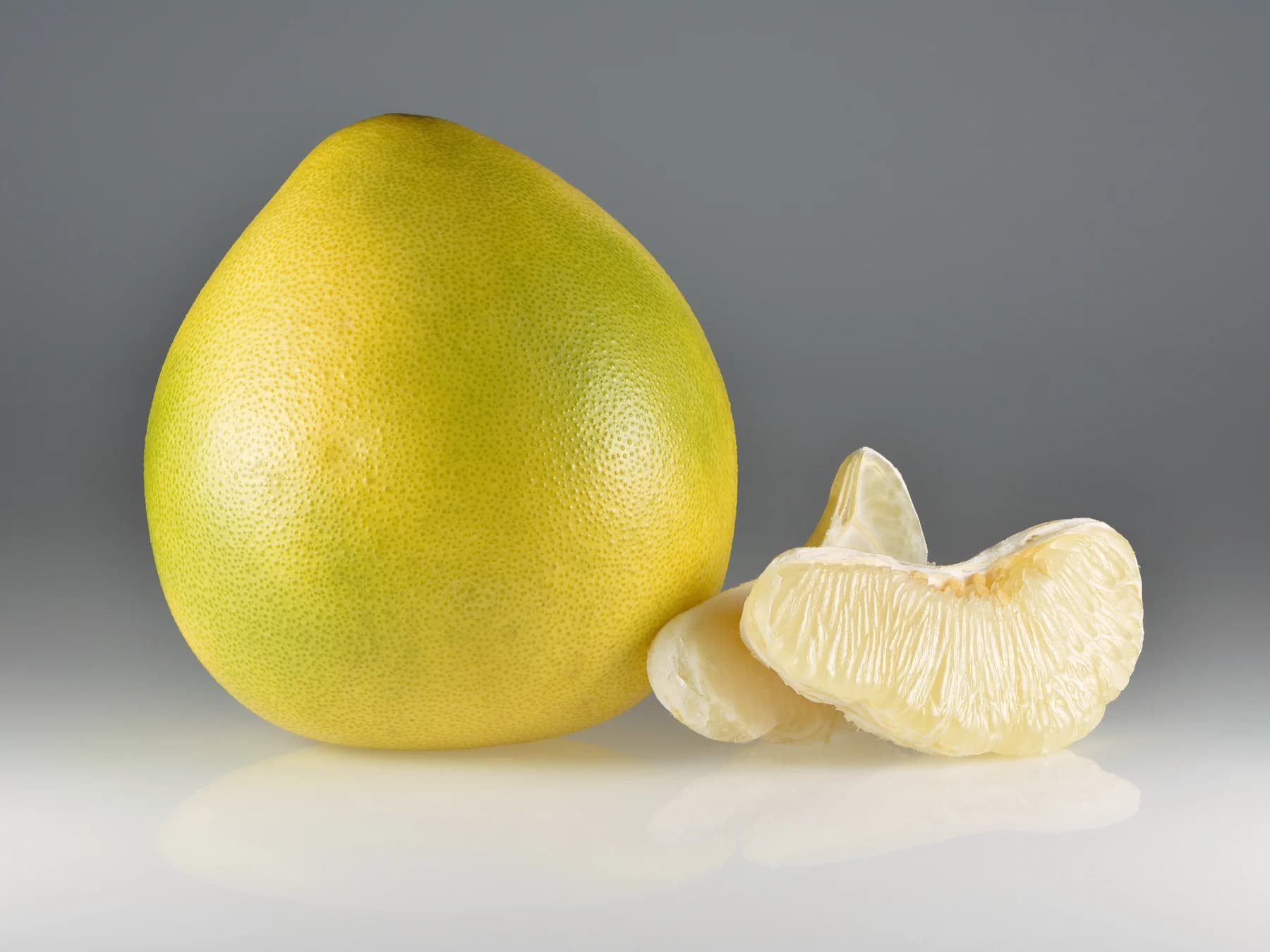
- 6. Pomelo fruit — Ivar Leidus — December 31, 2020; CC BY-SA 4.0. Pomelo fruit photograph. Does not establish Indian location, cultivar identity or harvest maturity standards.
- 7. Fruit photograph license — CC BY-SA 4.0 — Creative Commons Attribution-ShareAlike 4.0. The resized fruit photograph retains its original share-alike license.
Image credits
- Pomelo fruit and segments. Photo: Ivar Leidus, CC BY-SA 4.0; resized under the same license. Fruit reference, not an Indian orchard or identified regional cultivar.
Figures are published averages or study assumptions for the places named, not guarantees for your field. Check current local recommendations and product labels before acting.