

Growing persimmon in California
California commercial persimmons are Japanese persimmon (Diospyros kaki), including non-astringent Fuyu/Jiro and astringent Hachiya types. UC sources identify production districts and useful orchard context, but detailed spacing and harvest figures are largely from older publications and should be treated as historical pending current local confirmation.
Scope: Commercial Japanese persimmon in California. Cultivar class and harvest maturity are kept distinct; older UC production figures are explicitly dated. Updated 2026-10-07.
At a glance
Perennial growth and climate in California
A perennial planting remains in the field for multiple years. Establishment is a long-term investment; flowering, fruit development, harvest and plant care recur as the planting matures. Follow the named cultivar and production system.
Establish a long-lived planting1,2,3
No current statewide planting-month recommendation was verified. Confirm cultivar, rootstock, frost exposure, drainage and local nursery timing before establishing an orchard.
Management: Manage by cultivar and fruit type1,2,3
Fuyu/Jiro and Hachiya types have different maturity and handling needs. Use district and cultivar observations rather than treating the historical climate tiles as a production calendar.
Harvest: Historical California harvest reference2
A 1999 UCANR crop profile reports late September to early December. This is dated broad context, not a current county or cultivar forecast.
Historical monthly climate
Reference period: 1996-01-01 to 2025-12-31. ERA5-Land monthly mean soil temperature at 0–7 cm, air temperature and frost days at the regional reference point (37, -120). Select a month to inspect its historical conditions.
Month tiles show mean air temperature.
September historical conditions
- Mean topsoil temperature
- 28.2°C
- Mean air temperature
- 25.5°C
- Mean frost days per month
- 0.0 days
Use this monthly history to assess winter exposure, seasonal heat and water planning. It does not calculate cultivar chill hours, flowering dates, frost damage during bloom or fruit maturity. Topsoil at 0–7 cm describes shallow soil context, not the full root zone. Harvest periods follow the production evidence above.
Climate source: Open-Meteo Historical Weather APIChoose fruit type and market maturity
- 1
Select fruit type
Choose Fuyu/Jiro or Hachiya to match the buyer.
- 2
Confirm cultivar and rootstock
Use current California nursery and extension guidance.
- 3
Plan orchard structure
Account for cultivar vigor, training and field machinery.
- 4
Define grade and maturity
Set fruit handling to the target market.
Assess soil salinity, drainage and frost risk
- 1
Test soil and water
Check salinity, boron and drainage.
- 2
Review frost history
Assess bloom exposure after early warm spells.
- 3
Check summer conditions
Avoid assuming hot desert sites fit the crop.
- 4
Get county advice
Confirm locally adapted cultivars and current practices.
Treat older spacing as a historical reference
- 1
Choose cultivar and training
Canopy size affects usable orchard density.
- 2
Check machinery access
Plan alleys for pruning, spray equipment and harvest.
- 3
Design irrigation
Use current water availability and system guidance.
- 4
Validate costs
Include labor, packout and replacement costs.
- The detailed California profile dates to 1999
- UCANR’s crop profile describes spacing examples around 16–24 ft depending on cultivar and training, along with furrow or micro-sprinkler irrigation. These are historical commercial-system examples, not current statewide prescriptions; verify density and water practice with local extension.2,3
Use old harvest dates as context, not a promise
- 1
Identify the fruit type
Set distinct harvest maturity for astringent and non-astringent varieties.
- 2
Sample blocks repeatedly
Use current county and buyer protocols.
- 3
Handle by market route
Protect delicate fruit and follow packing requirements.
- 4
Update production statistics
Use current NASS or county reports rather than 2012 figures.
- Refresh county and cultivar records
- The 1999 crop profile reports a broad late-September-to-early-December harvest period and cultivar-specific differences. UC Davis’s public production figures refer to 2012. Use these only as historical context and refresh current acreage, yield and harvest guidance before making commercial projections.1,2,4
Frequently asked questions
- Where are persimmons grown in California?
- UC Davis identifies San Joaquin Valley districts and San Diego County in its California crop overview.
- What is the difference between Fuyu and Hachiya persimmons?
- Fuyu/Jiro types are non-astringent, while Hachiya types are astringent and require different maturity and handling decisions.
- How far apart should persimmons be planted in California?
- A 1999 UCANR profile gives historic examples around 16–24 ft, varying with cultivar and training. Confirm current local layout advice before establishing an orchard.
- When are persimmons harvested in California?
- An older UCANR profile reports late September to early December. Treat it as historical statewide context; actual timing depends on cultivar and district.
Put your own numbers in
Sources and image credits
- 1. UC Davis Fruit and Nut Research and Information Center — Persimmon in California — Page updated 2022; production statistics from 2012. California districts, climate context, cultivar types and historic production statistics.
- 2. UC ANR — Crop Profile for Persimmons in California — December 1999. Historical commercial cultivars, spacing, irrigation, harvest period and field management; old pesticide data excluded.
- 3. UC ANR — Growing Persimmons in California — Historical UC publication; publication date unverified. California crop context and orchard considerations; historical publication.
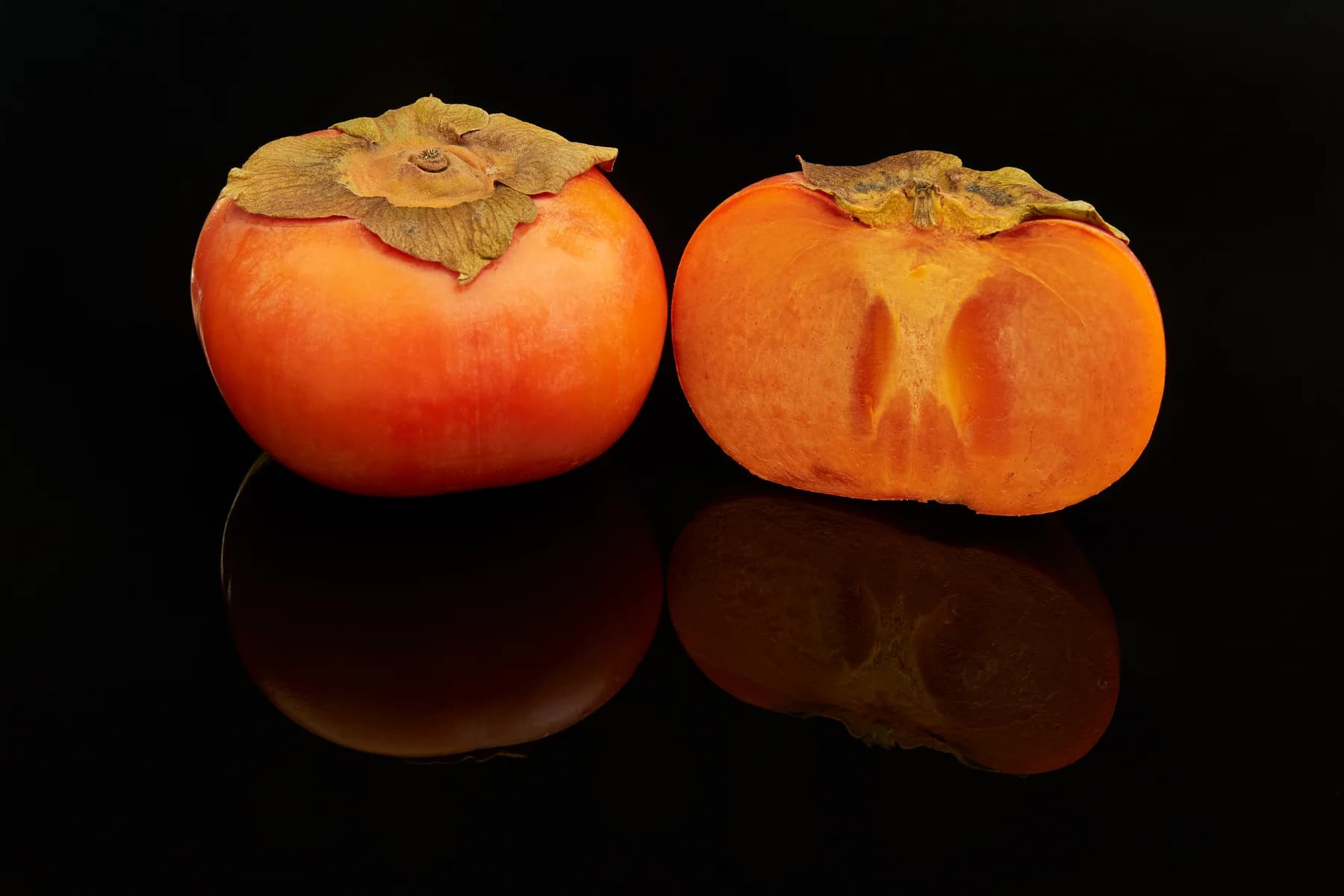
- 4. Fuyu persimmon fruits, one cut open — Frank Schulenburg — November 19, 2017; CC BY-SA 4.0. Diospyros kaki, Fuyu fruit identification. Does not show Hachiya fruit or a commercial orchard.
- 5. Fruit photograph license — CC BY-SA 4.0 — Creative Commons Attribution-ShareAlike 4.0. The resized fruit photograph retains its original share-alike license.
Image credits
- Fuyu persimmon (Diospyros kaki), whole and cut. Photo: Frank Schulenburg, CC BY-SA 4.0; resized under the same license. Fruit reference, not an orchard or a Hachiya-type persimmon.
Figures are published averages or study assumptions for the places named, not guarantees for your field. Check current local recommendations and product labels before acting.