

Growing pear in Brazil
The strongest Brazilian commercial pear example is the irrigated tropical semiarid system in the Submédio São Francisco Valley. It uses low-chill cultivars and crop regulation to induce and stagger production; it is distinct from temperate pear orchards in southern Brazil and should not be generalized nationally.
Scope: Low-chill commercial pear production in the irrigated Vale do São Francisco, especially Petrolina. Southern temperate orchards and other cultivars are separate systems. Updated 2026-10-07.
At a glance
- Documented layout
- 4.0 × 1.25 m, about 2,000 plants/ha in that system1
Perennial growth and climate in Brazil
A perennial planting remains in the field for multiple years. Establishment is a long-term investment; flowering, fruit development, harvest and plant care recur as the planting matures. Follow the named cultivar and production system.
Establish a long-lived planting1,2,3,4
Choose establishment timing with a local adviser using your cultivar, planting material and field conditions in Brazil. A single month cannot cover every site and production system. The historical climate display describes one regional reference point.
Historical monthly climate
Reference period: 1996-01-01 to 2025-12-31. ERA5-Land monthly mean soil temperature at 0–7 cm, air temperature and frost days at the regional reference point (-15, -50). Select a month to inspect its historical conditions.
Month tiles show mean air temperature.
January historical conditions
- Mean topsoil temperature
- 26.0°C
- Mean air temperature
- 25.0°C
- Mean frost days per month
- 0.0 days
Use this monthly history to assess winter exposure, seasonal heat and water planning. It does not calculate cultivar chill hours, flowering dates, frost damage during bloom or fruit maturity. Topsoil at 0–7 cm describes shallow soil context, not the full root zone. The monthly history does not establish a local flowering, maturity or harvest period.
Climate source: Open-Meteo Historical Weather APIUse low-chill cultivars adapted to the valley
- 1
Choose a named low-chill cultivar
Use local adaptation evidence, not generic pear assumptions.
- 2
Verify planting material
Confirm cultivar and rootstock identity.
- 3
Plan orchard density
The documented system used 4.0 × 1.25 m.
- 4
Confirm a market outlet
Match cultivar, fruit size and delivery window to the buyer.
Keep the Embrapa spacing tied to its source system
- 1
Mark 4 m row alleys
The source system reports 4.0 m between rows.
- 2
Set 1.25 m in-row spacing
This creates the cited 2,000 plants/ha density.
- 3
Confirm trellis and access
Align support and equipment with orchard design.
- 4
Record survival and growth
Use local establishment results to validate density.
- The reported 2,000 plants/ha is not a national density
- Embrapa’s technology summary reports 4.0 × 1.25 m and 2,000 plants/ha for the target semiarid production system. Treat the layout as a documented regional reference and confirm support, machinery, cultivar and local management before using it.1
Manage irrigation and crop regulation locally
- 1
Measure irrigation delivery
Record system, depth and crop response.
- 2
Check soil moisture
Adjust for site, cultivar and stage.
- 3
Plan pruning and bending
Use locally validated phenology and crop-regulation guidance.
- 4
Review product registration
Verify current labels before any chemical regulation.
- Use irrigation studies as system evidence, not fixed schedules
- Embrapa’s 2023 trial evaluated irrigation systems and water depths on cultivar Triunfo. The abstract confirms water management is an active production variable; it does not support a universal volume. Flowering induction and staggered production also depend on cultivar, season and local practice.3,4
Plan harvest from the induced crop cycle
- 1
Set target harvest lots
Coordinate cultivar and flowering decisions with demand.
- 2
Track bloom and fruit set
Use block-level dates and crop observations.
- 3
Sample harvest maturity
Use local standards and buyer specification.
- 4
Evaluate economics
Include irrigation, labor, crop regulation and packout.
- Do not mistake year-round potential for planting timing
- Regional Embrapa material discusses managed flowering and crop staggering. These are crop-scheduling practices in an irrigated semiarid orchard, not evidence that a pear can be planted in every month or that every farm can produce year-round.3,4
Frequently asked questions
- Where are pears grown commercially in Brazil?
- Embrapa documents an irrigated low-chill system in the Vale do São Francisco, especially the Submédio São Francisco region. It is distinct from southern temperate production.
- Which pear cultivars are used in the São Francisco Valley?
- Embrapa’s regional technology summary identifies Triunfo, Princesinha and Centenária as low-chill cultivars.
- What spacing is used for pears in the semiarid region?
- The cited Embrapa system reports 4.0 × 1.25 m, or about 2,000 trees per hectare. This is a regional example, not a Brazil-wide recommendation.
- Can pears be harvested year-round in Brazil?
- Embrapa discusses managed flowering and staggered production as a system objective. It is not a guarantee for every orchard or evidence of month-by-month planting feasibility.
Put your own numbers in
Sources and image credits
- 1. Embrapa — Introduction of commercial pear cultivation in the Vale do São Francisco — Regional technology summary. Target region, low-chill cultivars, orchard density and commercial-system potential.
- 2. Embrapa — Pear cultivar information — Technical crop reference. Cultivar identity and adaptation background.
- 3. Embrapa — Production of pear cv. Triunfo under irrigation systems and depths — 2023. Commercial orchard irrigation-system and water-depth experiment on Triunfo.
- 4. Embrapa — Produção de pera no Vale do São Francisco — Regional technical publication. Pruning, branch bending, nutrition, irrigation and crop regulation in the semiarid system.
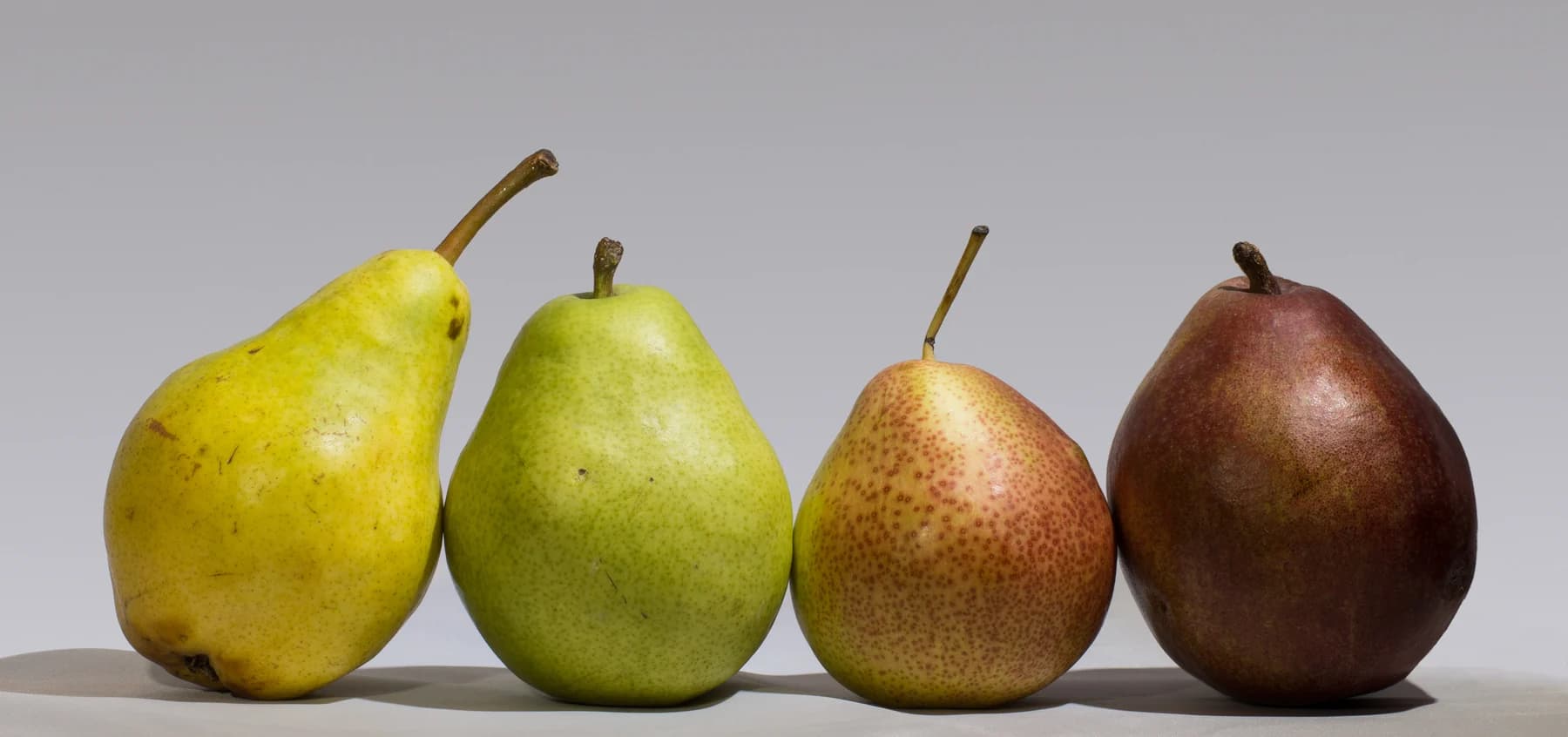
- 5. Four pears photograph — Rhododendrites — December 13, 2016; CC BY-SA 4.0. Bartlett, Anjou and Forelle fruit reference, with background/dust edits by Jebulon and W.carter. Does not show the Triunfo, Princesinha or Centenária cultivars described in the Brazilian guide.
- 6. Fruit photograph license — CC BY-SA 4.0 — Creative Commons Attribution-ShareAlike 4.0. The resized fruit photograph retains its original share-alike license.
Image credits
- Pear cultivar examples: green Bartlett, Anjou, Forelle and red Bartlett. Photo: Rhododendrites, with edits by Jebulon and W.carter; CC BY-SA 4.0; resized.
Figures are published averages or study assumptions for the places named, not guarantees for your field. Check current local recommendations and product labels before acting.