

Growing lettuce in Australia
Australian commercial lettuce spans field head, cos and leaf types as well as baby-leaf and protected systems. Current Queensland guidance gives different production seasons by region and emphasizes variety selection, moisture management and preharvest maturity checks. It does not establish one nationwide calendar or spacing plan.
Scope: Commercial field lettuce in Australia, with Queensland extension as the current regional example. Protected hydroponics and processed baby leaf are separate systems. Updated 2026-10-07.
At a glance
- Regional season context
- Lockyer Valley: autumn/winter/spring; Eastern Darling Downs and Granite Belt: spring/summer/autumn1
- Water risk
- Shallow roots make lettuce sensitive to water stress and tipburn1
- Spacing evidence
- Detailed Australian bed examples are in a 2004 NSW sheet and need current local validation3
Planting and harvest calendar for Australia
Use the source-backed production windows to coordinate establishment, crop care and harvest. Production districts and cultivars can have different cycles; the historical climate adds context for the field plan.
Planting: Queensland regional production seasons1
The Lockyer Valley source describes autumn/winter/spring production; the Eastern Darling Downs and Granite Belt describe spring/summer/autumn. These are broad crop seasons, not exact sowing dates. Check current district and variety advice.
Harvest: Harvest to maturity and buyer timing2
Queensland guidance recommends sampling heads about a week before expected harvest and checking internal packing and stem elongation. It does not set a statewide harvest-month band.
Historical monthly climate
Reference period: 1996-01-01 to 2025-12-31. ERA5-Land monthly mean soil temperature at 0–7 cm, air temperature and frost days at the regional reference point (-34.5, 147). Select a month to inspect its historical conditions.
Month tiles show mean topsoil temperature.
January historical conditions
- Mean topsoil temperature
- 29.1°C
- Mean air temperature
- 25.7°C
- Mean frost days per month
- 0.0 days
These are monthly means at one reference location. They describe seasonal field conditions, not crop maturity, actual seed-zone conditions, frost forecasts or a planting recommendation. Harvest bands follow the crop-specific production sources above.
Climate source: Open-Meteo Historical Weather APIDefine the lettuce product and buyer
- 1
Specify product type
Set head, cos, leaf or processing baby-leaf objective.
- 2
Select for region and season
Use the Queensland regional patterns only within their districts.
- 3
Confirm market volume
Lettuce is perishable; coordinate delivery and harvest.
- 4
Trial varieties
Compare new cultivars beside a locally accepted standard.
- Head, leaf and baby-leaf crops are not interchangeable
- Queensland guidance recommends choosing varieties for location and season and trialing new varieties beside local standards. Head and cos harvest, baby-leaf density and protected hydroponic production require different field and packout decisions.1,3
Match varieties to the Australian production region
- 1
Identify the district
Separate Lockyer Valley from the Darling Downs and Granite Belt.
- 2
Check heat exposure
Select a variety and crop period around local temperature risk.
- 3
Plan successive blocks
Use buyer needs and current state extension timing.
- 4
Keep records by variety
Track maturity, head quality, bolting and marketable yield.
- Regional schedules do not create one national calendar
- Business Queensland gives autumn/winter/spring production in the Lockyer Valley and spring/summer/autumn for the Eastern Darling Downs and Granite Belt. Heat can cause bolting or poor head quality; other states and protected systems need their own current schedules.1
Protect shallow-rooted crops from stress
- 1
Test soil and water
Identify drainage, nutrient and salinity constraints.
- 2
Monitor root-zone moisture
Use field sensors or local scheduling guidance.
- 3
Check tipburn risk
Maintain consistent growth and review variety response.
- 4
Avoid excess nitrogen
Use current soil and crop evidence rather than blanket rates.
- Use soil moisture and current local recommendations
- Queensland advice describes lettuce as shallow-rooted and sensitive to water stress and tipburn. Nitrogen requirements vary by variety, soil and season; excess can affect hearting, shelf life and acceptance. Avoid turning a historical national manual into a current fertilizer prescription.1,3
Sample heads before commercial harvest
- 1
Sample the block early
Check internal head fill about a week before expected harvest.
- 2
Look for stem elongation
Adjust timing to variety and warm conditions.
- 3
Plan cut count
Some blocks require one cut and others more than one.
- 4
Move promptly
Coordinate cooling and buyer collection for a perishable crop.
- Check internal packing and stem elongation
- Queensland’s harvest guidance recommends sampling heads about a week before expected harvest, checking internal leaf packing and the start of stem elongation. Warm conditions can accelerate maturity; one or two cuts may be required depending on crop and system.2
Frequently asked questions
- Where is lettuce grown in Australia?
- Queensland guidance describes several production regions, including the Lockyer Valley, Eastern Darling Downs and Granite Belt. Other states need their own crop-specific data.
- When is lettuce planted in Queensland?
- The Lockyer Valley’s broad production pattern is autumn, winter and spring; the Eastern Darling Downs and Granite Belt pattern is spring, summer and autumn. These are regional crop seasons, not planting-feasibility classifications.
- How much water does Australian lettuce need?
- Queensland advice emphasizes frequent moisture management because lettuce is shallow-rooted and sensitive to stress. Use current local scheduling rather than a single national volume.
- How do I know when lettuce is ready to harvest?
- Sample heads before the planned date and check internal leaf packing and the start of stem elongation, then harvest to the buyer’s size and quality requirements.
Put your own numbers in
Sources and image credits
- 1. Business Queensland — Growing lettuce — Current Queensland extension page. Regional season, variety, soil, fertility, water and field-production guidance.
- 2. Business Queensland — Harvesting lettuce — Current Queensland extension page. Preharvest sampling, maturity checks, temperature effect and cut planning.
- 3. NSW Department of Primary Industries — Field lettuce production — First edition May 2004. Historical commercial bed, irrigation and planting-system examples; validate before using current rates.
- 4. Lettuce crop-identification photo — en:User:Geographer — Wikimedia Commons; CC BY 1.0. Crop-identification image only; it is not a photograph of the named region or a production recommendation.
Image credits
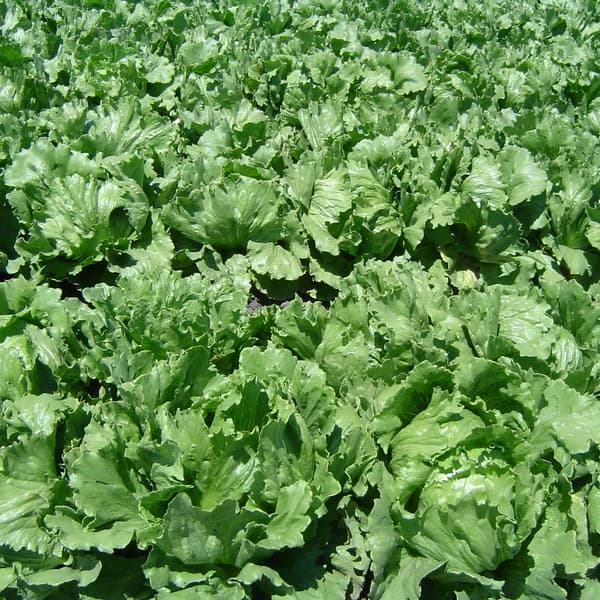
- Crop-identification photo; not a Australia production field. Photo: en:User:Geographer, CC BY 1.0.
Figures are published averages or study assumptions for the places named, not guarantees for your field. Check current local recommendations and product labels before acting.