

Kiwifruit farming in Punjab: site feasibility
Indian commercial kiwifruit references are concentrated in hill states, and the ICAR state list reviewed does not identify Punjab. Punjab should therefore be assessed site by site for winter chill, spring frost, summer heat, trellis needs, pollination and market access rather than treated as a validated production region.
Scope: Kiwifruit feasibility in Punjab, India. National guidance and hill-state production evidence are not presented as Punjab recommendations. Updated 2026-10-07.
At a glance
Perennial growth and climate in Punjab, India
A perennial planting remains in the field for multiple years. Establishment is a long-term investment; flowering, fruit development, harvest and plant care recur as the planting matures. Follow the named cultivar and production system.
Establish a long-lived planting1,2,3
Choose establishment timing with a local adviser using your cultivar, planting material and field conditions in Punjab, India. A single month cannot cover every site and production system. The historical climate display describes one regional reference point.
Historical monthly climate
Reference period: 1996-01-01 to 2025-12-31. ERA5-Land monthly mean soil temperature at 0–7 cm, air temperature and frost days at the regional reference point (30.9, 75.8). Select a month to inspect its historical conditions.
Month tiles show mean air temperature.
January historical conditions
- Mean topsoil temperature
- 13.0°C
- Mean air temperature
- 12.1°C
- Mean frost days per month
- 0.0 days
Use this monthly history to assess winter exposure, seasonal heat and water planning. It does not calculate cultivar chill hours, flowering dates, frost damage during bloom or fruit maturity. Topsoil at 0–7 cm describes shallow soil context, not the full root zone. The monthly history does not establish a local flowering, maturity or harvest period.
Climate source: Open-Meteo Historical Weather APIMeasure site conditions before choosing a cultivar
- 1
Record winter chill
Use multi-year site data and cultivar-specific thresholds.
- 2
Map frost exposure
Assess bloom-stage frost risk, not only annual minimums.
- 3
Assess summer heat
Check heat and water stress at the proposed elevation.
- 4
Request local review
Consult PAU or state horticulture experts before investment.
- Do not extend hill-state recommendations across Punjab
- The NHB model and ICAR review describe kiwifruit systems in Indian hill regions. Punjab has not been verified as a commercial production area in the reviewed state sources. Compare site-specific winter chill and frost exposure with cultivar requirements before planning an orchard.1,2,3
Plan a perennial orchard only after feasibility is proven
- 1
Select tested cultivars
Verify chilling fit, fruit market and female-male compatibility.
- 2
Design support system
Engineer trellis and anchoring for mature vine loads.
- 3
Secure planting stock
Confirm true-to-type, healthy plants and pollinizers.
- 4
Plan water and labor
Budget pruning, canopy training, irrigation and harvest.
- Pollinizer and trellis design are crop-critical
- The older NHB model describes a trellised orchard with male and female vines, but it is not a Punjab technical recommendation. Verify cultivar, pollination ratio, support design, spacing, irrigation and training with current local trial data before transferring any numeric layout.1,2
Check the packhouse and buyer route
- 1
Find a target buyer
Confirm cultivar, size, maturity and volume needs.
- 2
Check cold chain
Plan harvest, cooling, grading and transport.
- 3
Model orchard years
Include nonbearing establishment and trellis costs.
- 4
Test before scaling
Use a local pilot and measured crop records.
Avoid a statewide planting calendar
- 1
Choose cultivar first
Use verified chill and heat requirements.
- 2
Measure site history
Use local weather records and elevation.
- 3
Check bloom risk
Assess frost and pollination conditions.
- 4
Review trial survival
Track establishment before planting commercial acreage.
- Climate normals cannot verify cultivar chill
- Kiwifruit is perennial, so an annual month-feasibility map is not the right decision tool. The relevant test is whether a particular site meets cultivar-specific chill, frost, heat and water requirements, which the reviewed sources do not establish for Punjab.1,2
Frequently asked questions
- Is kiwifruit grown commercially in Punjab?
- Punjab-specific commercial evidence was not located in the reviewed sources. Indian commercial references focus on hill states, and the ICAR state list does not include Punjab.
- Can kiwifruit grow in Punjab?
- That depends on site-specific winter chill, frost, summer heat, water and cultivar requirements. A statewide suitability claim is not supported by the available evidence.
- How many chill hours does kiwifruit need?
- An older NHB model cites around 700–800 hours below 7°C for its general Indian context. Confirm the requirement for the chosen cultivar; it is not a Punjab recommendation.
- When should kiwifruit be planted in Punjab?
- No Punjab-specific planting month was verified. As a perennial crop, establishment timing should be based on local plant-stock guidance and site readiness, not a generic month map.
Put your own numbers in
Sources and image credits
- 1. National Horticulture Board — Kiwifruit model project — Older national model. General Indian kiwifruit biology, chill, elevation and orchard-system background; not Punjab advice.
- 2. ICAR — Indian Farming, July 2025 special issue — July 2025. Indian production states and perennial orchard context; Punjab not listed in the reviewed state list.
- 3. Lok Sabha — Ministry of Agriculture reply on exotic and state-promoted crops — 2021. Punjab crop-promotion context; does not list kiwifruit among crops cited for the state.
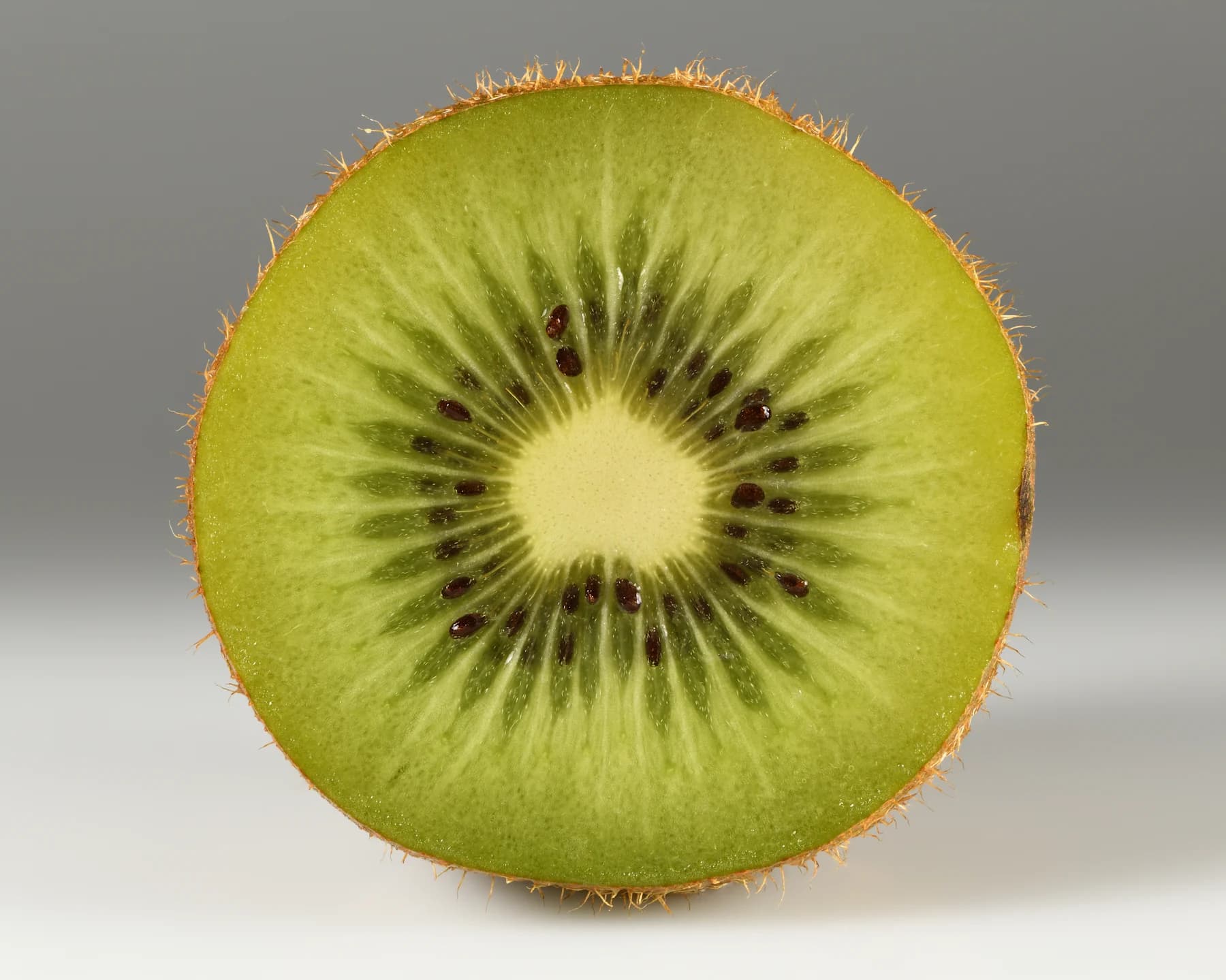
- 4. Kiwifruit cross section — Ivar Leidus — February 2, 2022. Focus-stacked Portugal-grown Hayward green kiwifruit. Product identification, not evidence of Punjab production or site suitability. Resized under the original license.
- 5. Fruit photograph license — CC BY-SA 4.0 — Creative Commons Attribution-ShareAlike 4.0. The resized fruit photograph retains its original share-alike license.
Image credits
- Hayward green kiwifruit grown in Portugal. Photo: Ivar Leidus, CC BY-SA 4.0; resized and converted to WebP.
Figures are published averages or study assumptions for the places named, not guarantees for your field. Check current local recommendations and product labels before acting.