

Growing florence fennel in France
French vegetable fennel is concentrated mainly in Provence-Alpes-Côte d’Azur and relies on imports for year-round supply. GRAB’s 2025 organic technical sheets describe separate PACA open-field spring/summer and protected autumn/winter systems. Bulb fennel requires a different crop plan from bitter fennel grown for seed and essential oil.
Scope: Commercial Florence/bulb fennel (Foeniculum vulgare var. azoricum) for fresh markets. PACA organic examples are not national prescriptions; bitter fennel is excluded. Updated 2026-10-07.
At a glance
Planting and harvest calendar for France
Use the source-backed production windows to coordinate establishment, crop care and harvest. Production districts and cultivars can have different cycles; the historical climate adds context for the field plan.
Planting: PACA open-field transplanting example3
GRAB’s 2025 spring/summer sheet describes early March–early May transplanting, with cold and wind protection through mid-April. Later May plantings have greater bolting risk. This is a southeastern France example, not a national sowing calendar.
Harvest: PACA open-field harvest example3,4
GRAB describes harvest from May 15 to July 10 for the spring/summer field system; dates vary with weather and cultivar. Its separate protected autumn/winter system harvests late November–early April. These are separate production systems, not a continuous harvest band.
Historical monthly climate
Reference period: 1996-01-01 to 2025-12-31. ERA5-Land monthly mean soil temperature at 0–7 cm, air temperature and frost days at the regional reference point (46.6, 2.4). Select a month to inspect its historical conditions.
Month tiles show mean topsoil temperature.
March historical conditions
- Mean topsoil temperature
- 7.5°C
- Mean air temperature
- 7.9°C
- Mean frost days per month
- 4.4 days
These are monthly means at one reference location. They describe seasonal field conditions, not crop maturity, actual seed-zone conditions, frost forecasts or a planting recommendation. Harvest bands follow the crop-specific production sources above.
Climate source: Open-Meteo Historical Weather APIChoose the market system and crop type
- 1
Confirm bulb fennel
Choose Florence fennel for the fresh vegetable market.
- 2
Select open-field or protected
PACA sources describe distinct crop cycles and varieties.
- 3
Match season and buyer
Plan around local demand and imported competition.
- 4
Exclude seed systems
Do not use bitter fennel production as bulb-fennel guidance.
- Keep vegetable and seed fennel separate
- CTIFL describes modest French vegetable fennel production concentrated mainly in PACA, supplemented by imports. FranceAgriMer also reports bitter fennel grown for essential oil; those fields are not bulb-fennel area and do not share the same harvest product.1,5
Use the PACA layout as a system-specific example
- 1
Prepare a drained bed
The source describes 1.2–1.5 m bed widths.
- 2
Set four crop lines
Use 25–30 cm between lines in the cited layout.
- 3
Transplant plugs
The sheet recommends plug transplants.
- 4
Target the stand
The reference gives 10–13 plants/m²; confirm with the variety and system.
- Bed geometry comes from organic trial guidance
- The GRAB 2025 open-field sheet describes 1.2–1.5 m beds with four lines 25–30 cm apart, 10–13 plants/m² and plug transplants. These details apply to that PACA organic system and its varieties, not every French farm.3
Maintain moisture without excess
- 1
Check bed moisture
Avoid drying plugs during establishment.
- 2
Irrigate evenly
Support growth while avoiding saturation.
- 3
Watch bolting and splitting
Heat, drought and crop stage can affect bulb quality.
- 4
Keep system records
Track variety, field or shelter, water and harvest grade.
- Establishment and early growth need attention
- GRAB advises careful irrigation during transplant establishment and the first weeks while avoiding excess water. Its 120 N–60 P₂O₅–150 K₂O baseline is part of an organic PACA sheet; test local soil and follow current regional guidance rather than applying it as a French-wide fertilizer recipe.3
Harvest at the buyer’s bulb specification
- 1
Check bulb size
Use the source-specific 300–400 g target only for its PACA system.
- 2
Look for defects
Monitor bolting, splitting, stalk disorders and suckers.
- 3
Harvest by maturity
Coordinate cutting with the buyer and actual field development.
- 4
Separate system records
Keep protected autumn/winter and open-field crops distinct.
- Protected and open-field calendars differ
- The protected PACA sheet reports late-November to early-April harvest for its autumn/winter system. It should not be merged with the open-field spring/summer system or interpreted as a national planting window. GRAB’s open-field sheet gives 300–400 g target bulb averages and 3–4.5 kg/m² potential bed yields as source-specific references.3,4
Frequently asked questions
- Where is vegetable fennel grown in France?
- CTIFL describes French bulb fennel production as modest and concentrated mainly in Provence-Alpes-Côte d’Azur, with imports contributing year-round supply.
- What is the spacing for commercial fennel in France?
- A 2025 PACA organic open-field sheet describes four lines on 1.2–1.5 m beds, 25–30 cm between lines and 10–13 plants/m². This is a system-specific reference.
- When is French fennel harvested?
- A PACA protected autumn/winter sheet reports harvest from late November to early April. Open-field timing differs and should not be merged into one national calendar.
- Is bitter fennel the same as Florence fennel?
- No. Florence fennel is grown for fresh bulbs; bitter fennel may be grown for seed or essential oil. The systems have different layouts and harvest goals.
Put your own numbers in
Sources and image credits
- 1. CTIFL — Fenouil — Verified 1 July 2025. French vegetable-fennel production geography, market and import context.
- 2. GRAB — Fenouil: South-East technical dossier — Regional technical hub. PACA open-field and protected fennel systems.
- 3. GRAB — Spring-summer open-field Florence fennel in organic production — January–February 2025. PACA organic bed layout, density, irrigation, fertility, bulb size, yield and crop risks.
- 4. GRAB — Protected fennel production in PACA — 2025. A distinct protected autumn/winter crop system and source-specific harvest range.
- 5. FranceAgriMer — PPAM market panorama 2023 — December 2024. Bitter fennel seed/essential-oil production areas; excluded from vegetable-bulb acreage.
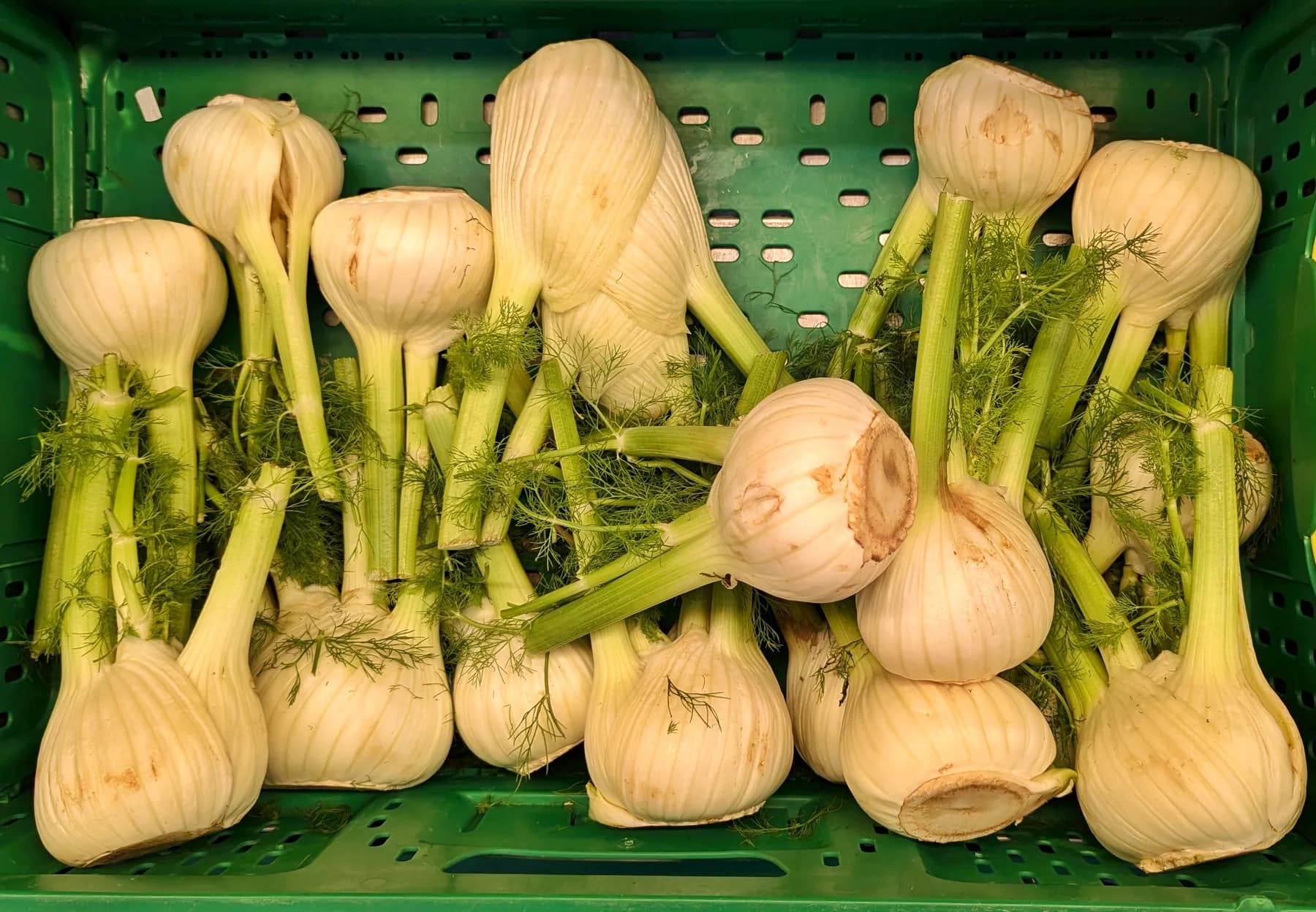
- 6. Fennel bulbs — Daderot — CC0 1.0 public-domain dedication. Wellington market photograph; resized. Correct bulb-fennel product reference, not a photograph of French cultivation.
Image credits
- Harvested fennel bulbs for sale in Wellington, New Zealand. Photo: Daderot, CC0 1.0; resized. Bulb-crop reference, not a French production field.
Figures are published averages or study assumptions for the places named, not guarantees for your field. Check current local recommendations and product labels before acting.