

Banana farming in California: feasibility and evidence
Before investing in a California banana planting, assess winter injury, irrigation costs, time to fruiting and demand for the harvested fruit. Request records from local farms or trials with comparable conditions. USDA stopped publishing banana estimates in 2018, so missing state statistics cannot tell you whether a commercial planting will succeed at your site.
Scope: Commercial banana (Musa spp.) feasibility in California. Statistical discontinuation and a legacy postharvest factsheet are not treated as field-production evidence. Updated 2026-10-07.
At a glance
Perennial growth and climate in California
A perennial planting remains in the field for multiple years. Establishment is a long-term investment; flowering, fruit development, harvest and plant care recur as the planting matures. Follow the named cultivar and production system.
Establish a long-lived planting1,2,3
Choose establishment timing with a local adviser using your cultivar, planting material and field conditions in California. A single month cannot cover every site and production system. The historical climate display describes one regional reference point.
Historical monthly climate
Reference period: 1996-01-01 to 2025-12-31. ERA5-Land monthly mean soil temperature at 0–7 cm, air temperature and frost days at the regional reference point (37, -120). Select a month to inspect its historical conditions.
Month tiles show mean air temperature.
January historical conditions
- Mean topsoil temperature
- 8.9°C
- Mean air temperature
- 9.4°C
- Mean frost days per month
- 3.5 days
Use this monthly history to assess winter exposure, seasonal heat and water planning. It does not calculate cultivar chill hours, flowering dates, frost damage during bloom or fruit maturity. Topsoil at 0–7 cm describes shallow soil context, not the full root zone. The monthly history does not establish a local flowering, maturity or harvest period.
Climate source: Open-Meteo Historical Weather APISeparate crop presence from commercial production
- 1
Check statistical definitions
Note that state estimates stopped in 2018.
- 2
Review county reports
Look for crop-specific entries across production counties.
- 3
Contact local extension
Ask about verified commercial field systems and trials.
- 4
Record evidence limits
Do not infer zero production from omitted statistics.
- A statistical gap is not a zero-production finding
- USDA NASS says its banana estimates ended in 2018, and the state overview has no current banana estimate. County commissioner reports may add local detail, but a crop-by-crop review is needed before making claims about current acreage or commercial presence.1,2,3
Assess site constraints before a commercial trial
- 1
Choose a documented cultivar
Record cultivar, plant source and propagation method.
- 2
Measure site climate
Track cold, heat, wind and frost at the field.
- 3
Check irrigation economics
Evaluate water quality, allocation and delivery cost.
- 4
Run a monitored block
Measure growth, fruit set and harvest before scaling.
Do not transfer old handling data into field advice
- 1
Define harvest maturity
Use a current standard tied to cultivar and market.
- 2
Test packing and transport
Measure damage and temperature along the transport route.
- 3
Confirm ripening capacity
Check facility, ethylene protocol and buyer timing.
- 4
Calculate marketable yield
Record grade, culls, costs and realized price.
- The available UC factsheet is legacy postharvest guidance
- UC Davis’s banana factsheet discusses mature-green harvest and ripening logistics, but was last updated in 1996 and is not California production research. Verify current quality and handling standards before using those details in a business plan.3
Treat this as a commercial feasibility question
- 1
Find existing farms or trials
Ask extension and county agriculture commissioners.
- 2
Document several seasons
Track winter losses, growth and fruiting.
- 3
Test a buyer route
Confirm demand, grading, ripening and transport.
- 4
Model full costs
Include water, protection, labor and facility needs.
- Check several seasons of local farm performance
- Before scaling a California banana planting, obtain local field records of cultivar, winter injury, water use, time to bearing, yield and fruit quality. Confirm buyers and handling costs; performance in a tropical production region cannot establish the return from a California block.1,2,3
Frequently asked questions
- Are bananas grown commercially in California?
- The sources reviewed do not establish a current commercial field system. USDA discontinued banana estimates in 2018, so missing statistics should not be interpreted as proof of no farms.
- Can bananas grow in California?
- The available sources do not establish field performance across California. A specific site would need a locally monitored trial covering winter injury, water, fruiting and marketability.
- What California banana spacing should I use?
- No current California commercial spacing recommendation was located. Do not treat ornamental plant spacing or overseas guidance as a local farm standard.
- When are California bananas harvested?
- No California commercial harvest calendar was verified. The UC Davis factsheet is a legacy postharvest document, not a local harvest schedule.
Put your own numbers in
Sources and image credits
- 1. USDA NASS — Noncitrus Fruits and Nuts 2019 Summary — 2019 report. Notes that banana estimates were discontinued beginning in 2018; not a finding of zero farms.
- 2. USDA NASS — California State Agriculture Overview — 2026. Current state commodity overview; no banana estimate listed.
- 3. UC Davis Postharvest Research and Extension Center — Banana (Cavendish) — Last updated November 1996. Legacy commercial postharvest background only; not California field-production guidance.
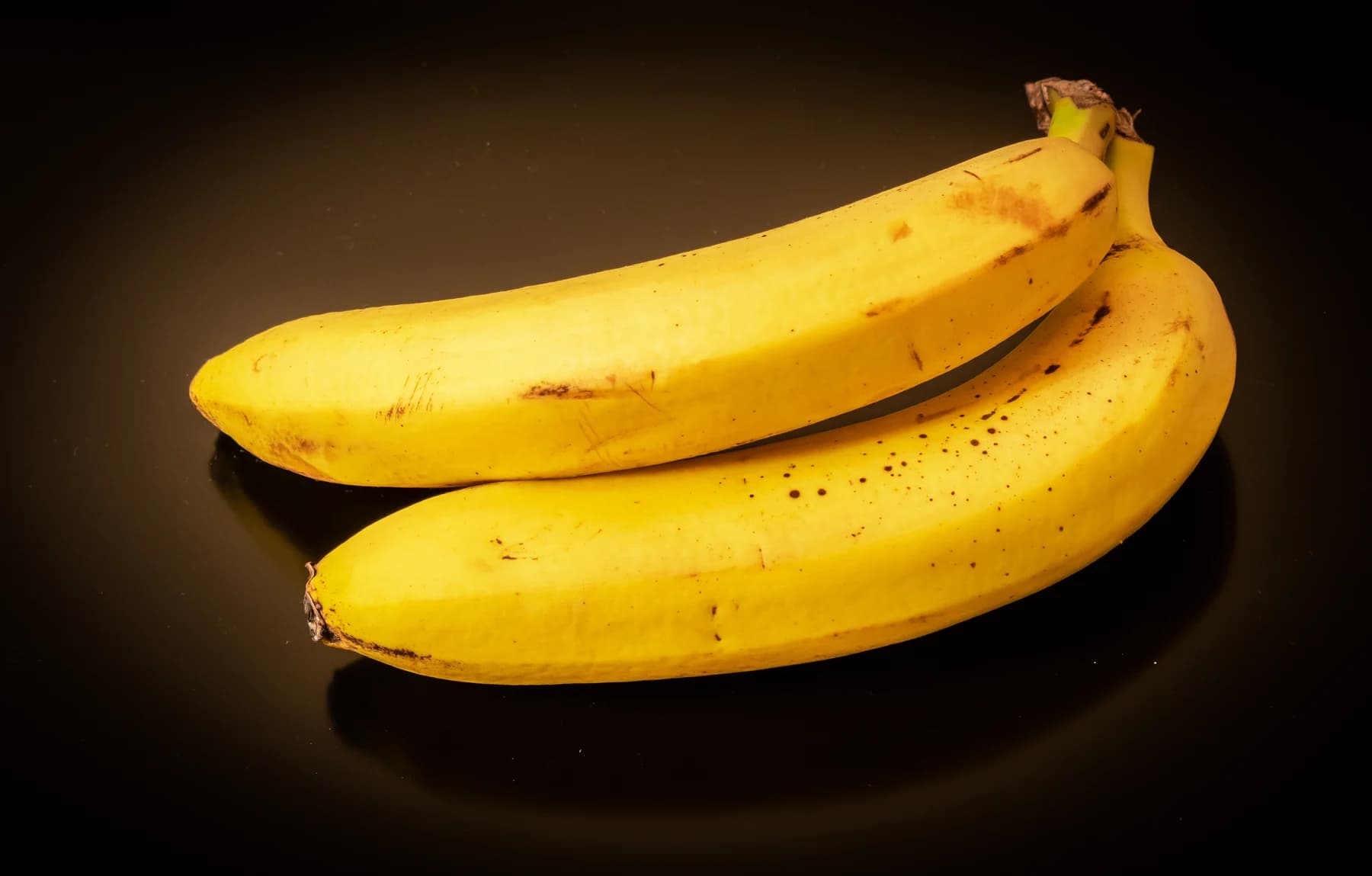
- 4. Bananas on black background 02 — Krzysztof Golik — December 16, 2021. Cavendish product photograph taken in France. Does not establish California field production or a suitable local cultivar. Resized under the original license.
- 5. Fruit photograph license — CC BY-SA 4.0 — Creative Commons Attribution-ShareAlike 4.0. The resized fruit photograph retains its original share-alike license.
Image credits
- Cavendish banana fruit photographed in France. Photo: Krzysztof Golik (Tournasol7), CC BY-SA 4.0; resized and converted to WebP.
Figures are published averages or study assumptions for the places named, not guarantees for your field. Check current local recommendations and product labels before acting.