

Growing sisal in China
China’s documented commercial agave crop is sisal fiber, produced from Agave sisalana and commercial hybrids, with Zhanjiang in Guangdong the clearest regional example. CATAS’s 2005 reference names hybrid 11648 as the main Chinese production variety. This page keeps fiber sisal separate from tequila agave, agave syrup and ornamental species; the full current local standard is not available in the reviewed public record.
Scope: Commercial sisal fiber in southern China, with Zhanjiang as the local example. Historical CATAS field details are labeled as such; exact current spacing, input rates and economics are not asserted. Updated 2026-10-07.
At a glance
- Evidence limit
- The local 2021 GI standard is registered, but its technical clauses were not available here2
Perennial growth and climate in China
A perennial planting remains in the field for multiple years. Establishment is a long-term investment; flowering, fruit development, harvest and plant care recur as the planting matures. Follow the named cultivar and production system.
Establish a long-lived planting1,2,3
Choose establishment timing with a local adviser using your cultivar, planting material and field conditions in China. A single month cannot cover every site and production system. The historical climate display describes one regional reference point.
Historical monthly climate
Reference period: 1996-01-01 to 2025-12-31. ERA5-Land monthly mean soil temperature at 0–7 cm, air temperature and frost days at the regional reference point (34, 113). Select a month to inspect its historical conditions.
Month tiles show mean air temperature.
January historical conditions
- Mean topsoil temperature
- 2.3°C
- Mean air temperature
- 1.7°C
- Mean frost days per month
- 28.5 days
Use this monthly history to assess winter exposure, seasonal heat and water planning. It does not calculate cultivar chill hours, flowering dates, frost damage during bloom or fruit maturity. Topsoil at 0–7 cm describes shallow soil context, not the full root zone. The monthly history does not establish a local flowering, maturity or harvest period.
Climate source: Open-Meteo Historical Weather APIPlan for the fiber market
- 1
Confirm species
Verify the sisal species or hybrid and planting-stock identity; the historical CATAS reference names hybrid 11648.
- 2
Secure a fiber outlet
Match harvested leaves to a named processor and product specification.
- 3
Check local standard
Obtain DB4408/T 8-2021 before using exact local production requirements.
- 4
Budget the cycle
Include multi-year field care, cutting, transport and processing access.
Choose an aerated, well-drained site
- 1
Map field slope
Identify runoff paths and erosion exposure.
- 2
Check drainage
Do not establish in persistently waterlogged ground.
- 3
Review crop history
Avoid repeating sisal on the same site without a locally approved rotation plan.
- 4
Inspect disease symptoms
CATAS reported local stem-rot and leaf-symptom diagnoses in 2022.
- Avoid standing water and compaction
- CATAS describes sisal roots as shallow and sensitive to poor aeration, advises drainage and erosion control on slopes, and warns against continuous cropping. Those are historical technical notes; have local soil and drainage risks assessed before establishing a long-lived stand.1
Verify planting material and field protocol
- 1
Source healthy material
Confirm cultivar and propagation source with the local production chain.
- 2
Retrieve the standard
Use the full Zhanjiang GI technical text for current requirements.
- 3
Plan access and drainage
Allow equipment and labor to reach rows without damaging soil.
- 4
Record the block
Track planting material, field, inputs, symptoms and later leaf cuts.
- Do not reuse old rates as current standards
- CATAS’s public cultivation note is an older technical reference, while the Zhanjiang standard registry confirms a 2021 local standard without exposing its clauses. Verify planting material, spacing, fertilizer, pest controls and harvest criteria against the full standard and current local extension before setting a commercial block.1,2
Coordinate leaf cutting with processing
- 1
Confirm maturity criteria
Use the current local standard rather than an old size threshold.
- 2
Schedule cutting
Coordinate labor, field access and processing capacity.
- 3
Keep lots traceable
Record harvest block, date and delivered fiber lot.
- 4
Review disease losses
Use local diagnosis for stem rot and leaf issues; do not copy old chemical advice.
- Treat area statistics as dated context
- A CATAS field advisory described about 52,000 mu in the Zhanjiang Reclamation Group in 2022. That figure indicates local industry at that time; it is not current total Chinese area, verified output or an individual farm yield target.3
Frequently asked questions
- What agave is grown commercially in China?
- The documented fiber crop is sisal from Agave sisalana and commercial hybrids, especially in the southern production belt and Zhanjiang. It is not the same crop system as tequila agave or agave syrup.
- Where is sisal produced in China?
- CATAS lists several southern provinces, while Zhanjiang in Guangdong has a registered geographical-indication standard and active farm evidence.
- What spacing should a Zhanjiang sisal farm use?
- The sources reviewed do not expose a current local spacing clause. Obtain the full DB4408/T 8-2021 standard and local technical advice before laying out a commercial field.
- When should sisal leaves be harvested?
- Use maturity and cutting requirements in the current Zhanjiang standard and coordinate harvest with the fiber processor. The older public CATAS note should not be treated as the current local schedule.
Put your own numbers in
Sources and image credits
- 1. Chinese Academy of Tropical Agricultural Sciences — Sisal cultivation — 27 February 2005; historical technical reference. Sisal species, production provinces, drainage, crop history and historical field practices.
- 2. National Standards Information Public Service Platform — DB4408/T 8-2021, Zhanjiang Sisal Fiber — Issued 18 September 2021; effective 18 November 2021. Official standard identity and status; full technical clauses were not accessible in this review.
- 3. CATAS Environment and Plant Protection Research Institute — Zhanjiang field advisory — 2022. Local field visits, disease and nutrient concerns, and dated production-area context.
- 4. Agave field photo — Moses Londo, Pexels photo 10465243 — Pexels license. Crop imagery only. The photo species and capture location are not verified and it is not evidence of China-specific sisal production practices.
Image credits
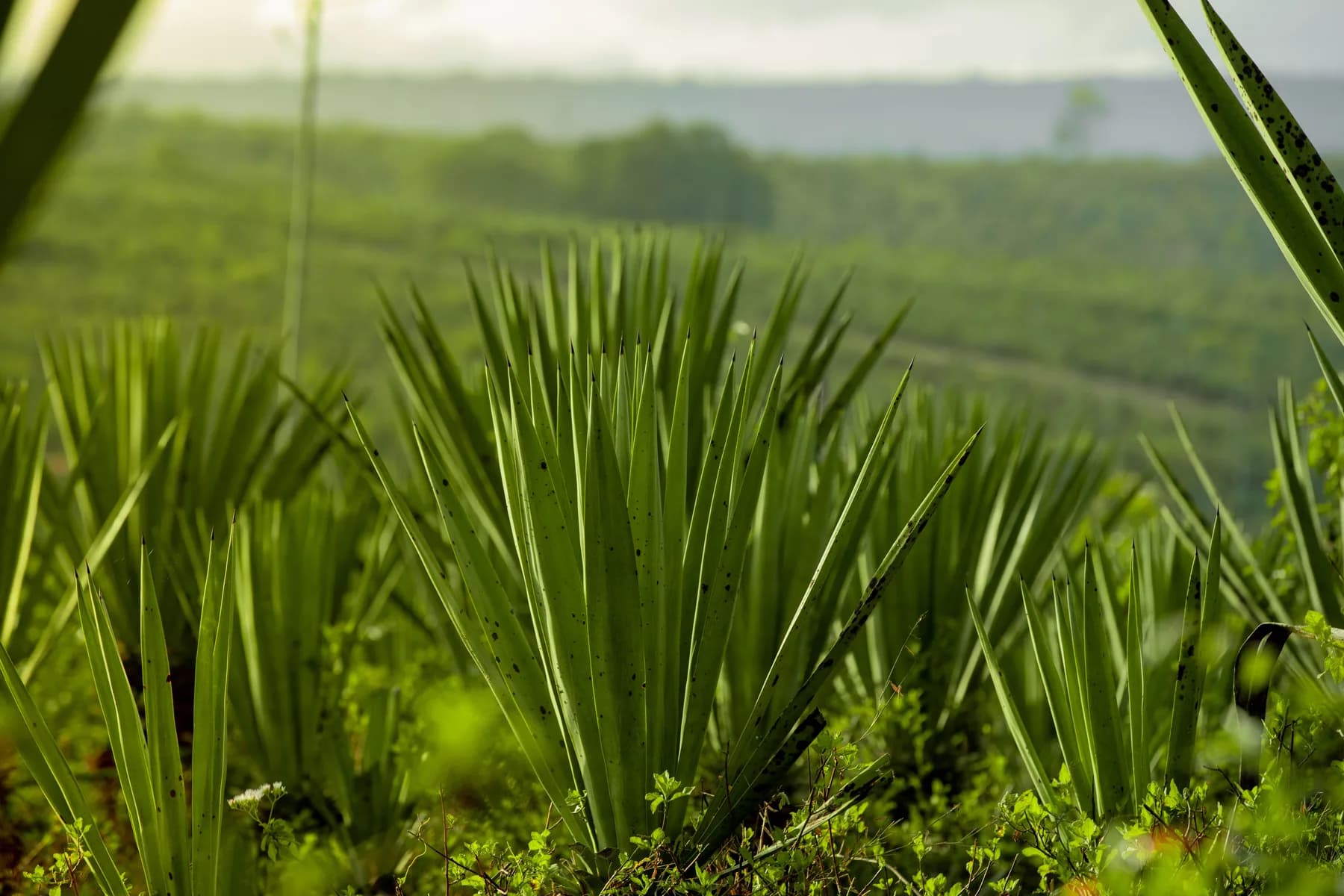
- Agave plants in cultivation. Photo by Moses Londo via Pexels (photo 10465243). The species and capture location are not verified; this image does not document sisal farming in China.
Figures are published averages or study assumptions for the places named, not guarantees for your field. Check current local recommendations and product labels before acting.